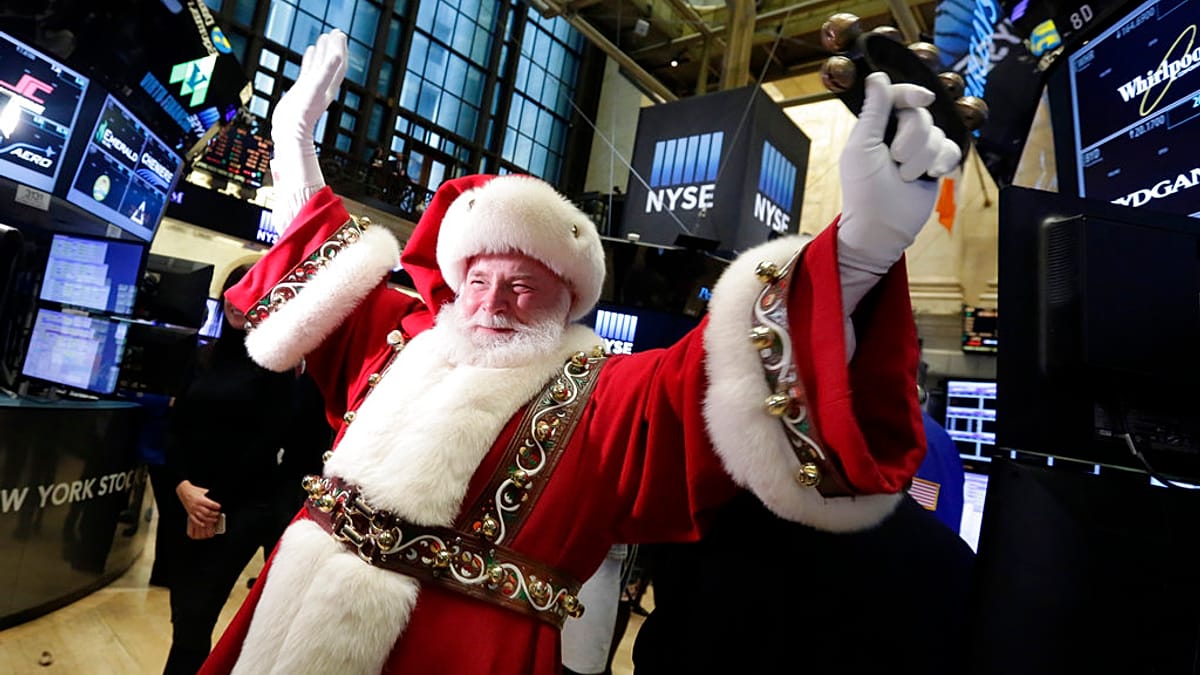
Is Santa bringing a rally — or coal — to global markets this Christmas?
World shares were mixed on Wednesday, with investors weighing the traditional year-end Santa Claus rally against fresh signs of a late-season slowdown, after the benchmark S&P 500 closed at another record high on a report showing the US economy grew at an unexpectedly strong 4.3% annual rate in July to September.
In financial shorthand, a Santa Claus rally refers to the tendency for share prices to rise in the final days of December and the first trading sessions of the new year, often attributed to thinner holiday trading, year-end portfolio adjustments and a generally upbeat seasonal mood among investors.
The pattern is far from guaranteed, however, and has failed to materialise in years marked by economic uncertainty or heightened market stress.
The futures for the S&P 500 and the Dow Jones Industrial Average were down less than 0.1%.
Britain’s FTSE 100 was down 0.2% at 9,870.89, while the CAC 40 in Paris added 0.2% to 8,121.32.
Stock exchanges including those in London, Paris, Hong Kong and Australia have closed early or will be closing early on Christmas Eve. Germany's markets were closed for the day.
US markets will end early Wednesday for Christmas Eve and stay closed for Christmas.
In Asian trading, Tokyo’s Nikkei 225 fell 0.1% to 50,344.10 and South Korea's Kospi slipped 0.2% to 4,108.62.
Hong Kong’s Hang Seng gained 0.2% to 25,818.93. The Shanghai Composite index edged 0.5% higher, to 3,940.95.
In Australia, the S&P/ASX 200 slipped nearly 0.4% to 8,762.70. Taiwan's Taiex picked up 0.2% while the Sensex in India fell 0.1%.
Gold and silver extended their rally after hitting record highs this week driven by heightened geopolitical tensions.
The price of gold rose 0.3% early Wednesday to $4,525.20 (€3,837.19) per ounce, adding to gains of about 70% for the year. Silver rose 1.6%.
The final stretch of the year is often marked by lighter trading and seasonal optimism, but this December has delivered a more complicated picture.
While US equities have continued to notch record highs, uneven performances across Europe and Asia suggest investors remain cautious about inflation, interest rates and the durability of global growth as 2025 approaches.
On Tuesday, big gains for tech stocks pushed the S&P 500 up 0.5%, even though most stocks in the index fell. The Dow industrials added 0.2% and the Nasdaq composite rose 0.6%.
The US government’s first estimate of growth for the third quarter showed inflation remained high, while a separate report said consumer confidence faded further in December. The US economy expanded at a 3.8% annual pace in April-June.
Markets are also contending with a familiar year-end tug-of-war: hopes that easing financial conditions will extend gains into the new year, versus concerns that sticky inflation and slowing consumer confidence could cap the rally.
With many exchanges closing early for the holidays, thin volumes have amplified modest moves across assets.
The Federal Reserve’s favored inflation gauge — called the personal consumption expenditures index, or PCE — climbed to a 2.8% annual pace in the last quarter, up from 2.1% in the second quarter.
On Wednesday, the Labor Department will release its weekly data on applications for jobless benefits, which stands as a proxy for US layoffs.
Investors are betting the Fed will hold steady on interest rates at its January meeting.
Recent reports show high inflation and shaky confidence among consumers worried about high prices. The labour market has been slowing and retail sales have weakened.
In other dealings early Wednesday, the dollar continued to fall against the Japanese yen, after officials said they could intervene with excessive moves in the yen. The dollar was trading at 155.83 yen, down from 156.17 yen.
The euro rose to $1.1797 from $1.1796.
Oil prices edged higher as traders kept an eye on risks of supply disruptions in Venezuela and Russia.
US benchmark crude oil added 12 cents to $58.50 per barrel. Brent crude gained 8 cents to $61.95 per barrel.