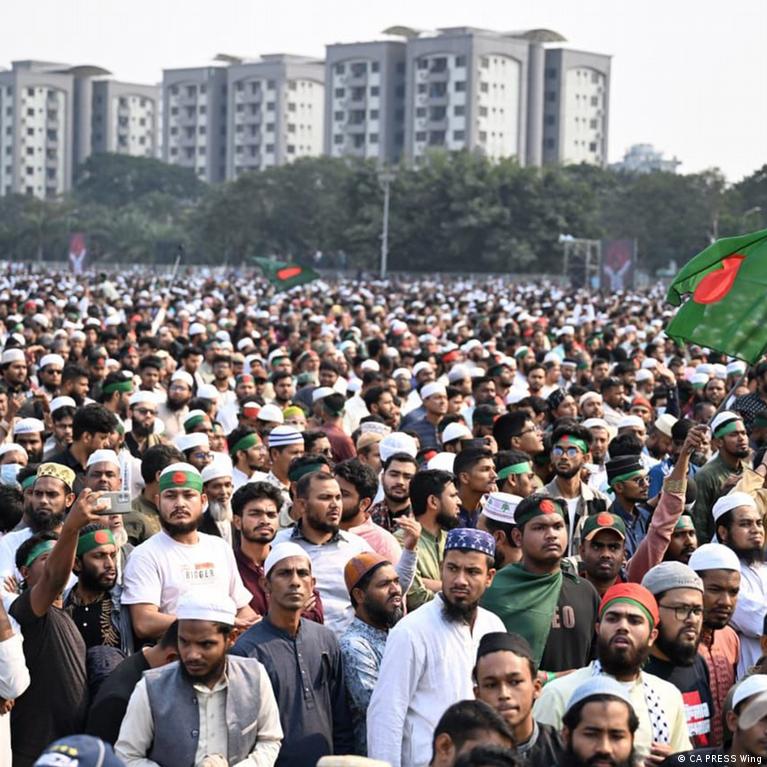
The 32-year-old, a staunch critic of neighboring India, was a key figure in last year's pro-democracy uprising that ousted former Prime Minister Sheikh Hasina.
Hadi was shot by masked gunmen on December 12 as he was leaving a mosque in the capital Dhaka. He died on Thursday while receiving treatment at a hospital in Singapore.
The student leader had planned to contest the upcoming general election, scheduled for February 12.
The killing set off violent demonstrations in Dhaka. Angry protesters torched several buildings, including two major newspapers deemed to favor India as well as a prominent cultural institution.
They also hurled stones at the Indian High Commission in the port city of Chattogram. India has since suspended visa services there.
Police said they identified the suspects behind Hadi's killing but have yet to arrest them.
Bangladesh's Home Affairs Adviser Jahangir Alam Chowdhury said the perpetrator "could be either inside the country or outside" and that "if his exact location were known, he would have been caught."
UN Secretary-General Antonio Guterres condemned Hadi's killing and urged the authorities to conduct "a prompt, an impartial, a thorough and transparent investigation, in line with international human rights standards."
In a separate incident, Dipu Chandra Das, a 25-year-old Hindu man, was lynched and burned publicly on December 18 following allegations of blasphemy in Mymensingh district's Bhaluka subdistrict.
The killing deepened fears of insecurity among religious minorities in Muslim-majority Bangladesh since Hasina's ouster.
Minority groups have accused the interim government headed by Nobel Peace Prize laureate Muhammad Yunus of failing to protect their safety. The Yunus administration rejects the allegations.
Authorities said at least 12 suspects have been arrested over the killing of Das.
The death further heightened tensions between Dhaka and New Delhi, where hundreds of people protested near Bangladesh's High Commission.
Under Hasina, Bangladesh shared warm ties with India.
New Delhi viewed her as a friend and both countries intensified bilateral economic and security cooperation.
But Hasina's opponents accused her administration of being subservient to India.
Hasina, who sought refuge in India, has been handed down a death sentence in absentia for her government's crackdown on last year's student uprising. She has denied the allegations against her.
But India has so far not acted on repeated requests by the Yunus-led government for her extradition.
Backing Hasina and helping her stay in power for years has bred anti-India discontent among Bangladeshis, said Mohiuddin Ahmed, a Dhaka-based political historian. "It also helped her party to manipulate elections in the past," he claimed.
To view this video please enable JavaScript, and consider upgrading to a web browser that supports HTML5 video
Against the backdrop of political unrest and heightened regional tensions, Tarique Rahman, one of Bangladesh's top politicians, is set to return home on Thursday, after spending 17 years in exile in the UK.
He is the heir to the nation's longtime ruling family and a leader of the Bangladesh Nationalist Party (BNP), which is widely seen as the frontrunner in the upcoming elections.
He has lived in London since 2008, saying he fled politically motivated persecution. Rahman was implicated in a 2004 grenade attack on a Hasina rally. He denied the charges but was sentenced in absentia to life in prison.
Since Hasina's ouster, Rahman has been acquitted of that charge.
He is widely expected to take over the party leadership from his ailing mother, 80-year-old ex-Prime Minister Khaleda Zia.
Zahed Ur Rahman, a Dhaka-based political analyst, views Rahman's return favorably.
"Many things will happen due to his return. The administration will start functioning properly. The perception of the election will gain momentum. And his party will regain confidence," he told DW.
"I think if the BNP acts properly at the grassroots level, the voting will be a good one," he added.
Ahmed shared a similar view, underlining that Rahman's return will reinvigorate the BNP, which has been without an active and visible leader for years due to ex-PM Zia's imprisonment and illness.
A December poll by the US-based International Republican Institute (IRI) indicated the BNP could win a majority of the seats in the February polls.
About 33% of the survey participants said they would vote for the BNP, while Jamaat-e-Islami, the country's largest Islamist party, followed with around 29%.
Some 6% said they would vote for the newly established National Citizen Party (NCP), which was formed by students who spearheaded last year's uprising.
But Ahmed believes there will be a credible election in February.
"The political parties in our country tend to engage in unruly activities during elections. It's nothing new. However, if the government wants, it will be able to contain them to ensure a peaceful election," he said.