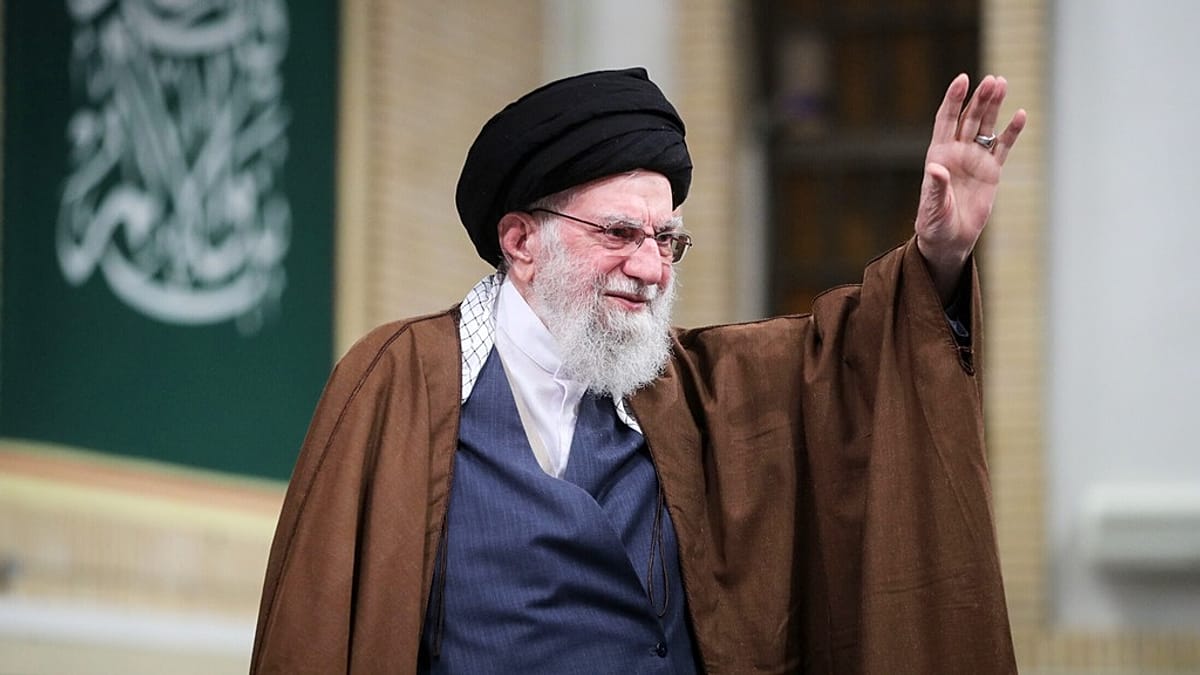
The question of whether Iran's Supreme Leader Ali Khamenei has authorised the development of nuclear weapons has taken on urgency following the devastating 12-day conflict with Israel in June.
Israeli and US strikes severely damaged Iran's nuclear facilities during the conflict that killed more than 1,000 Iranians and 29 Israelis, prompting intense speculation about Tehran's next move.
As of August, US intelligence continued to assess that Khamenei has not authorised a nuclear weapons programme.
"The intelligence community continues to assess that Iran is not building a nuclear weapon and Supreme Leader Khamenei has not authorised the nuclear weapons program he suspended in 2003," director of US National Intelligence Tulsi Gabbard told the Senate Intelligence Committee in March.
However, Gabbard noted that "in the past year, we have seen an erosion of a decades-long taboo in Iran on discussing nuclear weapons in public, likely emboldening nuclear weapons advocates within Iran's decision-making apparatus."
In October 2024, CIA Director William Burns said he was "reasonably confident" the US would be able to detect weaponisation work "relatively early on".
The exiled National Council of Resistance of Iran claimed in October 2024 that Khamenei ordered the Islamic Revolutionary Guard Corps to "complete and accelerate the project of building nuclear bombs".
However, these claims have not been independently verified by international intelligence agencies or the International Atomic Energy Agency.
ISPI, an Italian foreign policy think tank, reported this month that its sources in Tehran now indicate Khamenei made a decision in October to authorise development of compact warheads for ballistic missiles, though not to increase uranium enrichment beyond 60%.
According to ISPI's analysis, all sources consulted over the years had previously denied that any such decision had been taken.
The think tank said Khamenei had consistently blocked the final decision to move to 90% enrichment and begin developing miniaturised nuclear warheads, despite pressure from the Revolutionary Guards.
However, ISPI stated that the June conflict altered the calculation after it demonstrated that Iran's defensive systems were largely ineffective, with only its medium-range missile arsenal proving capable.
ISPI's analysis suggested Tehran concluded that nuclear weapons would be its only actual deterrent against Israel and the US, short of surrender. The think tank noted rumours are also circulating of an ultra-secret enrichment programme at undisclosed sites never reported to the IAEA.
These claims by ISPI's sources cannot be independently verified through official intelligence assessments or IAEA reports.
What is verified is Iran's rapid advancement in uranium enrichment capabilities before the June conflict.
According to the IAEA, Iran possessed 441 kilograms of uranium enriched to 60% as of 13 June 2025, just before the Israeli attacks began. This is the highest level of enrichment by any non-nuclear-weapon state.
Uranium enriched to 60% is technically close to the 90% needed for weapons-grade material.
A November 2024 US intelligence report stated Iran has enough fissile material that, if further enriched, would be sufficient for "more than a dozen nuclear weapons".
ISPI noted that moving from 60% to 90% enrichment would require only a few weeks, provided there are sufficient operational advanced centrifuges.
However, building compact warheads small enough for Iran's longest-range missiles presents a far more complex challenge.
While Iran could rapidly enrich uranium to weapons-grade levels, developing compact nuclear warheads is significantly more difficult.
ISPI cited Pakistan's experience, which conducted five nuclear tests in May 1998 followed by a compact warhead test two days later.
Pakistan managed to develop compact warheads without intermediate live tests, thanks to 24 simulated tests conducted from 1983 onwards, but this still required 15 years to reach a viable design.
ISPI suggested that if Khamenei has prioritised warhead development over enrichment, it may be because enriching fissile material now would leave Iran in an extremely exposed position.
However, enrichment and warhead development will eventually have to converge, as weapons-grade material is required even for simulated tests.
Meanwhile, North Korea has intensified cooperation with Iran on ballistic missiles and advanced designs, according to reports, although whether this extends to compact nuclear warheads remains impossible to verify.
The Iran-Israel conflict fundamentally altered the strategic calculus.
Israeli strikes on 13 June targeted Iran's main enrichment facilities at Natanz, killing nuclear scientists and damaging infrastructure.
The US joined the campaign on 22 June, striking three Iranian nuclear facilities, including the deeply buried Fordow site with bunker-buster bombs.
Iran fired over 550 ballistic missiles and more than 1,000 drones at Israel during the conflict, until a ceasefire took effect on 24 June.
Trump said the bombing of Tehran's facilities amounted to "obliteration," though official US sources said they had only delayed Iran's nuclear weapons development by a few months.
Iranian officials have publicly discussed reconsidering the country's nuclear weapons ban.
In October 2024, 39 members of Iran's parliament wrote to the Supreme National Security Council calling for a change in Iran's defence doctrine to include nuclear weapons.
Kamal Kharrazi, an adviser to Khamenei, said in November 2024 that Iran will "modify its nuclear doctrine" if "an existential threat arises".
Ali Shamkhani, a top adviser to Khamenei, said in October that Iran's earlier attacks against Israel "did not achieve the outcomes" sought by Tehran.
He openly mused about Iran pursuing a nuclear weapon, saying "now that it has become clear, Iran should have developed this capability for itself".
Iran has long cited a religious decree, or fatwa, issued by Khamenei banning the development and use of nuclear weapons.
The fatwa, first referenced in 2003 and formalised in subsequent years, declares that building, stockpiling and using nuclear weapons is forbidden under Islam.
However, analysts note that fatwas can be modified in response to changing circumstances, and discussions of revising the nuclear doctrine suggest that such a change may be under consideration.
The IAEA has been unable to conduct inspections at Iran's most sensitive nuclear sites since the June strikes.
"We are only allowed to access sites that were not hit," IAEA Director General Rafael Grossi said in mid-December.
"These other three sites — Natanz, Isfahan and Fordow — are even more significant, since they still contain substantial amounts of nuclear material and equipment, and we need to return there."
Intelligence assessments suggest Iran moved approximately 408 kilograms of 60% enriched uranium to secret locations, possibly in deeply buried facilities at Isfahan, before the US strikes.
Satellite imagery from the Washington-based Institute for Science and International Security indicates that Iran has undertaken minimal cleanup at most damaged sites.
However, it has made efforts to access the Isfahan tunnel complex where enriched uranium may be stored.
US Ambassador to Israel Mike Huckabee said in December that Iran appears to be attempting to rebuild Fordow, suggesting "they didn't get the full message" from the June strikes.