Amteshwar Singh Gill (40) has emerged as a one of the true pioneers of Recirculating Aquaculture System (RAS) fish farming in North India. At present, he is perhaps the only farmer in the northern region operating RAS at such a large and fully mechanised scale, producing premium freshwater fish varieties with remarkable commercial success.
RAS are modern fish-farming systems where fish are grown in tanks instead of open ponds, rivers or seas. Water is continuously filtered, cleaned and reused, resulting in very low-water consumption and a fully controlled environment.
Gill has been running his advanced RAS unit for the past four years in Bhagatpura village, Fatehgarh Sahib district. His state-of-the-art facility, Golden Aqua RAS, is spread over his half-an-acre of land.
The other thing that sets him apart is his passion for agriculture, for which he quit his dentistry practice. (Express Photo)
The system produces around 30 to 32 tonnes of fish annually, valued at over Rs 1.5 crore, with over 40 per cent net profit, making it one of the most successful aquaculture models in the region. Gill is originally from Moga district where his family owns agricultural land.
Gill’s RAS unit consists of eight large concrete tanks, each with a capacity of 90,000 litres, measuring 25×25 feet with an eight-foot depth. The total water-holding capacity of the system is about 7.2 lakh litres. All tanks, which are open from the top, are housed under a large shed that helps regulate temperature, enabling fish to survive and grow even during extreme summers and winters.
“The tanks are designed with sloping bottoms and vertical perforated pipes, allowing fish waste to be automatically flushed out through water pressure. The system runs throughout the day, supported by CCTV surveillance and advanced sensors that continuously monitor water parameters such as ammonia level, dissolved oxygen, pH levels and temperature,” said Gill.
A Moving Bed Biofilm Reactor (MBBR) uses beneficial bacteria to convert toxic ammonia generated from fish waste into nitrate, which is harmless to fish. (Express Photo)
In the unit, nearly 1.5 lakh litres of water are filtered and cleaned daily through drum filters. The water is further purified using ozonators, ensuring optimal water quality at all times.
“RAS offers efficient use of land and energy, optimal feeding, easy grading and harvesting, and strong disease control. However, successful operation requires continuous electricity, a reliable water source, premium nutritionally balanced feeds and technically skilled staff to manage the system effectively.”
According to Gill, production that would normally require 18 acres of land under traditional open fish culture can be achieved on just half an acre under RAS.
“This is high-density fish farming with negligible mortality and very high productivity,” he said. In open pond fish farming if a farmer is producing 2.5 tonnes fish while Gill, in RAS, produces 60 per cent higher yield from just a 25X25 feet tank which is around 1.7 per cent area of one acre.
In this type of farming farmers can even produce high-value species. “I exclusively produce Sole and Singhi (freshwater catfish) — high-value riverine freshwater species that are rarely cultivated in Punjab. Traditional fish farming in open fish ponds in the state largely focuses on Rohu, Catla, Grass Carp, Silver Carp and other varieties, which sell for Rs 100-120 per kg. In contrast, Sole and Singhi command much higher market prices.”
“Sole fish matures in about six months, weighs over 500 grams and sells at Rs 800–900 per kg. Around 6,000 seeds are stocked per tank,” said Dr. Amteshwar, adding that Singhi fish matures in about one year, weighs over 100 grams, and sells at Rs 300–400 per kg. Due to its smaller size, 30,000 seeds can be stocked per tank.
Each tank produces nearly four tonnes of fish annually, and Gill has strategically divided Sole and Singhi across the eight tanks. He grows Sole and Singhi in four tanks each. High-quality pellet feed is used, and feed conversion ratios are closely monitored to maximise efficiency.
Gill’s annual operational expenses include approximately Rs 8 lakh for seed, Rs 13 lakh for feed, Rs 2.5 lakh for electricity, Rs 2.5 lakh for manpower and around Rs 3 lakh for miscellaneous costs. The unit employs two full-time workers, and their salaries also cost him around Rs 6-7 lakh.
While the Government of India promotes and supports the RAS system and also provides around 40 per cent subsidy, for this set-up the government-estimated cost of the project was around Rs 50 lakh.
Gill invested nearly Rs 1 crore apart from the land to establish the largest RAS facility under the government scheme. He received a 40 per cent government subsidy, amounting to about Rs 20 lakh, as the government’s fixed rate for the biggest RAS facility is Rs 50 lakh only, and his project falls under the biggest RAS category.
“The first year was a learning phase and one cannot expect much profit as one needs to develop a market also. From the second year onwards, profits started coming in, and today I have recovered my investment,” Gill said.
His farm’s proximity to the Tricity (Chandigarh–Mohali–Panchkula) has further boosted profitability by ensuring easy market access.
Gill received professional training from Guru Angad Dev Veterinary and Animal Sciences University (GADVASU), Ludhiana, and his work has earned widespread recognition.
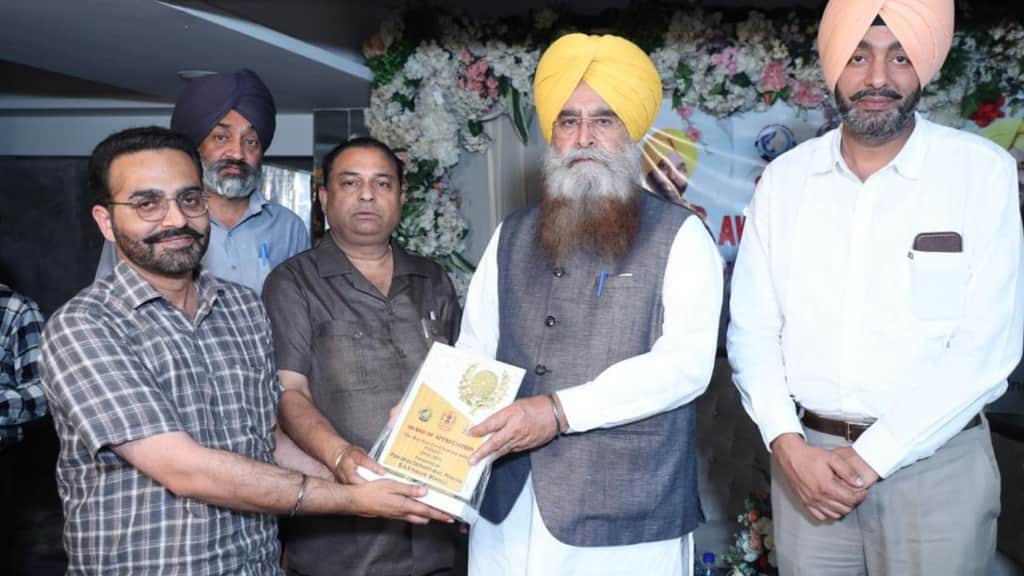
In March 2025, he was honoured with the Chief Minister Award by GADVASU and later received an appreciation letter from the Punjab Agriculture Minister, Gurmeet Singh Khuddian. Officials from the Fisheries Department, Government of India, have also visited his farm to study the model.
Gill said, “A beginner can start with one or two tanks, but since it is a technical system, one must understand the nitty-gritty before adopting it. Once you learn it, it is not difficult.” Urging farmers to move beyond conventional methods of farming, he added, “We must break out of the repetitive cycle. Innovative, technology-driven systems in farming, horticulture, fishery and animal husbandry can generate much higher income from limited land.”
Gurpreet Singh (Director and Warden of Fisheries Punjab) said, “Amteshwar Singh Gill has positioned himself as a trailblazer in modern aquaculture, demonstrating that high-density, technology-driven fish farming can be a game-changer for North India’s agricultural economy.”
Editorial Context & Insight
Original analysis & verification
Methodology
This article includes original analysis and synthesis from our editorial team, cross-referenced with primary sources to ensure depth and accuracy.
Primary Source
The Indian Express