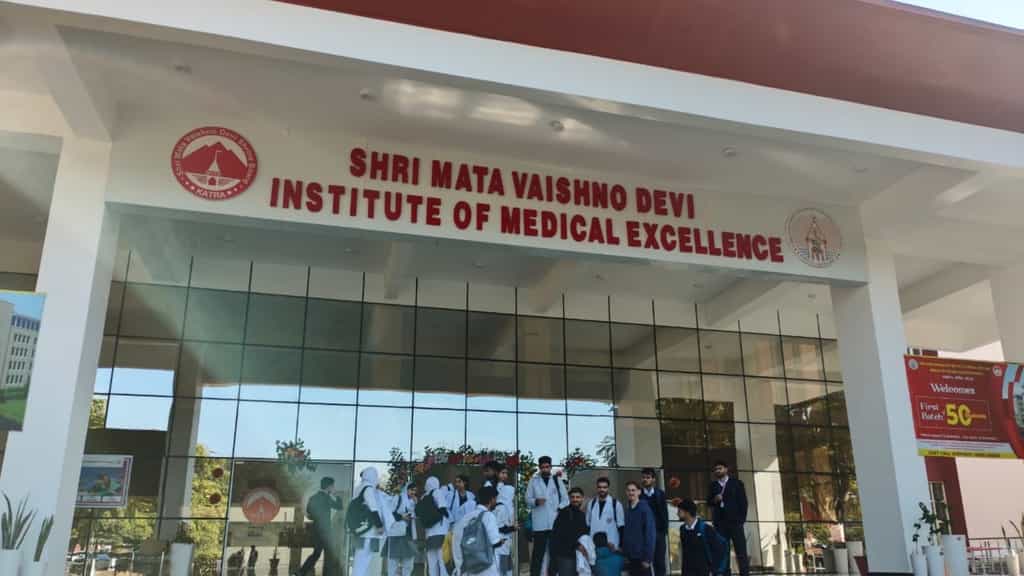
Officials from the institute and from central health bodies also said the decision appeared to be made in “undue haste” and without “due process”. “Colleges are usually served a show cause notice based on the online data or a surprise inspection. Then, a decision is taken based on the reply, followed by a first appeal before the NMC and a second appeal before the health ministry. Officials from the regulatory body confirmed that no appeal has been filed by the college so far,” an official said.
Faculty and administrative officials at the institute, who spoke on condition of anonymity, said the NMC’s decision seems like a direct fallout of protests by the Shri Mata Vaishno Devi Sangarsh Samiti, a group of nearly 60 pro-RSS and pro-BJP organisations, which have been opposing admission of Muslim students at the institute. Of the 50 students in the college’s first-ever MBBS batch for 2025-26, 44 were Muslim.
On Tuesday, members of the Samiti distributed sweets and danced to drums outside the campus, calling the NMC decision a victory for all who believe in Sanatan Dharma.
Shri Mata Vaishno Devi Sangarsh Samiti Chairman Colonel Sukhbir Singh Mankotia (sitting, second from left) addresses the media regarding the National Medical Commissions decision to withdraw permission for the Shri Mata Vaishno Devi Institute of Medical Excellence for non-compliance with minimum standards, in Jammu, Wednesday, Jan. 7, 2026. (PTI Photo)
The Samiti had been demanding that students from Kashmir be moved to other colleges in the UT, arguing that SMVDIME had been set up using offerings made at the Shri Mata Vaishno Devi Shrine by Hindu pilgrims from across the country.
According to college faculty, the January 2 inspection, based on which the NMC withdrew its Letter of Permission (LoP) to run the MBBS course, was a “farce”, with the institute getting a 15-minute notice to prepare and the inspection team “predetermined” in its approach.
Late on Tuesday, the NMC, while withdrawing the LoP, cited alleged deficiencies in infrastructure, including faculty strength and clinical material.
It said that the students admitted to the course based on their NEET results will be accommodated in other government institutions within the UT as supernumerary seats.
The January 2 surprise inspection was conducted after complaints that the college lacked the infrastructure to run a medical course. “The assessment report submitted by the team of assessors conclusively established that the complaints were true and substantiated… Continuation of the institution under such circumstances would have seriously jeopardised the quality of medical education and adversely affected the academic interests of the students,” a Union Health Ministry official claimed.
Jammu: Police personnel keep vigil during a demonstration, organised by Shri Mata Vaishno Devi Sangharsh Samiti, demanding revocation of the MBBS admission list of Shri Mata Vaishno Devi Institute of Medical Excellence in Jammu and Kashmir’s Reasi, outside Civil Secretariat, in Jammu. (PTI Photo)
The NMC made a range of claims to justify its decision. These include a 39 per cent deficiency in teaching faculty; a 65 per cent shortage of tutors, demonstrators, and senior residents; the OPD recording fewer than 50 per cent of patients; bed occupancy of 45 per cent; and ICU bed occupancy of 50 per cent. It also cited issues with lecture theatres and library resources.
On the campus, college officials described the NMC report as a “farce”.
“The NMC team put the number of books in our library at 75, while there are 2,713 books. According to them, we have only two journals (hard copies), while there are 480 journals, apart from 392 national e-journals and 9,900 foreign e-journals,” claimed an official.
“They talk of an absence of separate wards for male and female patients, even though there are separate rooms for all indoor patients. Their report talks about the institute having two operation theatres when there are, in fact, eight,” said the official.
“The NMC team arrived at the medical college on January 2, in the middle of the December 15-January 15 winter vacation, when nearly 50 per cent of the faculty had either left or were planning to leave the campus. We got a call from NMC 15 minutes before their arrival, and we cooperated as we had nothing to hide,” an official claimed.
The team visited the hospital and reported that only 181 patients visited the OPD that day, even though 405 patients were examined on January 2, the official claimed. Likewise, there were 175 IPDs, or 79 per cent of the total bed strength, while the NMC team put it at 45 per cent, he claimed.
The team concluded that there were only 25 deliveries in a month, but did not consider the fact that the number of people visiting the institute dips around the New Year. “The team appeared predetermined to withdraw the LoP right from the moment they arrived,” the official said.
“We know that they wanted to assuage the demonstrators outside the campus, but you should not defame us by saying that we lacked infrastructure,” said a doctor.
Many faculty members said they were dismayed since they had left lucrative jobs to come and work here. “Did the NMC think about us before deciding to withdraw the LoP?” a doctor asked.
The most palpable impact, though, is on the students, who were told by the college on Wednesday to head home. “We have the best infrastructure – from operation theatres to libraries – as compared to many government medical colleges across J&K,” a student said, attributing the NMC decision to “politics outside the campus”.
“We have been asked to vacate the hostel and stay at home until the government takes a call on our future,” another student said. “We do not want to leave even if we are adjusted in a government college, which every medical candidate aims for and which will save us money. The facilities, infrastructure and care we got here won’t be available elsewhere.”
For instance, a woman student recalled falling ill recently and missing the practicals, only for the faculty to ensure she got another chance to learn: “Ma’am explained what I had missed during dissection. She held my hand and guided me.”
Editorial Context & Insight
Original analysis & verification
Methodology
This article includes original analysis and synthesis from our editorial team, cross-referenced with primary sources to ensure depth and accuracy.
Primary Source
The Indian Express