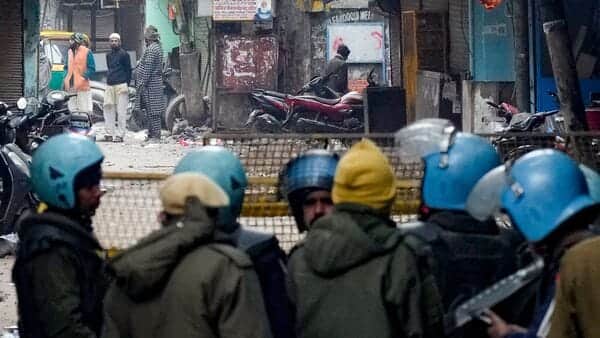
Tensions broke out in the Turkman Gate area of Delhi early on Wednesday, with at least five police personnel sustaining injuries after stone pelting during a demolition drive near a century-old mosque.
Wednesday's violence, though contained for the time being, harked back to a dark chapter in Indian history, when, during the Emergency, hundreds of protesters were killed in the area and thousands injured.
Around this time, Sanjay Gandhi visited the Turkman Gate, and was upset by the hostile reception from local residents, mostly Muslims, as well as by the slum dwellings that obscured his view from the Trukman Gate to Jama Masjid mosque.
Irked by the view, Sanjay Gandhi reportedly ordered the demolition of structures around the Turkman Gate.
The first bulldozer arrived at the area on 13 April 1976, and cleared out some settlements with no resistance from locals.
Subsequently, on 15 April, the Dujana House family planning camp was inaugurated by Sanjay Gandhi and the governor of Delhi, Krishan Chand, a stone's throw away from Turkman Gate.
Notably, Gandhi carried out the sterilization and demolition drive without holding any formal government office.
According to Chakravarti's book, things took a turn for the worse following the opening of the camp—rickshaw pullers, street vendors, beggars, and even passers-by were reportedly picked up at random and taken to the camp for forced sterilizations.
Soon, this pressure turned into force, and police teams were deployed to ensure that daily targets for sterilizations were met, sparking a wave of anger in the Turkman Gate area, and the nearby neighbourhoods of Jama Masjid and Chandni Chowk.
As anger erupted, a general strike was called, and it was decided to mobilize locals to come out en masse to oppose further demolitions.
Then came the fateful day of 19 April, when bulldozers were pressed into service again for beautification of the area, and protesters came out in droves to oppose the drive.
However, authorities were having none of it—as protesters took to the streets, the police responded with lathi charges and lobbed tear gas shells into the crowd. Soon, they started arresting women and children who had gathered to demonstrate against the drive, leading to multiple injures.
Undaunted protesters, however, pressed on, moving to the area in front of the Faiz-e-Ilahi mosque and occupying the demolished structures.
By this time in the afternoon, the crowd had reportedly swelled to 5,000 to 6,000 people, but the bulldozers pressed on, triggering widespread stone pelting by the protesters.
As the protest escalated to violence, police opened fire on the demonstrators, prompting a Molotov cocktail attack on one of the bulldozers, whose driver was beaten up by the enraged crowd.
This attack sparked a second volley of shots from the police, as per Chakravarti's book, and set the tone for the rest of the day, with cops repeatedly firing at random until the protesters were either left dead or had fled the area.
In the meantime, another group of protesters emerged from behind the Faiz-e-Ilahi mosque and attacked the old police station of the Turkman Gate, chasing away the few police personnel guarding it.
This act of aggression was met with reinforcements from the reserve police and armed police, who crossed the Asaf Ali Road determined to reclaim the police station.
This force, too, was attacked by protesters, who reportedly threw stones and acid bulbs from rooftops, halting the progress by the cops.
By this time, police had noticed protesters attacking from rooftops and re-directed their fire, eventually dispersing the protesters from rooftops.
As the dust settled, Chakravarti's book recalled an army of bulldozers being sent overnight to clean up the area, with the bulldozers disposing of bodies of protesters and the rubble at rubbish heap some distance away.
Independent researchers put the death toll at around 400 hundred, with over 1,000 wounded, but the demolition drive continued unabated for the next 10 days.
Years later, the Shah Commission investigated the event and named several individuals including Sanjay Gandhi as culpable for the excesses. However, no action was taken against any of the accused.
Editorial Context & Insight
Original analysis & verification
Methodology
This article includes original analysis and synthesis from our editorial team, cross-referenced with primary sources to ensure depth and accuracy.
Primary Source
mint - news