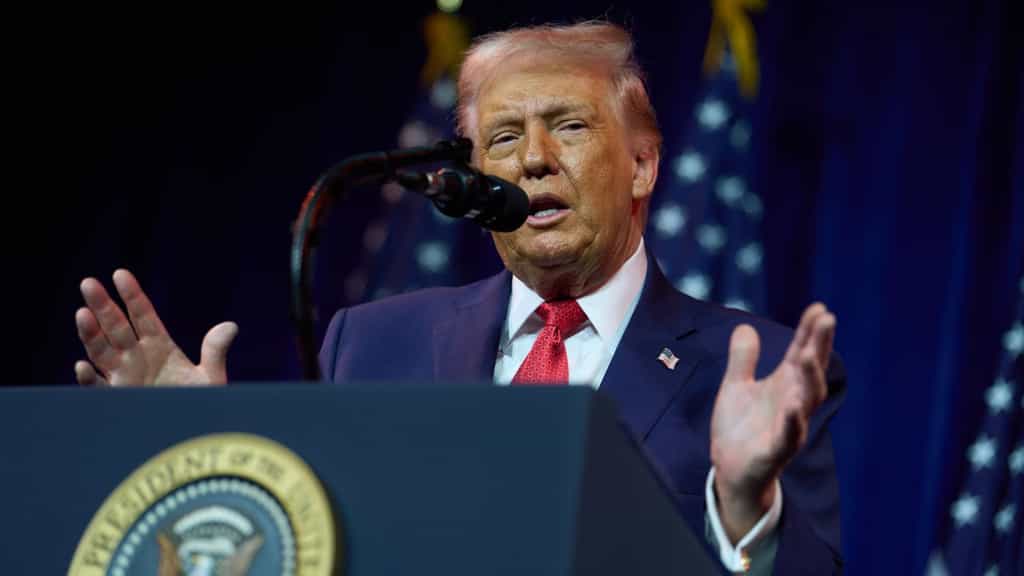
India looks toward trilateral forums, such as the India-EU-US, which now may well become India-EU, as well as the BRICS climate agreements. (AP Photo)
The significance of President Donald Trump’s January 7 Memorandum on the US’s abandonment of 66 international organisations has caused a stir in the climate community. This broad-based exit encompasses 31 UN entities, including the UNFCCC and IPCC, as well as an additional 35 entities, such as the Green Climate Fund and the International Renewable Energy Agency, resulting in the end of US participation in emissions reporting, COP negotiations, and climate finance. This isolationism on the climate front will affect the Global South. Countries like India are experiencing catastrophic floods, killer heatwaves, and crop meltdowns, all of which are undermining already fragile economies.
The Global South, including Africa, Asia, and Latin American developing countries, have contributed less than 20 per cent of historical emissions, yet are among the worst impacted by the effects of climate change. The cutoff of funding would include the Green Climate Fund, which has directed $19 billion towards projects in vulnerable areas — these include funding for cyclone barriers in Bangladesh and non-irrigation agriculture in Kenya. The US’s reneging will leave a $100 billion hole that Europe cannot possibly fill with its own purse strings, especially because it’s confronted with the expenses of post-conflict recovery in Ukraine.
IPCC reports are already weakened by the absence of US scientific contributions. Its withdrawal from the UNFCCC will leave the US without a voice in negotiations on the Nationally Determined Contributions (NDCs). UN Climate Chief Simon Stiell described the move as a colossal own-goal, but for the South, it’s just plain abandonment, perpetuating the Global North’s historical responsibility for the problem.
India, with a population of 1.4 billion and ranked at the top of the Climate Risk Index, finds itself in a vulnerable position. Ten million have been displaced while monsoons have wreaked havoc. In 2026, climate models are forecasting an even worse situation due to residual El Niño activity. The IPCC estimates that India’s National Action Plan on Climate Change will drive $500 billion in green investment in India. The US withdrawal could leave India bereft of technical assistance through the International Renewable Energy Agency (IRENA) — some of the interventions of this agency played a role in reducing solar tariffs by 85 per cent from 2010.
Financially, the $2.5 billion pledged by the Green Climate Fund to India for coastal defences and Himalayan glaciers is now in limbo. The US decision is also a signal to the private sector that multilateral support is crumbling. The 7 per cent rupee depreciation will lead to higher borrowing costs. Geopolitically, India has found itself unable to employ a WTO strategy on trade-related issues in climate negotiations.
The US promised to deliver $11.4 billion by 2024 for climate finance and has honoured payments sporadically. Complete disengagement would eliminate commitments going forward and put pressure on India and Brazil to provide funding that they themselves cannot afford. The unravelling of Article 9 of the Paris Agreement — NDCs in the Global South are based on this “new collective quantified goal” now abandoned as US observers have no vote.
The technology transfer process also remains stagnant. In addition, the US’s advances in battery storage and green hydrogen were facilitated through UNFCCC platforms and served as the policy driver behind India’s Production Linked Incentive (PLI) schemes, which enabled the country to attract $25 billion in FDI.
The point is that the Global South will have to change and cannot be dependent on the whims of the US. India looks toward trilateral forums, such as the India-EU-US, which now may well become India-EU, as well as the BRICS climate agreements. However, in the absence of US economic prowess, China’s Belt and Road Initiative could occupy centre stage in renewable energy markets. This is a two-edged sword for African countries — it could open up opportunities or push them into a debt trap. The US exit also raises questions over adaptation. Several countries are dependent on US satellites and World Meteorological Organisation alerts.
Trump’s retreat reveals the precarious nature of multilateralism. Difficulties, however, can also become an opportunity. India’s International Solar Alliance (ISA), which has over 150 member partners, aims to achieve $1 trillion in solar energy by 2030 as a “South-South” movement, sidestepping the UNFCCC’s bureaucratic processes. Domestic capex — a $120 billion green budget for 2026 — promotes self-reliance, from electrolysers to EVs. Global pressure needs to be put on the EU/Japan to double their pledges, especially in order to use the G20 presidency to achieve “finance without borders”.
The climate crisis does not wait for the hegemon; adaptation is now a condition for survival.
The writer is clinical associate professor (Research) and research director at Bharti Institute of Public Policy, Indian School of Business (ISB). He teaches sustainability at ISB and is contributing to the IPCC’s upcoming report on Cities and Climate Change as lead author
Editorial Context & Insight
Original analysis & verification
Methodology
This article includes original analysis and synthesis from our editorial team, cross-referenced with primary sources to ensure depth and accuracy.
Primary Source
The Indian Express