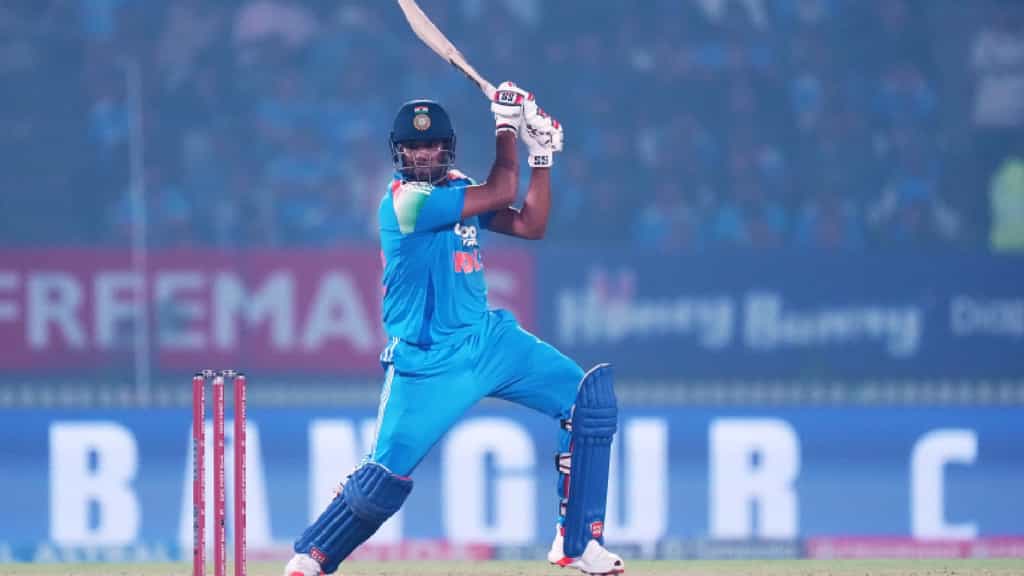
At 242 for 5, with 59 runs still needed in 53 balls and the momentum drifting away towards the Black Caps, India found themselves in an unfamiliar position: slightly anxious, suddenly thin on finishing, and one wicket away from discomfort. New Zealand sensed it too, their body language sharpening as Harshit Rana walked out to bat in the first ODI at Vadodara.
Rana was not meant to be here – not as a problem-solver in batting, not as a finisher. But with Washington Sundar injured and the chase slowing, India needed him to be more than a fast bowler with a bat.
The steep Kyle Jamieson had cracked the game open by removing Virat Kohli, Ravindra Jadeja and Shreyas Iyer in the space of two overs and left the match intriguingly poised.
Rana’s first few balls were about survival. He was beaten outside off, defended with soft hands and resisted the urge to manufacture shots. Off the third ball of the 42nd over, Jamieson hit the channel hard and the ball flew over off stump, underlining how little room there was for error.
The tension peaked two balls later. Rana punched a short-of-length ball square and set off for a risky second. He was more than halfway down when KL Rahul sent him back. Rana turned sharply, dived full length, and made his ground – awkwardly. He stayed down briefly, clearly in discomfort. It was a small moment, but a telling one. India could not afford to lose him.
Slowly, Rana began to breathe. A squeezed two to deep backward point. Gentle nudges into the leg side. Nothing extravagant yet everything purposeful. Against Kristian Clarke’s changes of pace, he misread a slower ball and hacked across the line, the ball sneaking under his bat.
The release came in stages. A full delivery outside off was driven hard and sliced past backward point for four, a boundary India badly needed. Then came the moment New Zealand would rue. Off the fifth ball of the 44th over, Rana mistimed a slog off Zack Foulkes, the ball ballooning to long-on. Mitchell kneeled, settled, but spilled it.
From there, the innings shifted tone. Rana rotated strike, combined well with Rahul, and ensured the required rate never climbed again. A couple off Michael Bracewell through midwicket. A controlled drive back past the bowler. The pressure ebbed away quietly.
And then, with the finish line in sight, Rana picked his moment. Clarke dropped one short and slower into the wicket. He cleared his front leg, threw everything behind the pull, and nailed it over deep midwicket for six. The crowd responded instantly. India were almost home.
Rana eventually fell for 29 off 23 balls, top-edging a pull to wicketkeeper Mitchell Hay, but by then the job was done.
“Harshit did a terrific job as soon as he walked in,” Rahul said later. “He took a lot of pressure off me with the way he struck the ball, and suddenly the chase became much easier.”
Earlier in the afternoon, Rana’s day with the ball unfolded in phases. He began in a containing role with the new ball on a surface offering little assistance. As New Zealand pushed towards 350, he returned to break the opening stand, dismissing both openers in contrasting fashions. In a late third spell, Rana combined effectively with Mohammed Siraj and Prasidh Krishna, using his variations to curb the scoring and deny the big hits. The finishing with the bat was something more.
Harshit Rana of India celebrates the wicket of Henry Nicholls of New Zealand during the 1st ODI match between India and New Zealand at Baroda Cricket Association Stadium, Vadodara, India, on January 11, 2026. (CREIMAS for BCCI)
That ‘something more’ is what India are quietly trying to build.
“The team management wants to groom me as an all-rounder and it is my task to keep working on it,” Rana revealed after the match.
India’s ODI balance is currently in flux. Hardik Pandya, central to the side’s composition for years, is still not fully fit to bowl his full quota of ten overs regularly. While his presence remains invaluable, it has forced India to explore alternatives. Nitish Kumar Reddy has promise but is yet to receive a sustained run.
More significantly, Rana, only 24, is already clear about where the team sees him.
“It was a matter of confidence, which KL bhai helped me with when I went in,” Rana said. “I kept my focus on it and made the runs.”
Rana’s value lies in what his batting unlocks. He is a frontline fast bowler first. If he can reliably contribute runs, India can afford to think differently – especially away from home. Once Pandya is fully fit to bowl, a batting No. 8 like Rana could allow India to drop a finger spinner and field four fast bowlers without excessively lengthening the tail, especially with an eye on the 2027 World Cup in South Africa.
For now, these remain possibilities rather than guarantees. Rana will face sterner tests ahead, but on a night when India briefly flirted with uncertainty, he showed he could absorb pressure and deliver.
In a format that increasingly demands flexibility, such contributions carry weight beyond a single result. They give captains options, selectors reassurance, and teams the freedom to think ahead rather than react. For India, that may matter as much as the runs themselves.
Not by slogging wildly – but by understanding the moment, ball by ball.
Editorial Context & Insight
Original analysis and synthesis with multi-source verification
Methodology
This article includes original analysis and synthesis from our editorial team, cross-referenced with multiple primary sources to ensure depth, accuracy, and balanced perspective. All claims are fact-checked and verified before publication.
Primary Source
Verified Source
The Indian Express
Editorial Team
Senior Editor
Aisha Patel
Specializes in India coverage
Quality Assurance
Associate Editor
Fact-checking and editorial standards compliance