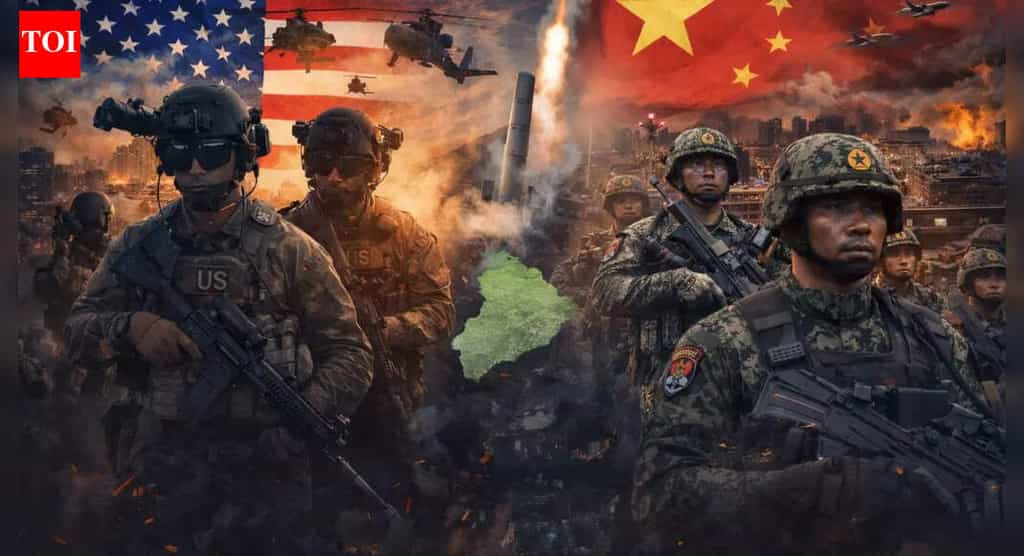
The extreme precision of the US in its Venezuelan operation has many analysts debating whether China could be able to execute a similar surgical strike.
The rapid US operation that removed Venezuelan leader Nicolas Maduro from Caracas in under three hours on January 3 sent shockwaves far beyond Latin America.In China, the raid triggered a surge of online debate and nationalist commentary asking why Beijing could not execute a similar “decapitation strike” against Taiwan - an island Beijing considers part of its territory and sits just 100 kilometers from the mainland.The comparison, analysts say, is tempting but deeply misleading.
As per a report in the SCMP, the Maduro operation underscored a defining asymmetry in US–China military competition: Washington’s advantage is no longer just about superior platforms or weapons, but about institutional integration.China has spent two decades modernizing its military at breakneck speed. It fields stealth fighters, advanced missiles, modern naval platforms, cyber and space forces, and tens of thousands of elite troops. Yet the Pentagon and independent analysts agree that Beijing still lacks the organizational architecture to conduct ultra-precise, politically sensitive operations that depend on flawless joint execution.
That gap shapes how China would actually pursue high-end coercion - especially against Taiwan - and why any Chinese attempt to replicate a Maduro-style raid would likely be louder, slower and far more destructive.
The US raid was a textbook example of what modern militaries call all-domain operations: intelligence, cyber, electronic warfare, air power, special operations forces and logistics converging at exactly the right moment.No single element made the operation decisive. Intelligence identified the target. Electronic warfare suppressed defenses. Aviation assets inserted and extracted the assault force. Command-and-control systems synchronized every step.China, by contrast, has most of the individual components - but not the same ability to fuse them into a single, agile system.
The Pentagon’s 2025 report to Congress puts it bluntly: while the People’s Liberation Army (PLA) has between 20,000 and 30,000 special operations personnel, it has “no national-level special operations command responsible for all SOF activities,” leaving elite units reliant on conventional forces for transport, logistics and support.That structural reality is the core reason Beijing cannot easily copy what Washington did in Caracas.
Unlike the US, which consolidated its elite units under a unified special operations command with dedicated aviation, intelligence and logistics, China deliberately scattered its special forces.PLA special operations brigades exist within ground force group armies, the navy’s marine corps, the air force’s airborne corps, the rocket force’s reconnaissance elements, the People’s Armed Police and regional commands in Xinjiang and Tibet.This is not an accident.Analysts say the Chinese Communist Party has long viewed concentrated military power as a political risk. Fragmentation prevents any single commander from accumulating the autonomy or influence that could challenge Party control.Dennis Wilder, a former CIA official now at Georgetown University, told South China Morning Post that China “does not have the equivalent of Seal Team Six or Delta Force for this kind of strategic insertion.”The result: even highly trained PLA commandos remain embedded within bureaucratic chains built for conventional warfare, not fast-moving strategic raids.
Joshua Arostegui, chair of the China Landpower Studies Centre at the US Army War College, argues the decisive gap lies in integration rather than firepower.“The ability to effectively enable the ‘convergence’ of the different domains … is what differentiates the US military and the PLA currently,” Arostegui said, adding that the PLA would “struggle” to execute a stand-alone special operation independent of a larger conventional campaign.
If the PLA implements mission command, it will likely be varied and uneven across units and mission types, as the PLA has always struggled to move away from centralized command because of the Chinese government’s strong preference for political control of the military.
Song Zhongping, a former Chinese military instructor, emphasized intelligence as the critical variable. He said the US succeeded through “the coordinated efforts of various agencies and intelligence departments” and by cultivating informants to ensure precision - a level of intelligence fusion China has not consistently demonstrated.“The relevance is that China has a long way still to go to reach the US gold standard,” he told the SCMP.Ni Lexiong, a professor at Shanghai University of Political Science and Law, pointed to electronic warfare and experience, arguing that electromagnetic suppression, stealth technology and battlefield practice were “three crucial dimensions” behind the US success.
The Maduro raid was not improvised. Analysts say it rested on months of human intelligence collection and surveillance that mapped the Venezuelan leader’s movements with near-minute precision.US intelligence agencies fused human sources, cyber access, signals intercepts and overhead surveillance into an actionable targeting picture. That intelligence flowed directly into operational planning - a process refined over decades of interagency cooperation.Taiwan would be a far harder target.
A primary objective of any potential Chinese strike would be “decapitation”—the removal of Taiwan’s political leadership to force a rapid surrender. However, Taiwan’s multiparty electoral system, checks and balances across branches of government, and active civil and media sectors create redundancy that preserves governmental continuity despite leadership shocks. That will make it extremely difficult for Beijing to achieve its political objective.
The island has mandatory military service, an open media environment and a security apparatus shaped by decades of counterintelligence work aimed specifically at thwarting Chinese penetration.
Beijing has intelligence assets in Taiwan, but analysts doubt it could achieve the same depth, redundancy and real-time accuracy that enabled the Caracas operation.Compounding the challenge, China’s intelligence-to-operations pipeline remains fragmented. PLA special forces units spread across services must coordinate through conventional command channels that were never designed for rapid, covert strike missions.
Precision raids depend on specialized aviation - not just helicopters, but pilots, maintenance crews and planners who train exclusively for high-risk insertion and extraction missions.The US relies on dedicated special operations aviation units flying highly modified helicopters, with crews drilled for night operations in dense urban environments under electronic attack.
China’s closest analogue, the Z-20 helicopter, matches US platforms on paper.
But according to Arostegui, PLA special forces do not control their own aviation assets and therefore cannot train regularly with the same crews under realistic conditions.That distinction matters. Flying commandos into contested airspace is not standard troop transport. It requires a unique culture of risk, rehearsal and trust between pilots and operators.Beyond aviation, global logistics remain a constraint. The Pentagon notes that China is expanding overseas access points, but it still lacks a systematic overseas command-and-control structure.
A Caracas-style operation requires staging, refueling, intelligence support and extraction far from home - something Washington has practiced for decades and Beijing is only beginning to attempt.
Another invisible pillar of the Maduro raid was dominance of the electromagnetic spectrum.US electronic warfare assets reportedly blinded Venezuelan radar and communications long enough for the operation to unfold.
Analysts increasingly view this as a prerequisite for modern special operations: control the spectrum, or risk losing the mission before it begins.China has invested heavily in electronic warfare and cyber capabilities. But those systems largely remain service-specific assets rather than tools integrated into a unified special operations framework.
Ni Lexiong noted that while the PLA has made progress, it lacks the depth of battlefield experience needed to synchronize electronic warfare, stealth aircraft and special forces in real time.Exercises can model these interactions. Combat reveals where they fail.
Perhaps the most difficult gap to close is experience.The US special operations community refined its methods through repeated deployments in Afghanistan and Iraq, learning how intelligence breaks down, how plans fail and how to adapt under fire. That institutional memory - what works and what doesn’t - cannot be replicated through simulations alone.The Pentagon’s assessment states that despite extensive training, the PLA “lacked real-world combat experience,” particularly in complex joint operations.China’s elite units have participated in counterterrorism missions, anti-piracy patrols and evacuation operations. Valuable as those are, analysts stress they bear little resemblance to penetrating defended airspace in a modern city to seize a political leader.
As Arostegui put it, some PLA teams have experience “against suspected terrorists or insurgents,” but those missions are “much smaller in scale and limited in the need for joint integration.”
Underlying all these constraints is a deeper issue: political control.The PLA is not a national military in the Western sense; it is the armed wing of the Chinese Communist Party. Political commissars share authority with commanders at every level, ensuring loyalty but slowing decision-making.Western-style mission command - where commanders delegate authority and empower subordinates to adapt on the fly - is central to special operations. Embracing it fully would require Beijing to accept less centralized political oversight.Pentagon-linked analyses suggest Chinese strategists understand this tension, but recent purges and anticorruption campaigns indicate the Party consistently prioritizes control over operational flexibility.That choice has consequences for missions where speed, initiative and autonomy are decisive.
The inability to replicate a Maduro-style raid does not mean China lacks coercive options.Pentagon assessments suggest Beijing would more likely pursue “decapitation” effects through missile strikes, cyber operations and air power - methods that reduce risk to elite personnel but increase collateral damage.In other words, China could still aim for shock.
It just wouldn’t look surgical.This lack of surgical capability doesn't mean China is toothless. It simply means their methods would be messier. Although the PLA was not likely to be currently capable of carrying out a US-style precision strike operation, but they have other options.This implies that instead of a silent night raid by a small team, a Chinese "decapitation" strike might look more like a massive barrage of cruise missiles or a large-scale air assault-tactics that destroy the target but also level the city block and invite immediate global condemnation.The PLA has conducted simulation training in recent years, with state media stating that the military’s training base in Zhurihe in Inner Mongolia features life-size mock-ups of Taiwan’s presidential office and parliament. But no information has been revealed on exercise scenarios carried out by the PLA there.
The US succeeded because it has spent decades building - and stress-testing - a system that fuses intelligence, aviation, electronic warfare and special operations under unified command.China has modern weapons, elite troops and growing ambition. What it still lacks is the organizational ecosystem that allows all those elements to move as one.Until Beijing is willing to trade a measure of political control for operational autonomy - a trade-off it has consistently rejected - the precision gap exposed in Caracas is likely to remain.
Editorial Context & Insight
Original analysis and synthesis with multi-source verification
Methodology
This article includes original analysis and synthesis from our editorial team, cross-referenced with multiple primary sources to ensure depth, accuracy, and balanced perspective. All claims are fact-checked and verified before publication.
Primary Source
Verified Source
Times of India
Editorial Team
Senior Editor
Dr. Elena Rodriguez
Specializes in India coverage
Quality Assurance
Associate Editor
Fact-checking and editorial standards compliance