At the peak of the Samyukta Maharashtra Movement in the 1950s, and the fight over Bombay, two warring slogans resounded in the city: ‘Mumbai aamchya hakkachi/naahi konachya baapchi,’ (Mumbai is ours by right; it’s not someone’s fiefdom) cried the sons of the soil. To which, votaries of the Mahagujarat movement who wanted Bombay to become their capital, shot back with: ‘Mumbai tumchi/bhandi ghasa aamchi’ (Mumbai is yours; (but you) clean our utensils).
Salman Rushdie captures the fractiousness of that time in Midnight’s Children when his protagonist Salim Sinai shouts back at Samyukta Maharashtra activists heckling him to speak in Gujarati: “Su chhe? saaru chhe/danda le ke maaru chhe” (How are you?—I am well!—I’ll take a stick and thrash you to hell!).
Seventy years after the linguistic movement, the old fault line is again gaping wide. Overriding bad roads, bad air, bad water, inept and corrupt housing schemes, elections to Brihanmumbai Municipal Corporation, India’s richest civic body, are being fought on identity politics.
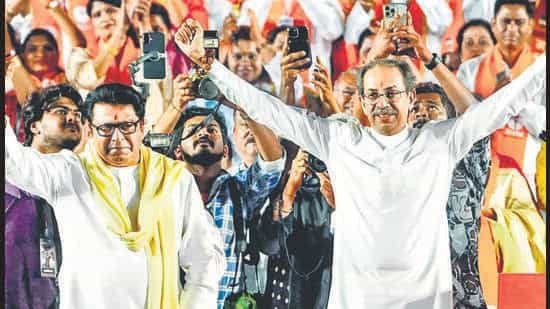
At the heart of this is the Marathi manoos (people) who account for a third of the city’s 10.3 million voters. Estranged cousins Uddhav and Raj Thackeray have come together. Eknath Shinde, the valiant carpetbagger from Thane (not really Mumbai, according to purists), has wrested 90 of the 227 seats from the BJP, to prove, once and for all, that his is the real Shiv Sena. Even the Bharatiya Janata Party finds its hegemonic cultural appeal coming up short against the famously khadoos (grumpy) Marathi manoos. To counter the opposition’s accusations of promoting Gujarati interests, the party has promised that should they win on January 15, the mayor and the chief of the standing committee, which clears all BMC contracts, will be Marathi speakers.
Mumbai is an elusive entity. “It belongs to none, and yet to one and all,” says Sambhaji Bhagat, Maharashtra’s famed Lok Shahir in the tradition of troubadours Amar Shaikh and Annabhau Sathe. Bhagat, who taught history at Mumbai University, and whose working-class anthem, “Inki Soorat Ko Pehchanon, Bhai,” (Brother, recognise their true face) is still taught in universities, offers a quick history re-cap to back his claim. “The Gujarati-Marathi antagonism goes back to Chhatrapati Shivaji’s twin raids on Surat in the 17th century. He used that loot to build his forts, but he never came to Bombay. Konkan, Kalyan, Vasai, yes, but never here. Mumbai, built by the British, was run by the Parsi, Gujarati, Marwari and Jewish mercantile class which made it the cosmopolitan city it is.”
The rise of the textile mills in Bombay that coincided with the agrarian crises of the 1930s led to the influx of native Marathi speakers from the hinterland. “But even as late as the ‘70s, the power in the city was still with the mill owners. The Marathi middle class remained a subdued presence in Bombay,” says Bhagat.
Bal Thackeray’s Shiv Sena which arose as a reactionary cultural force, and the eventual disintegration of the textile mills were, however, seminal events that, even in their last throes, continue to shape Mumbai’s everyday life and politics.
On a recent Wednesday, the poll action is focused on a rundown cluster of four-storied buildings housing 400 families of former mill workers. Amid cacophonous traffic, a group of boys is blowing, full pelt, on plastic whistles, the election symbol of Arun Gawli’s Akhil Bharatiya Sena.
The reformed gangster, who racked up a terrifying kill count through the 1980s and the 1990s when the underworld held sway on Mumbai streets, is out on bail. His two daughters, Geeta and Yogita, are contesting the civic elections from adjoining wards at Byculla in the former mill district. Dagdi chawl, Gawli’s domain, was once a hard-to-breach fortress famed for its warren of torture rooms. It stands today exposed to the luxury skyscrapers that encircle it.
A mill worker himself, Gawli witnessed firsthand the disintegration of Mumbai’s mill district and its working class — many of whom got sucked into the underworld. From a small wrought iron window of Dagdi chawl ‘Daddy’ watches the city shape-shift again. The 452 acres in south-central Mumbai where 54 mills — 32 of them privately held — once stood, form the backbone of the Marathi voter bloc. It was here that Gawli’s rival, Amar Naik, sensationally shot dead mill owner Sunit Khatau in 1994. When Naik was killed in a police encounter two years later, ‘Saamna’, the Sena mouthpiece, criticised the Mumbai police for its “selective killing of Hindu and Marathi mafia dons.” Shiv Sena’s Manohar Joshi was Maharashtra’s chief minister then.
Ashish Shelar, Maharashtra’s culture minister, and until recently the BJP’s Mumbai chief, grew up close to Dagdi chawl. His father was a class IV employee in the income tax department, and Shelar’s family of five along with his uncle’s family shared a room in a chawl opposite Arthur Road jail. When the chawl went into redevelopment, taking 27 years to complete, the Shelar family moved into a transit accommodation in Bandra west. “I am that Marathi manoos, I have experienced how they live and what their challenges are; not Aaditya Thackeray who grew up in Matoshree,” says Shelar, taking a dig at the scion of the Shiv Sena (UBT).
“The Marathi manoos is not some static entity. Their young, like their peers, want to listen to Coldplay as much as they want to listen to Lata Mangeshkar,” he says testily. “They are aspirational, but what did Uddhav Thackeray whose party ran the BMC for 26 years, do to fulfil their aspirations? Did he enable them to be entrepreneurial?”
Such is the appeal of the Thackerays though that the BJP had to execute a hasty mid-course correction after Shiv Sena (UBT) and Raj Thackeray’s Maharashtra Navnirman Sena announced an alliance last month. The party swiftly moved from its twin planks of development and polarisation to launch a high-decibel campaign aimed at the nativists, and even conceded 90 seats to Eknath Shinde in the alliance. But that too is fraught. “Hindi, Hindu, Hindustan was Savarkar’s slogan. For the BJP to suddenly move to the Marathi manoos will require political dexterity,” says Bhagat the troubadour.
But political contradictions beset the Shiv Sena (UBT) as well. “In the 1992 civic election we had to go with heavy security to set up our booth at Behrampada in Bandra east, and here we are today, contesting this election Allah ke bharose, (on the grace of Allah)” says a senior UBT leader unwilling to be named. The city’s 12% Muslim vote has become critical for Shiv Sena (UBT), especially after the Congress dumped them unceremoniously to contest BMC elections in alliance with Prakash Ambedkar’s Vanchit Bahujan Aghadi.
Seated in his well-appointed editor’s room at the Saamna office, Sanjay Raut, the UBT MP in Rajya Sabha struggles to hide his disappointment and befuddlement at the Congress’s decision. He also concedes that the party is low on funds that had long lubricated the Sena’s patronage network.
The 2022 split and the four-year delay in holding local body polls have blocked all revenue sources for them. Raut is explicitly bitter about the Supreme Court and the Election Commission’s delay in hearing their case. “Neither institution could find two hours to hear a matter that goes to the heart of Schedule X of the Constitution!?” With Eknath Shinde walking away with 44of their 84 corporators from the last time, the alliance with Raj Thackeray was an imperative, he says. “It was now or never.”
“The shakha level network has been hollowed out,” says Sena scholar Sanjay Patil. “In addition, there has been such massive redevelopment across Mumbai that no one really knows how the demographic profile of the city has changed.” While the city’s $30 billion infra upgrade is indeed welcome, Patil points to fundamental changes that have added to the insecurities of the working class.
There are still 1.3 million slum households in Mumbai and more than 22 cluster projects like Kamathipura, Abhyudaya Nagar, BIT and BDD chawls. “Mumbai had a thriving informal slum economy, be it in Dharavi or in Ramabai Ambedkar Nagar, or in Kamathipura. But the way these redevelopments have been imagined, capital has been formalised. Once Adani completes the Dharavi redevelopment, Mumbai will be a different city.” This insecurity, he says, makes the Marathi populace cleave closer to Thackeray. “All these years it was the shakhas that resolved their gutter, paani, meter issues.”
Both Sanjay Raut and Ashish Shelar estimate that there has been a drop of about 4-5% in the Marathi-speaking population of Mumbai in the last two decades. This correlates directly with the manner in which Mumbai is being redeveloped, says former lawmaker Chandrashekhar Prabhu.
Former president of the Maharashtra Housing and Area Development Authority (MHADA) Prabhu serves on the board of the Slum Rehabilitation Authority (SRA). There are 19,800 cess buildings in Mumbai, that include most of the chawls. (Cess buildings in the island city are those from which the Mumbai Building Repair and Reconstruction Board collects a cess for maintaining them).
“In 35 years, MHADA has reconstructed only 1,500 of the 19,800 cess buildings,” says Prabhu. “All the schemes of rehabilitation have failed in Mumbai because the main aim was never to reaccommodate old inhabitants. It was always to take their land and give it to private developers,” he says, rattling off names of luxury towers in south and south- central Mumbai that have been built either on slum land or sites of cessed buildings. “This is prime government land that has been handed over on a platter to private developers.”
In turn, gated communities, the likes of which have come around Gawli’s Dagdi chawl for instance, charge prohibitive maintenance fees, leading to middle-class residents cashing out and moving outside Mumbai to the far-flung areas of Kalwa, Dombivali, Kalyan, Ambernath-Badlapur or Vasai-Virar. “By the next municipal elections in Mumbai, the demographic profile of this mill-land area would have completely changed, and as would have its politics,” predicts Sanjay Patil.
As part of its campaign aimed at the Marathi manoos, the BJP is promising in-situ redevelopment. Ashish Shelar cites the case of BDD Chawls, built by the British in the 1920s, to house labour in Parel, Worli, Naigaon and Sewri. In 2016, the Fadnavis government appointed MHADA to redevelop these chawls and last year, the chief minister handed over keys to 556 families in two of the proposed 33 towers. Similar cluster redevelopments will happen at Abhyudaya Nagar, Adarsh Nagar at Worli, Motilal Nagar at Goregaon west, and at Bandra Reclamations, promises Shelar. “Wherever there is redevelopment, Mumbaikars must get homes on site, and speedily -- that’s our effort.”
The minister, one of the most visible faces of the BJP in the city, says Mumbai is integral to the party’s Virasat se Vikas Tak (From legacy to development) campaign for 2047, the centennial year of India’s Independence. He points to the upcoming bullet train project, the Mumbai Trans Harbour Link, the new metro lines, the airport at Navi Mumbai, the proposed Vadhvaan port and the construction of a third Mumbai as the BJP’s commitment to the financial capital. The Mumbai Metropolitan Region comprises 9 municipal corporations and elects 11 MPs and 66 MLAs. For 2025-26, its cumulative budget was ₹1,01,723 crore. For comparison, the budget of a mid-size state like Uttarakhand was ₹1 lakh crore in the last fiscal.
In a concerted effort to make transformative change, the central and state governments have unlocked 6,000 acres of the city’s total habitable land of 34,000 acres for commercial exploitation. This includes the eastern waterfront, the salt pan lands, bus depots owned by the BEST, even the Mulund dumping ground. Activists and citizens groups are calling it the Great Mumbai Garage Sale. Journalist and founder-trustee of Moneylife Foundation Sucheta Dalal has floated a petition on change.org opposing monetisation of public land which has found support from over 12,000 people and organisations such as the Urban Design Research Institute, Vanashakti and Aamchi Mumbai Aamchi BEST.
Dalal told HT that the proposed monetisation needs to be stopped until there is greater transparency and that citizens are assured that this public land will be used for affordable housing, civic amenities and open spaces. Former urban development secretary TC Benjamin frets about the unlocking of salt pan lands. “This is holding land during heavy rain and high tide. By opening it up for development are we putting the city at risk of flooding in case of an extreme weather event?”
While the BMC is the catch-all for all of Mumbai’s woes, the big-ticket infra projects are planned and executed by the Mumbai Metropolitan Region Development Authority (MMRDA) which reports to the state government. The four-year delay in holding civic polls has meant the municipal commissioner too reported to bosses at Mantralaya instead of elected corporators. “This centralisation is antithetical to the idea of local self-governance,” says economist Ajit Ranade. “Mumbai pays 40% of the country’s tax but in these last four years, it hasn’t had a chance to weigh in on how the city should run.”
For local political aspirants, this lag of four years in holding civic polls has meant they have missed out on nearly one term leading to an unprecedented free-for-all. Rebellion and resentment are rampant across parties. “Every political worker thinks this is their last opportunity. It’s very difficult to manage aspirations,” says a senior BJP leader speaking off-the-record. Like locust capitalism, these civic polls have become Mumbai’s version of locust politics
Editorial Context & Insight
Original analysis and synthesis with multi-source verification
Methodology
This article includes original analysis and synthesis from our editorial team, cross-referenced with multiple primary sources to ensure depth, accuracy, and balanced perspective. All claims are fact-checked and verified before publication.
Editorial Team
Senior Editor
Aisha Patel
Specializes in India coverage
Quality Assurance
Senior Reviewer
Fact-checking and editorial standards compliance