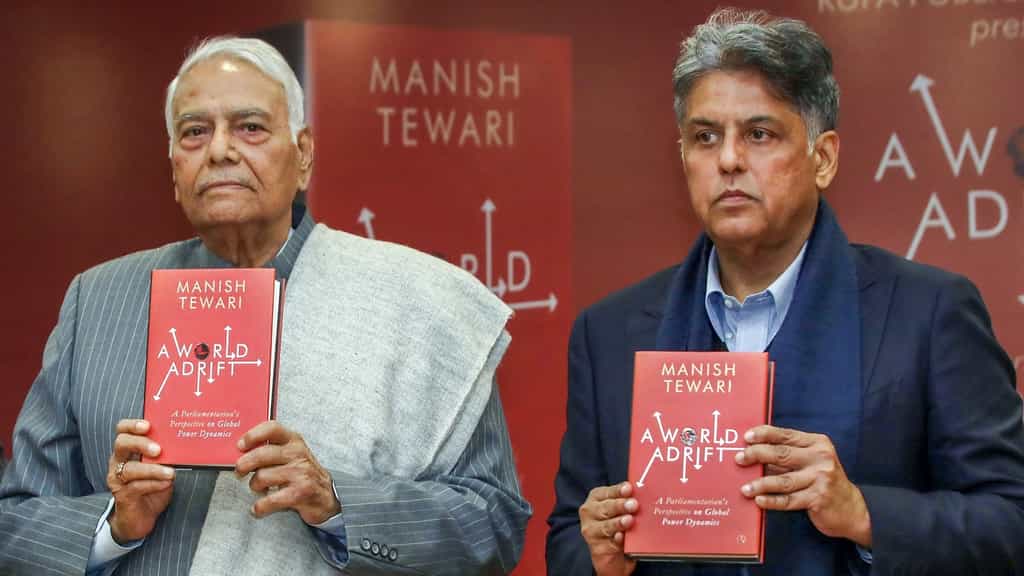
THE Narendra Modi government’s tilt towards “multi-alignment” in foreign policy is a continuum of former Prime Minister Jawaharlal Nehru’s policy of non-alignment, with a different label, said Congress MP and former union minister Manish Tewari on Monday.
Even the Atmanirbhar Bharat initiative is a rehash of Congress PM Indira Gandhi’s call towards self-reliance, said the Chandigarh MP during a discussion at the launch of his new book, ‘A World Adrift: A Parliamentarian’s Perspective on the Global Power Dynamic’ (Rupa Publications) in the Capital.
“There are strategic continuums… PM Nehru conceptualised non-alignment; there were two world wars, devastation, destruction, imperialism and colonialism were in retreat. PM Nehru gave the nations a third way — that held the field from 1947 till 1962, when the Chinese war happened… After that we signed a treaty of friendship with the Soviet Union… that is what our national interest dictated.”
“When the Soviet Union collapsed, we started looking West. And now we have difficulties with the West. When I see the narrative of so-called multi-alignment from the government, it is nothing but Nehru alignment without giving him ownership. Similarly, when you talk about atma nirbharta, it is the self-reliance of late PM Mrs (Indira) Gandhi when she started the Green Revolution and didn’t want to be humiliated in the capitals of the world,” said the MP. Tewari said if the country aims towards strategic autonomy, it can only come from internal cohesion.
Talking about the United States’ recent action in Venezuela, he said, “If at all, there was a post World War-II global order that has completely collapsed…We are living in an orderless world.”
The book release was attended by former external affairs minister Yashwant Sinha, Congress leaders P Chidambaram, Mukul Wasnik and Vivek Tankha, former Congress leader Ghulam Nabi Azad, BJD MP Sasmit Patra, UK High Commissioner Lindy Cameron and Australian High Commissioner Philip Green among others.
Speaking at the event, Sinha said what happened in Venezuela has raised many issues and once again established the imperialism of the world’s most powerful democracy. “Quite clearly, there are threats and dangers, and we have to navigate through these choppy waters with dexterity,” Sinha said.
Tewari said India needs to remain internally cohesive to protect its strategic autonomy, asserting that the country’s cohesion is its biggest antidote to the external challenges it faces.
“Pluralism is no longer a luxury which can be taken for granted. India’s cohesion is its biggest antidote to the external challenges,” Tewari said.
He pointed out that India has an extremely robust democratic tradition and continues to be a beacon amid the changing global dynamics. “At a time when you have nations which have yielded over, India, with all its problems and contradictions and the kind of politics we have been seeing over the past decade, continues to be that beacon,” he said.
“But what worries me is pushing the entire spectre of religious polarisation to an extent where it weakens our social fabric so immeasurably that we are not able to retrieve it,” the Congress MP said, adding, “We think because it gives electoral dividends we can continue pushing the envelope, but there is a limit to that.”
“If India… wants to preserve and protect its strategic autonomy and engage with the world on its own terms, the strength is going to come from internal cohesion and not from outside,” said the Congress MP, who is also part of the parliamentary panel on external affairs. “That is where we need to focus,” he said.
Referring to the India-Pakistan “kinetic action” in May 2025, Tewari said it completely changed the paradigm, and now one can no longer fight the battles of the present with the mindset and weapons of the past.
Tewari, who was part of a multi-party parliamentary delegation sent abroad to present India’s viewpoint post-Operation Sindoor, also argued that the United Nations needed reforms and such global institutions were important and that multilateralism was the way forward.
“There’s been a revolution in military affairs. It’s been a transformation that has been unprecedented and what happened between May 7 and 10 demonstrates how that paradigm has completely changed. No longer can you fight the battles of the present with the mindset of the past and weapons of the past,” he said. “You’ve moved from an informationised to an intelligencised battlefield,” he said.
Editorial Context & Insight
Original analysis and synthesis with multi-source verification
Methodology
This article includes original analysis and synthesis from our editorial team, cross-referenced with multiple primary sources to ensure depth, accuracy, and balanced perspective. All claims are fact-checked and verified before publication.
Primary Source
Verified Source
The Indian Express
Editorial Team
Senior Editor
James Chen
Specializes in India coverage
Quality Assurance
Fact-Check Editor
Fact-checking and editorial standards compliance