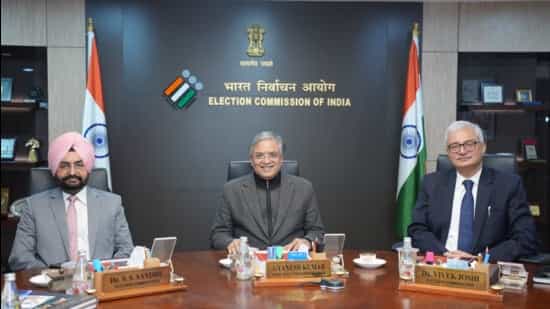
The Election Commission of India (ECI) will host the inaugural India International Conference on Democracy and Election Management from January 21 to 23 at Bharat Mandapam in New Delhi, where election authorities from across the world will discuss issues including voter roll management, technological interventions in elections, and Special Intensive Revision (SIR) exercises.
The three-day conference is being organised by the India International Institute of Democracy and Election Management (IIIDEM) under the aegis of the ECI. It will bring together representatives from 42 election management bodies, with more than 90 international delegates confirming participation, including officials from the United States and Bhutan.
According to the ECI, the conference will serve as a forum to examine challenges faced by election authorities globally, including voter registration, electoral roll integrity, misinformation, campaign regulation, and the use of technology in elections. Officials said discussions on voter registration processes and roll revision exercises, including SIR mechanisms, will form a key part of the deliberations.
The conference is being held as India assumes the chair of the Council of Member States of International IDEA for 2026. The agenda follows the theme articulated by Chief Election Commissioner Gyanesh Kumar, “Democracy for an inclusive, peaceful, resilient and sustainable world.”
The ECI said IIIDEM will use the platform to promote cooperation among election management bodies, enable the exchange of practices and innovations, and develop shared responses to contemporary electoral challenges. Over 40 bilateral meetings are scheduled during the conference between the Chief Election Commissioner, election commissioners Sukhbir Singh Sandhu and Vivek Joshi, and heads of participating election authorities.
Ahead of the conference, IIIDEM unveiled the official logo of the 2026 edition on Wednesday. The logo features stylised human forms arranged like protective hands around a globe, representing citizens as the foundation of democracy and shared responsibility for democratic institutions. India is positioned at the centre of the globe, reflecting its role as the host nation and its engagement in global election management discussions.
IIIDEM Director General Rakesh Verma said the conference would provide a platform for international cooperation among election management bodies and facilitate a shared understanding of challenges related to voter participation, institutional independence, and election technology.
The programme includes general and plenary sessions such as the inaugural session, an election management bodies leaders’ plenary, working group meetings, and the launch of ECINet, the ECI’s integrated digital platform. Thematic sessions will be structured around two pillars: reimagining democracy for the future, and the role of professional and independent election management bodies in sustaining democratic systems.
Thematic discussions will cover seven global electoral themes, 11 model international electoral standards, and 25 sessions on best practices and innovations in electoral processes. These sessions will be led by chief electoral officers from Indian states and Union Territories, along with national and international academic experts.
The model international electoral standards include laws governing electoral democracies, the legal framework and independence of election management bodies, voter registration and voter rolls, political parties and candidates, campaign finance and expenditure, balloting systems including electronic voting machines and postal ballots, counting and tabulation of results, election observers, election technology, and the role of media and voter education. Sessions will also discuss the use and misuse in elections.
Best practice sessions will examine issues such as the eligibility of electors, ease of voter registration, access to voter registers, identification at polling stations, grievance redressal mechanisms, regulation of political parties, enforcement of the model code of conduct, law and order during elections, polling day operations, robustness of counting processes, and election planning.
Additional sessions will focus on technology-driven voter registration, integrated digital platforms, tackling misinformation and disinformation during elections, regulation of media campaigns, and the role of democracy in addressing diversity, marginalisation, entrepreneurship, and sustainable development goals.
The conference will also familiarise international participants with India’s electoral framework, administrative processes, and technological systems used in the conduct of elections. ECI officials said the participating election authorities collectively represent a significant proportion of the global electorate.
Academic participation will include representatives from four Indian Institutes of Technology, six Indian Institutes of Management, 12 National Law Universities, the Indian Institute of Mass Communication, and 20 national and international academic experts. Thirty-six thematic groups led by state and Union Territory chief electoral officers will contribute to the deliberations.
The ECI said the conference is intended to institutionalise regular international engagement on election management and position IIIDEM as a hub for global dialogue on electoral processes.
Editorial Context & Insight
Original analysis & verification
Methodology
This article includes original analysis and synthesis from our editorial team, cross-referenced with primary sources to ensure depth and accuracy.