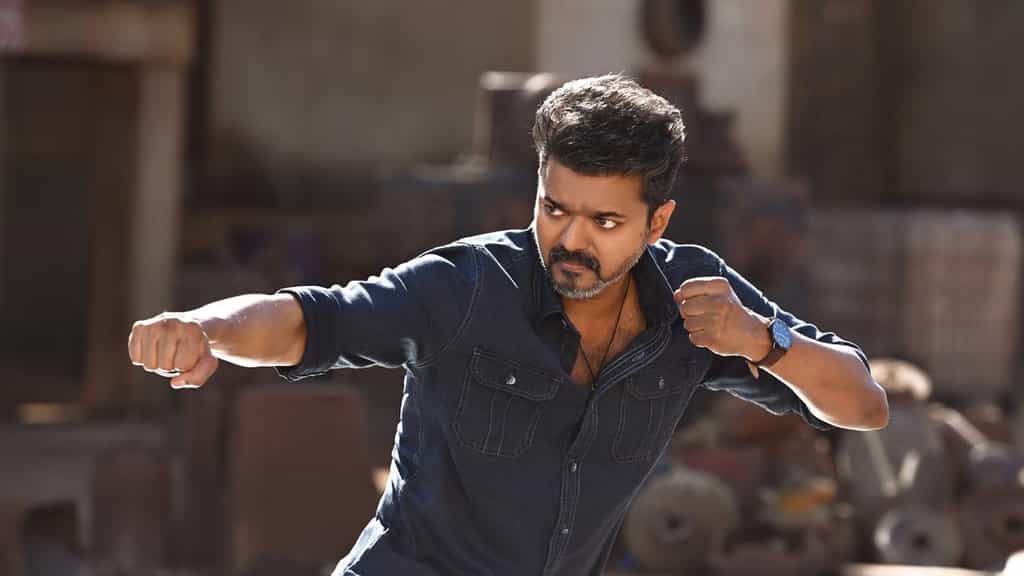
Actor-politician Vijay’s fans have been left deeply disappointed by the last-minute postponement of his highly anticipated final film, Jana Nayagan, after the Central Board of Film Certification (CBFC) refused to issue it a censor certificate. This, despite the filmmakers agreeing to make 27 cuts in the film. The film has not been referred to a larger review committee following objections from one of the members of the first examining committee.
Mr. Vijay’s supporters are alleging that a political conspiracy is at play, particularly since the actor-politician has been vocal about his opposition to both the ruling Bharatiya Janata Party (BJP) at the national level and the Dravida Munnetra Kazhagam (DMK) in Tamil Nadu. Some have drawn comparisons between Mr. Vijay’s troubles and those faced by former Chief Minister M.G. Ramachandran (MGR), who struggled to release his film Ulagam Sutrum Valiban in 1973 after being expelled from the DMK by Chief Minister M. Karunanidhi. Incidentally, when shooting for that film began, MGR was still in the DMK. Back then, when MGR was visiting Japan for a shoot, Karunanidhi himself went to the airport to see him off—and even boarded the aircraft to wish him well.
According to an incident (based on an Intelligence officer’s interview to a magazine) recounted by MGR’s biographer, R. Kannan, when MGR returned from the shoot, the Indira Gandhi government allegedly attempted to pressure MGR through the Income Tax Department, hoping to weaken the DMK.
When Ulagam Sutrum Valiban was finally ready for release, theatre owners came under pressure to not screen the film. However, it went on to become one of MGR’s greatest hits, running for a silver jubilee not only in Tamil Nadu but also in Sri Lanka, Canada, the U.S., and the U.K. The political message of the film was encapsulated in the dialogue: “I have seen your power. Don’t you have to see my strength? Give me a chance.”
For Jana Nayagan, Mr. Vijay’s political message is clear: “I am coming.” However, fans will have to wait for his arrival on screen, and it might be delayed—possibly for the last time.
This is not the first time Vijay has faced such obstacles. Since hinting at his political ambitions over 15 years ago, several of his films have faced controversies that many believe are politically motivated.
In 2012, Thuppakki, in which Mr. Vijay played a military officer hunting down a terrorist network, faced backlash from Muslim groups who objected to the portrayal of community members as terrorists. Fearing attacks, many theatres were initially reluctant to screen the film. After the filmmakers, including director A.R. Murugadoss and producer Kalaipuli Thanu, issued a public apology and agreed to remove the controversial scenes, the film eventually enjoyed a successful run.
Mr. Vijay’s father, S.A. Chandrasekhar, later suggested that Mr. Vijay could play a Muslim character in his next film, emphasising his desire to be loved by all communities.
A year later, Thalaivaa was scheduled for a release on Eid, but the film ran into trouble after a tag line, “Time to Lead,” appeared on posters. At that time, Chief Minister Jayalalithaa was reportedly upset by remarks made by S.A. Chandrasekhar, who had partly credited Mr. Vijay’s fan club for her 2011 electoral victory. The tag line was seen as a challenge to her authority. Initially, cinema owners claimed police pressure was preventing the film’s release, though the Director General of Police (DGP) denied this. It later emerged that the issue was related to the film’s lack of entertainment tax exemption from the State government. Mr. Vijay later appealed in an emotional video to Jayalalithaa to help ensure the film’s release. In the end, the film hit theatres after a two-week delay, but only after the tag line was removed. Mr. Vijay publicly thanked Jayalalithaa for her intervention.
In 2018, during the release of Sarkar, Mr. Vijay’s relationship with the AIADMK took another hit. Several AIADMK ministers objected to the film’s portrayal of freebie schemes, like mixers and grinders, which were distributed by Jayalalithaa’s government. The villain’s character was also named Komalavallai, which is the birth name of Jayalalithaa. Tamil Nadu’s Law Minister, C.Ve. Shanmugam, warned that certain scenes could incite violence, and some theatres screening the film were vandalised by AIADMK cadres. The filmmakers eventually reached a compromise by removing controversial scenes and muting the villain’s name.
Mr. Vijay also faced criticism from BJP leaders during the release of Mersal in 2017, particularly over dialogues mocking the Goods and Services Tax (GST) and Digital India initiatives. BJP leaders, including Tamilisai Soundararajan, demanded that the objectionable scenes be removed. H. Raja, a senior BJP leader, even referred to Mr. Vijay as “Joseph Vijay,” ostensibly to highlight the actor’s religion. However, Mr. Vijay found support from opposition parties, including the DMK and Congress.
In 2020, Mr. Vijay’s troubles resurfaced when Income Tax officials raided the sets of his film Master, questioning him about his finances. When the film was scheduled for a Pongal release in January 2021, the COVID-19 pandemic presented another obstacle. Mr. Vijay met with then-Chief Minister Edappadi K. Palaniswami and urged him to lift the 50% seating capacity restrictions for theatres. The government complied, and Master went on to become a blockbuster.
Throughout his career over the past decade, Mr. Vijay’s films have been entangled in politics—whether through direct attacks or subtle insinuations. As his final film Jana Nayagan waits for release, his supporters remain hopeful, even as they question whether politics will always stand in the way of his on-screen success.
Editorial Context & Insight
Original analysis & verification
Methodology
This article includes original analysis and synthesis from our editorial team, cross-referenced with primary sources to ensure depth and accuracy.