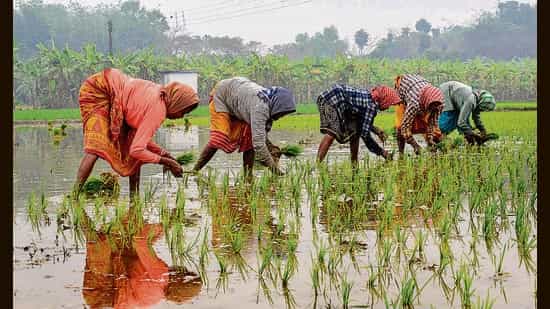
The government is likely to introduce the Seeds Bill 2025 in the upcoming Budget session of Parliament, seeking to enforce new regulations to an estimated ₹1,600-crore industry, including, for the first time, steep penalties for selling spurious planting material to farmers, an official with knowledge of the matter has said.
The agriculture ministry-steered bill, a draft of which was first circulated in November last year, has received the final go-ahead from the law ministry and provides for mandatory registration of all agricultural firms in the seed-production business, including plant nurseries, according to a copy reviewed by HT.
The bill proposes penalties and punitive action on seed producers for various violations, codifying offences as “trivial”, “minor” and “major”. For serious and repeated violations, such as selling spurious seeds, penalties and fines can go up to ₹30 lakh along with suspension of licences.
The Centre had been planning to bring stricter rules to tackle the issue of fake fertilisers and spurious agricultural inputs, a problem that, according to a recent study, accounts for 40% of total sales by value, which HT reported on June 3. The proposed seed legislation is aimed at addressing these problems, the official said.
The preamble of the bill states that it will “provide for regulating the quality of seeds for sale and import, to facilitate production and supply of quality seeds”.
According to section 3 of the bill, the government will set up a central seed committee to regulate key issues, while section 6 gives the Centre powers to notify minimum quality thresholds regarding germination, purity, seed health, or variety.
The bill stipulates, for the first time, that every seed producer, including plant nurseries, must register with a central authority. Section 21 also requires that all retail seed packages must carry a quick response or QR Code generated through a Centralized Seed Traceability Portal of the Centre. The QR code will have to disclose the details of the certification agency to confirm the seed standards specified under the Indian Minimum Seed Certification Standards specified under the section 6 of the bill, according to the copy seen by HT.
Substandard agricultural materials can cut over 10 million tonnes of potential agricultural output in the country, according to a 2015 study by the Federation of Indian Chambers of Commerce (FICCI). The value of illegal pesticides, for instance, has been expanding by nearly 20% a year, according to the study’s findings.
The bill also gives powers to the central government to regulate the “sale price of seeds of any kind or variety in the emergent situation in such manner as may be prescribed”.
For “trivial” violations, offenders can be penalised up to ₹50,000. For “minor” offences, defined in the bill, those at fault can face fines of up to ₹1 lakh and ₹2 lakh in case of repeated offences committed within three years of the first crime. These include the sale of “substandard seeds” and selling at a price that is higher than that fixed by the xxxx
Editorial Context & Insight
Original analysis and synthesis with multi-source verification
Methodology
This article includes original analysis and synthesis from our editorial team, cross-referenced with multiple primary sources to ensure depth, accuracy, and balanced perspective. All claims are fact-checked and verified before publication.
Editorial Team
Senior Editor
Dr. Elena Rodriguez
Specializes in India coverage
Quality Assurance
Associate Editor
Fact-checking and editorial standards compliance