A British endurance swimmer and ocean advocate, Lewis Gordon Pugh, once said, “We need to save the Arctic not because of the polar bears, and not because it is the most beautiful place in the world, but because our very survival depends upon it.”
U.S. President Donald Trump is publicly discussing options for the United States to take control of Greenland, even saying military force remains on the table. This comes days after Washington DC carried out a major military operation in Venezuela that resulted in the capture of President Nicolás Maduro.
Trump has intensified his focus on the mineral-rich, self-governing Danish territory in the Arctic, framing it as a strategic priority for U.S. national security.
White House Press Secretary Karoline Leavitt said that “acquiring Greenland is a national security priority” for Trump to deter US adversaries like Russia and China.
“The president and his team are discussing a range of options to pursue this important foreign policy goal, and of course, utilising the US military is always an option at the commander in chief's disposal,” she said in a statement to AFP.
Greenland was a colony of the Danish kingdom for several centuries before becoming an integral part of Denmark in 1953. In the early 20th century, the United States formally recognised Denmark’s sovereignty over the entire island, AP reported.
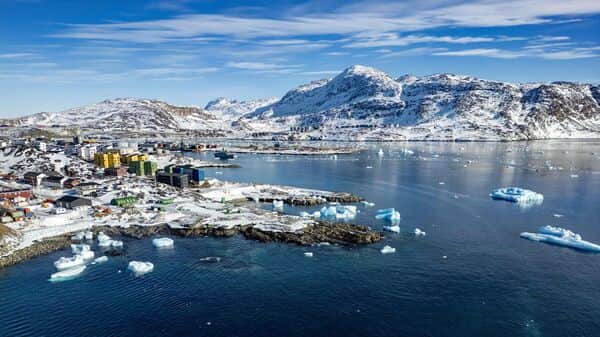
A 2009 law granting expanded self-rule to Greenland also acknowledged its right to independence under international law—an option supported by a majority of Greenlanders. Located northeast of Canada, with more than two-thirds of its landmass inside the Arctic Circle, Greenland has held strategic importance for North American defence since World War II.
During World War II, Greenland’s strategic importance came to the forefront when the United States defended the island from Nazi Germany following Denmark’s occupation, establishing bases crucial for Atlantic defence and weather monitoring.
The U.S. Department of Defence operates the Pituffik Space Base in northwestern Greenland. Built following a 1951 defence agreement between Denmark and the U.S., the base plays a key role in missile warning, missile defence, and space surveillance for both the United States and NATO.
Greenland's position astride the North Atlantic and Arctic makes it a linchpin for global security, particularly in monitoring submarine movements and emerging shipping lanes, according to a report by NBS News.
It forms part of the GIUK (Greenland-Iceland-UK) gap, a critical naval chokepoint that links the Arctic to the Atlantic, is essential for tracking Russian submarines, and maintains NATO's defensive posture.
These emerging routes enhance Greenland’s role as a key hub for both trade and military presence, attracting the attention of global powers eager to expand their influence in the rapidly warming Arctic region.
In 2019, then-U.S. Secretary of State Mike Pompeo noted that these routes could cut shipping time between Asia and the West by nearly three weeks, potentially rivalling the strategic importance of the Suez and Panama Canals.
By around 2050, a direct Transpolar Route across the North Pole could emerge, bypassing both Russian and Canadian corridors and positioning Greenland as a critical hub once again, according to a report by Marine Insight.
While the United States views these routes as commercial opportunities, they also raise significant geopolitical concerns. Rival powers could seek dominance over these Arctic corridors, drawing Washington’s attention.
In response to Western sanctions, Moscow is increasingly aiming to export oil and gas to China via the Arctic, while Beijing looks to reduce its dependence on the Strait of Malacca, a strategic vulnerability, according to a report by Modern Diplomacy.
Trump has argued the U.S. needs to control Greenland to ensure its security in the face of rising threats from China and Russia in the Arctic, as reported by AP.
“It’s so strategic right now,” he told reporters Sunday.
“Greenland is covered with Russian and Chinese ships all over the place,” Trump said. “We need Greenland from the standpoint of national security, and Denmark is not going to be able to do it.”
Greenland is home to vast, largely untapped mineral resources, including 25 of the 34 critical raw materials identified by the European Commission, positioning it as a potential key supplier for green technologies, according to 2023 GEUS (Geological Survey of Denmark and Greenland) report.
Its rare earth element reserves, essential for electric vehicle magnets and wind turbines, are comparable to those of the United States.
Major deposits are located in the southern Gardar province, including Tanbreez (developed by Critical Metals Corp), Kuannersuit (Energy Transition Minerals), and others operated by Neo Performance Materials. If fully developed, Greenland’s resources could potentially supply at least 25% of global rare earth demand, underscoring its strategic economic importance.
The U.S. Geological Survey has also identified potential offshore deposits of oil and natural gas.
Greenland has large deposits of rare earth minerals needed to make everything from computers and smartphones to batteries, solar and wind technologies that will power a transition away from fossil fuels.
Meanwhile, Ulrik Pram Gad, a global security expert at the Danish Institute for International Studies, questioned Trump’s characterisation of the Russian and Chinese presence in the region, AP reported.
“There are indeed Russian and Chinese ships in the Arctic, but these vessels are too far away to see from Greenland with or without binoculars,” he wrote.
Editorial Context & Insight
Original analysis & verification
Methodology
This article includes original analysis and synthesis from our editorial team, cross-referenced with primary sources to ensure depth and accuracy.
Primary Source
mint - news