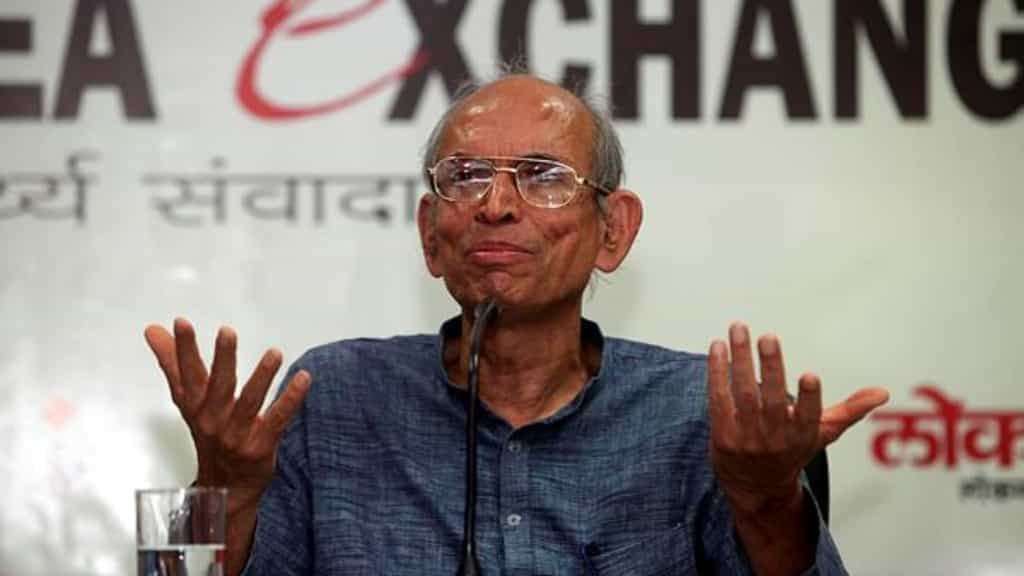
Gadgil’s legacy needs no personal anecdote. His life and influence are etched firmly in his work.
In the long arc of Indian history, only a handful of scientists have truly captured the public imagination. Madhav Gadgil was one of them. In the 2010s, his Report of the Western Ghats Ecology Expert Panel (WGEEP), widely known as the Gadgil Report, commanded newspaper front pages, primetime television debates, heated public meetings, and sharply divided political platforms. Rarely has a scientific assessment been so fiercely attacked and so passionately defended for its intellectual rigour and plain-speaking.
My own encounters with Dr Gadgil were fleeting: One meeting and one short phone call. Yet, like many environmental advocates of my generation, I feel I knew him well — through his ideas, writing, and the institutions he helped build and nurture.
I met him once at the Centre for Science and Environment, sometime after the Western Ghats report was released. We at CSE were critical of certain aspects of the report, and Gadgil had come to engage with us. What struck me during that interaction was not just his formidable intellect, but how deeply personal the issue was to him. The Western Ghats were not an abstract landscape to him; they were a living ecological entity whose degradation he felt morally compelled to prevent.
My second interaction was a phone call in 2021, lasting no more than 10 minutes. I had taken on an assignment to develop an ecological index for India’s forests — one that would define forest health based on biodiversity, ecological functions, and economic dependence, rather than the prevailing canopy-cover-based classification. I desperately wanted Gadgil to review the methodology, knowing that he was not only a leading ecologist but also a mathematician. He listened patiently, became excited about the idea, and then gently declined, explaining that he was fully occupied with writing his autobiography. Even in that brief exchange, his intellectual generosity and curiosity were unmistakable.
Like many others, my own ecological conscience was shaped by reading his books. Dr Gadgil’s two books, co-authored with Ramachandra Guha—This Fissured Land and Ecology and Equity — are foundational texts for understanding India’s ecological history. They advanced ideas that were both radical and intuitive: Sustainable use of natural resources, inclusive conservation, and the concept of ecological refugees — ideas that continue to shape environmental thinking worldwide. They also offered ecological explanations for Indian traditions such as non-violence, vegetarianism, and mixed agriculture. These works profoundly shaped my thinking on natural resource management and reinforced a belief that conservation, when divorced from people, is neither ethical nor effective.
Among his most consequential public policy contributions were the Biological Diversity Act and the WGEEP report. The Biodiversity Act, which sought to empower local communities to manage and benefit from their biological resources, remains poorly implemented. The WGEEP report was shelved largely because it was deemed unimplementable — owing to its recommendations of declaring the entire Western Ghats as an eco-sensitive zone and a governance framework that relied on a new national-level authority, with corresponding institutions at the state and district levels, for enforcement.
My own critique of the Western Ghats report was of the command-and-control governance model, which excluded economic and market-based instruments. Gadgil had an innate distrust of markets to manage ecology sustainably, and his solutions excluded them. At the same time, his deep faith in community stewardship is being tested by a reality in which communities themselves are becoming increasingly industrial and consumerist. These tensions, however, are part of the larger and necessary debate that Gadgil compelled India to confront.
Institution-building was another cornerstone of his legacy. At the Indian Institute of Science, he played a foundational role in building the Centre for Ecological Sciences into one of the country’s most respected hubs for ecological research. Generations of ecologists trained there now influence conservation science, policy, and practice across India.
Gadgil was also a participant in some of India’s most consequential environmental movements. He was part of the scientific scrutiny that questioned the ecological wisdom of damming Silent Valley in Kerala — an intervention that helped save one of India’s richest tropical forests and marked a defining moment in Indian environmentalism.
Madhav Gadgil was a colossus in his field. In an era of accelerating ecological crisis — of climate change, biodiversity loss, and deepening social inequities — we need more Gadgils: Thinkers with intellectual courage, moral clarity, and the willingness to engage with diverse views. His life reminds us that science, at its best, is not merely about understanding the world, but about defending and improving it.
The writer is CEO of the International Forum for Environment, Sustainability, and Technology (iFOREST)
Editorial Context & Insight
Original analysis & verification
Methodology
This article includes original analysis and synthesis from our editorial team, cross-referenced with primary sources to ensure depth and accuracy.
Primary Source
The Indian Express