

Key takeaways
- Time-series foundation models are changing the way forecasting systems are built.
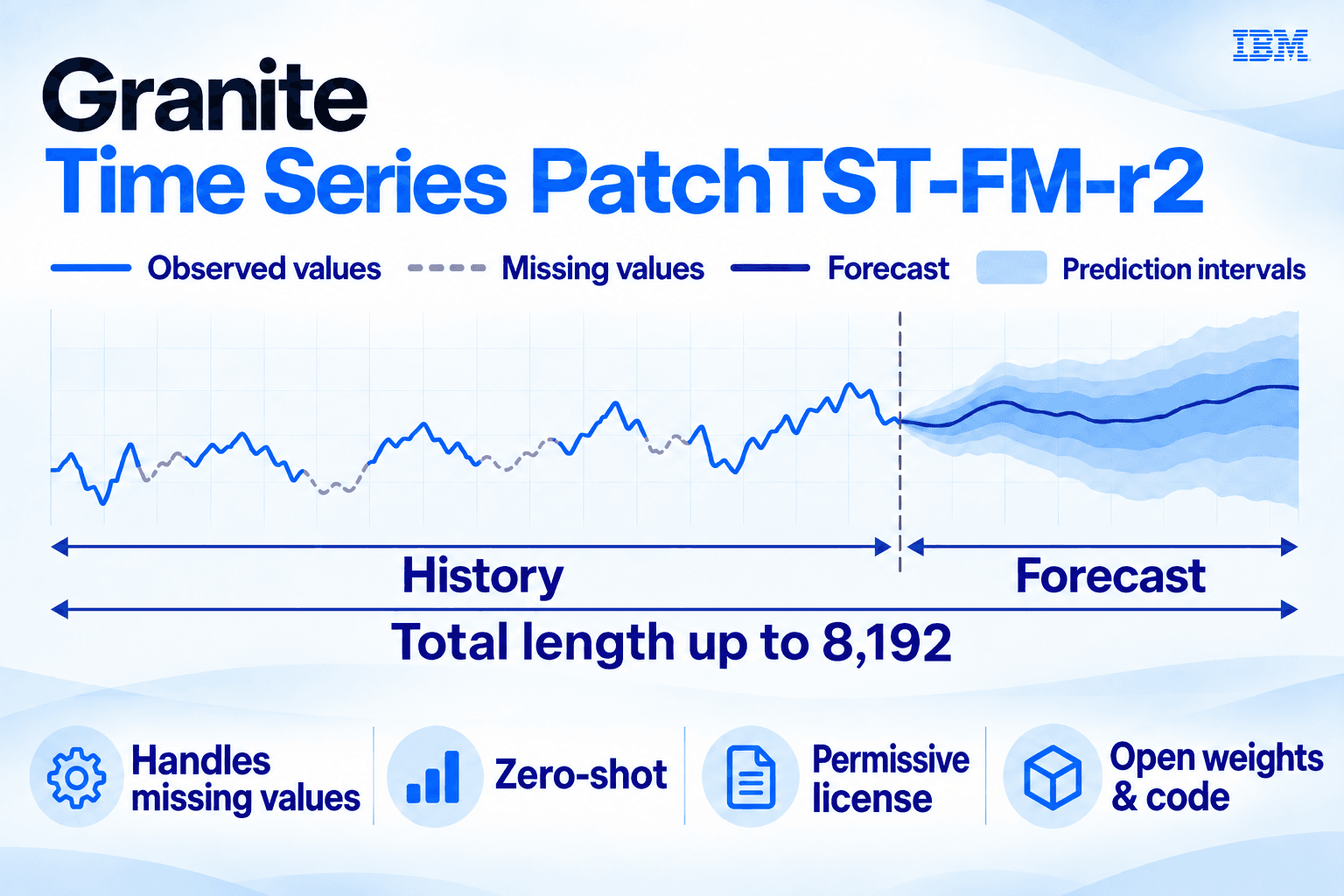
- PatchTST-FM-r2, a new version of its predecessor PatchTST-FM-r1, combines an updated architecture, a larger pretraining corpus…
- The model weights, architecture, inference pipeline, and code needed to reproduce the benchmark results are all available.
What happened
Time-series foundation models are changing the way forecasting systems are built. Instead of training and maintaining a separate model for every dataset, users can use a pretrained model and generate forecasts zero-shot. IBM has released Granite Time Series PatchTST-FM-r2, the latest model in the Granite TSFM family (github, blog).
GIFT-Eval MASE when both zero-shot and pretrained replicable models are considered. PatchTST-FM-r2 retains the patch-based representation that made the PatchTST family effective, but the internal architecture is redesigned to capture long- and short-term relationships efficiently and to smoothen inter-patch predictions — both of which substantially improve error measures. One change is the move from standard transformer layers to layers which incorporate convolution along with the multi-head self-attention.
These layers are referred to as conformer layers and has its origin in speech processing applications. Figure 5. Architectural evolution from PatchTST-FM-r1 to the Conformer-based PatchTST-FM-r2. A PatchTST-FM-r1 block combines multi-head self-attention with a feed-forward network. In r2, we replaced this with a conformer-style block containing two half-step feed-forward layers surrounding multi-head self-attention and a temporal convolution layer.
This gives the model two complementary mechanisms for reasoning over a time series. Self-attention can model long-range relationships between patches, while convolution provides an inductive bias toward local temporal structure. The convolution component can therefore capture shorter-term interactions while allowing attention to concentrate on relationships over longer horizons.
Why it matters
PatchTST-FM-r2, a new version of its predecessor PatchTST-FM-r1, combines an updated architecture, a larger pretraining corpus, probabilistic forecasting, support for imputation of missing values, and strong zero-shot performance in a ~385M-parameter model. 0) among replicable, zero-shot models on the GIFT-Eval leaderboard. GIFT-Eval is a comprehensive time series forecasting benchmark designed to evaluate models across diverse forecasting scenarios; the model ranks #2 overall among replicable, zero-shot models.
The model weights, architecture, inference pipeline, and code needed to reproduce the benchmark results are all available. In this blog we describe the model, dive deeper into the benchmarking results and the model architecture, discuss the training data and licensing, and provide code examples illustrating how to use the model.
Finally, we also highlight how the models from the Granite Time Series family can be used in streaming applications in production setting leveraging Confluent product. A foundation model is most useful when it generalizes to time series it has not been specifically trained on. For that reason, we focus first on zero-shot performance. GIFT-Eval provides a broad evaluation of forecasting models across heterogeneous datasets and forecasting scenarios.
When restricting the leaderboard to models that are zero-shot, replicable, and evaluated without test leakage, PatchTST-FM-r2 ranks second for both CRPS and MASE as of September 8, 2026, as illustrated in Figures 1 and 2 (lower values are better for both metrics). Importantly, PatchTST-FM-r2 is the highest-performing model in the same category among models with permissive, commercial-friendly licensing. Figure 1. GIFT-Eval CRPS for leading replicable zero-shot models.
467, placing it immediately behind TimesFM-3 in this comparison, and first among the models with permissive licenses. Figure 2. GIFT-Eval MASE for leading replicable zero-shot models. 6846. Blue bars denote models released by the IBM time-series foundation-model team. Some models on GIFT-Eval are categorized as pretrained rather than strictly zero-shot. These models are allowed to include the training portions of GIFT-Eval evaluation datasets in their pretraining corpora.
Even when these pretrained models are added to the comparison, PatchTST-FM-r2 remains near the top as seen in Figures 3 and 4: 3rd for CRPS and 4th for MASE among the replicable models. It outperforms several pretrained models, including Chronos-2, Timer-S1, and Toto variants, despite some competing models being considerably larger. Figure 3. GIFT-Eval CRPS when both zero-shot and pretrained replicable models are considered. Figure 4.
What to watch
This phenomenon is observable in attention patterns captured in the transformer and conformer versions (see example figure below using real samples from the ETTh1 dataset). , capturing local relationships, attentions in the conformer block (right in the figure) show long-distance (far-off-diagonal) focus, thanks to the convolution layer covering the short distances.
The conformer blocks in the backbone use alternating convolution kernel sizes of 3 and 5, in a repeating pattern {5, 5, 3, 3}. Figure 6. Comparing attention patterns captured in the transformer (left) and conformer versions(right) using real samples from the ETTh1 dataset.