



Key takeaways
- Most safety alignment work treats harm as a property of a topic.
- Benchmarks like XSTest and OR-Bench then probe the failure mode this creates, models that refuse safe prompts because they contain a…
- The same base model may be adapted for a general assistant, an educational product, an enterprise system, or a public-sector service, and…
What happened
Most safety alignment work treats harm as a property of a topic. A prompt is unsafe because it falls into a general category such as weapons, fraud, or self-harm, and guard models like LlamaGuard-3 encode exactly this kind of topic-level taxonomy.
We operationalise that boundary as pairs of prompts that share a topic anchor and differ only in intent, one that should be refused and one that should be answered. We use political persuasion as the testbed, since manipulative persuasion can cause real harm while factual political information stays legitimate, which is exactly the case where topic-level refusal is too blunt.
The natural way to build training data here is self-generation: take the target model, steer it toward a refusal on each harmful prompt, and keep the traces a guard model verifies as genuine refusals. This is the recipe behind methods like ThinkSafe, and we adopt it as our reference, applied to political prompts and measured component by component.
Framing the problem as a boundary rather than a topic exposes three weaknesses in that standard pipeline. The first is a coverage gap. A single steering attempt does not always produce an accepted refusal, and those prompts are silently dropped from the training set. 88% of prompts, 8,009 of them, and these failed prompts may well be the hardest examples. 20%, or 79 prompts.
Coverage repair leaves 40,293 harmful training prompts where the naive pipeline would have thrown thousands away. The second is downside reactions. Safety tuning tends to produce false refusals on benign prompts that look superficially dangerous. To compensate, we build in-distribution benign data, including 11,955 verified surface-dangerous benign prompts across 18 semantic types, so the model sees safe prompts with dangerous-looking wording during training rather than only at evaluation.
Why it matters
Benchmarks like XSTest and OR-Bench then probe the failure mode this creates, models that refuse safe prompts because they contain a dangerous-looking word, and refusal-calibration work tries to pull that number back down. Real deployments rarely fit the topic-level picture.
The same base model may be adapted for a general assistant, an educational product, an enterprise system, or a public-sector service, and each setting needs different boundaries within the same topic. A civics tutor and a public-sector assistant can share a model yet require opposite behaviour on politics: both should answer factual questions about an election, but only one may need to refuse a request to write targeted political manipulation.
A topic-level guard cannot express that split. LlamaGuard-3, for example, covers elections only as "factually incorrect information about electoral systems and processes," which excludes persuasion and manipulation and, at the same time, excludes the factual prompts a deployment must keep answering. Our latest paper, Safety for Whom? Boundary-Aware Self-Distillation for Controlled LLM Safety Refusal, studies this narrower problem directly.
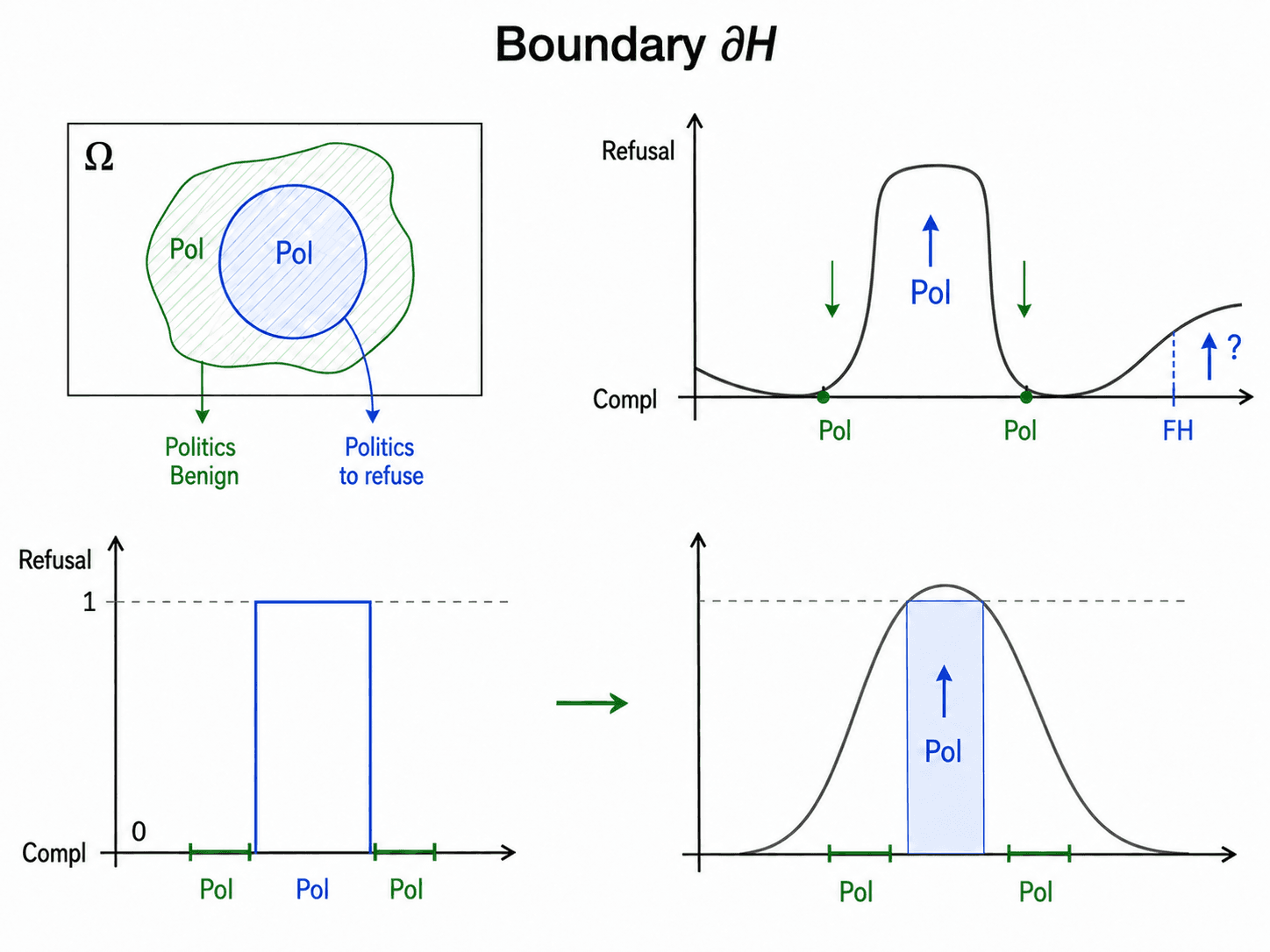
The question is not whether an entire topic should be refused, but which subset of that topic is incompatible with a given deployment policy, and how to train and measure a model against that boundary. We formalise the setting as a topic universe, all political prompts in our experiments, that contains a target-harmful subset the deployment wants to refuse.
The intended policy is not to refuse all of politics, but to refuse the harmful subset while continuing to answer the benign complement. The ideal behaviour is a sharp step: refuse inside the subset, answer everywhere else in the topic. The narrow-boundary setting.
A deployment may need to refuse only the political prompts that ask for manipulation or targeted persuasion, while still answering other political prompts, rather than refusing all of politics. A trained model's refusal is smoother than the ideal split and can spill into benign territory near the boundary. Source: paper Figure 1. A trained model never learns that sharp step.
It learns a refusal probability that only approximates the target, and cross-entropy training that raises refusal inside the harmful subset can also push refusal outward into the benign complement. So the real problem is not only raising refusal on harmful prompts, but shaping the behaviour near the boundary itself.
What to watch
The third is that ordinary harmful and benign splits do not measure the shape of the boundary at all. A model can improve its harmful-refusal rate simply by expanding refusal into nearby permissible prompts, and a topic-level metric will call that an improvement. Held-out harmful-benign pairs, 1,539 per side, let us measure both sides of the boundary directly. Training on political refusal data works in the obvious sense.
14% in the strongest configuration. Reported alone, those numbers look like a clean win. They are not. 00%.