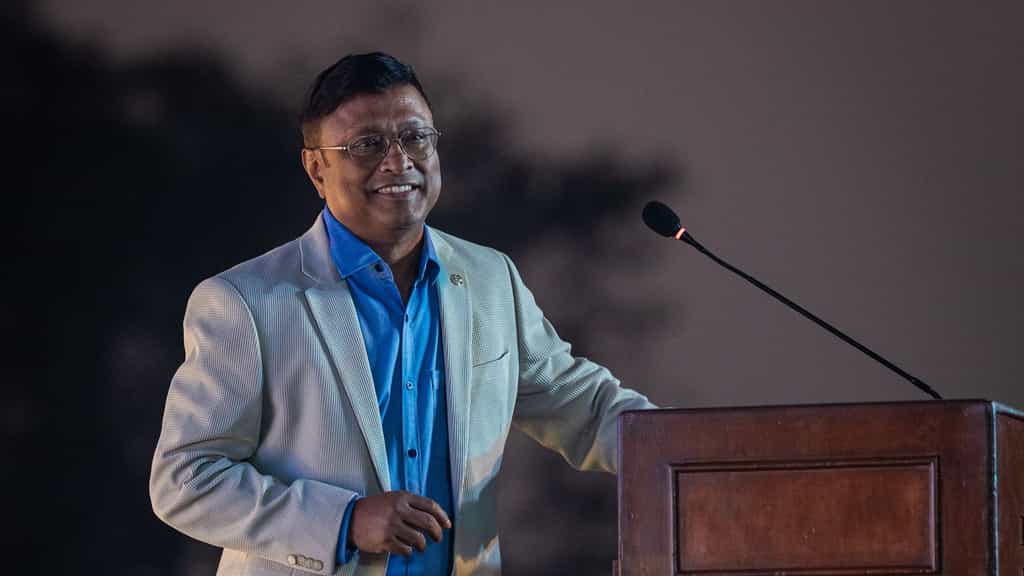
London’s Guildhall School of Music and Drama was thick with tension that morning in 1982. Everyone was waiting for a 15-year-old schoolboy who was running late. To save a few pounds, he and his father had lodged far from the city.
When he finally burst in, little did the gathered crowd know that the unassuming teenager would soon stun the chess world. But Dibyendu Barua would topple Soviet titan Viktor Korchnoi at the 6th Lloyds Bank Masters. The feat was reported by The New York Times as ‘Indian Turn Korchnoi Into Hastings Pudding.’
Korchnoi was World No. 2 at the time. To this day, many consider him the strongest player never to have been World Champion. He was 51 then but still a formidable force, and was stunned.
Rani Hamid, the legendary Bangladeshi women’s chess player whom Barua regarded as an aunt, wanted a photograph with Korchnoi, who was offering the Indian some unsolicited advice after the contest.
“His face was red, still disturbed by the loss. When Rani Hamid came up for a picture, Korchnoi refused with a straight face,” Barua remembers.
Barua had come into the spotlight three years earlier, when he received an invitation to the World Junior Championship in Mexico. The Indian government offered no financial support. For a family sustained by his father Benoy Barua’s modest income from a printing business, raising the required amount – well over a lakh – was a daunting task.
But Barua Senior, defiant in the face of those who told him he was wasting his time, effort, and money, took it upon himself to send his son to Mexico for his first major opportunity.
“My father took a loan. His friends came to our support. Then people learned I was struggling for funds, and somehow it was published in a local newspaper. A Bengali association in Dubai heard about our difficulties and chipped in. A Bengali doctor helped us tremendously, and somehow I was sent to Mexico. I was 13, on my first trip abroad,” Dibyendu recalls.
Barua did not return empty-handed. He brought home a bronze, the first medal for India at that level.
Benoy’s faith in Dipu (Dibyendu’s nickname) was not formed overnight. He had watched the boy win the sub-junior, junior, and senior state championships in succession in 1978, thus qualifying for the National Championship B that same year. An impressive performance at the Pollachi event then earned him a spot in the National Championship A, India’s premier tournament. At just 12 years of age, he was the youngest player to do so.
In the mid-1980s, the race to become India’s first Grandmaster was at its peak. There were only two contenders: Barua and a teenager from Chennai named Viswanathan Anand.
While Anand became India’s first Grandmaster in 1988 and later a world champion, Barua’s career followed a different trajectory. He earned the Grandmaster title in 1991, but not before facing his share of disappointments. At the 1988 Olympiad in Thessaloniki, Greece, Barua’s first, he missed his first GM norm. In the final round, he needed a victory, but botched up a winning position. It was then that words of motivation came from his friend and competitor Anand.
“I was disappointed and sitting alone when I felt a pat on my back. It was from Anand, who was also my roommate at the event. He came and said, ‘Dipu, don’t worry. You are pretty close to being a GM. You are already knocking on the door. You are almost there,’” Barua remembers.
Barua is an omnipresent figure at the Tata Steel Chess India event. He attends to guests, listens to the concerns of parents accompanying their children for the Open tournament, watches games, distributes prize money, and even escorts players to the media zone, functioning as a journalist in the process.
He loves doing it all. Since its inception in 2005, the Dibyendu Barua Chess Academy (DBCA) has hosted the ‘Chess For Youth’ event every year. He also organises two Open classical rating tournaments, as well as an event for senior citizens. The latter is especially close to his heart.
“I realised we didn’t have a tournament for them. They get so bored sitting at home. I wanted to do something for them. They don’t play for money… but purely for the joy of it. We don’t even charge them an entry fee. They truly enjoy their time at the event. The prize money for this tournament doesn’t come from any sponsor but from my own pocket, because I wanted to give something back. I still remember how my father’s friends helped me get to my first international event. I started this tournament as a tribute to my father,” he shares.
Editorial Context & Insight
Original analysis & verification
Methodology
This article includes original analysis and synthesis from our editorial team, cross-referenced with primary sources to ensure depth and accuracy.
Primary Source
The Indian Express