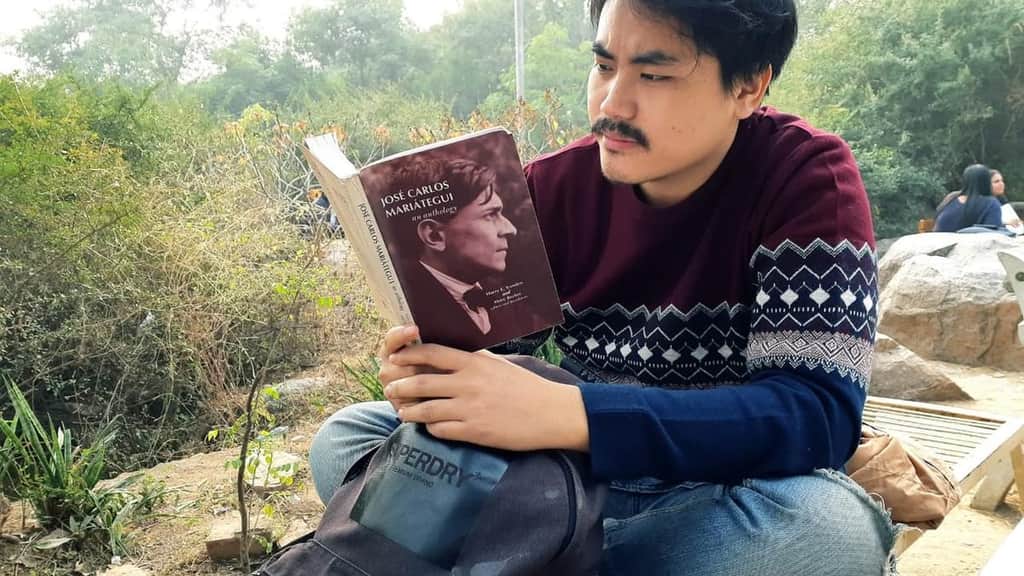
“Why don’t you talk in an Indian accent?”, “Are you Chinese?” are the kind of remarks George Chakma, Kalyan Chandra Kaman, and many other students from the Northeastern States encounter regularly while studying and living in other parts of the country.
In the aftermath of Anjel Chakma’s death, students from the Northeast studying in other parts of the country describe a daily life shaped as much by routine as by quiet vigilance. College campuses, hostels, rental houses, and public transport - spaces meant to be ordinary for all, often become sites of racial scrutiny, where appearance and accent invites intrusive questions, mockery, or suspicion for students from the North East.
Mr. Kaman, a native of Lakhimpur, Assam, has been living outside the State since 2021 for studies. After completing his undergraduate education in Kolkata from National Institute for Locomotor Disabilities, he is currently pursuing a postgraduate education in Public Health at the Tata Institute of Social Sciences (TISS) in Mumbai.
Mr. Kaman speaks of being routinely misidentified on campus. Students from the Northeast, he said, are often singled out for their facial features and labelled “foreigners” (non-Indians) based solely on appearance, which is an assumption he has faced himself. He recalls being subjected to casual slurs, frequently framed as jokes and passed off as harmless banter among friends.
Over time, such experiences shape how many students navigate life in the city, influencing where they go and with whom. For some, this means avoiding certain neighbourhoods altogether and confining social interactions largely to familiar circles that offer a sense of safety.
Mr. Kaman belongs to the Miri (Mising) tribe from Assam and speaks Mising at home. Mr. George, meanwhile, a member of the Chakma community from Tripura, he speaks Chakma at home.
Drawing on his experiences in both Kolkata and Mumbai, Mr. Kaman said that in Kolkata, many of the racial comments he encountered came from people who were themselves not originally from Kolkata. He observed that this was partly shaped by the city’s demographics, noting that in parts of north Kolkata, residents often share physical features similar to those of people from Assam and other Northeastern states.
He also mentioned that some friends casually refer to him using terms such as “chinki” or “momo,” often without intending to be explicitly racist, but having normalised these phrases through repeated use. He said, “TISS campus is comparatively milder, with little overt racial discrimination but has normalised remarks framed as jokes in everyday interactions ... .if I take offence, I will eventually have no friends, so I choose not to say anything”.
Most incidents do not escalate into physical violence, outright racial slurs or discrimination but are the cumulative effect of the more “subtle,” versions as Mr. George, said. Such incidents create an equal sense of insecurity which cements the fear that what happened with Anjel Chakmaa was not an isolated act but part of a broader pattern of racial hostility that remains largely unaddressed. “Is it only an issue when it happens outrightly..….it is only in notice when something big happens”, Mr. George says.
Mr. George is a native of Tripura and a Ph.D. scholar at Jawaharlal Nehru University (JNU). He left the State in 2014 to pursue undergraduate education at JNU, went on to complete his postgraduate degree at Jamia Millia Islamia during the CAA–NRC protests, and later returned to JNU for his M.Phil and Ph.D. He is also the convenor of the Northeast Students’ Forum at JNU.
Mr. George said he has met fellow students on campus, including Ph.D. students, who have little to no awareness of the Northeast States. He noted that States such as Manipur and Assam are relatively familiar but Tripura remains unknown and not very heard of and is “a blackhole of a place”.
He recalled being asked whether Tripura was located in the south of the country; “is it a south Indian city?” and, on another occasion, “Does it snow there?”. Mr. George responded with a sarcastic “yes,” recognising the broader sense of ignorance behind such questions. The repeated, playful, sarcastic “yes” has since become his quiet, habitual response to misconceptions about the region.
Mr. George recalled another incident when a batchmate seriously asked “why don’t you speak in an Indian accent?.” At the time, he said he was too naïve to recognise the question as part of a deeper problem; one rooted in the assumption that speaking with a particular accent defines who is considered Indian.
He noted that such bias continues to persist, often implying that the Northeastern States exist outside the country’s mainstream imagination. Mr. George also mentioned being told, as a supposed compliment, that he had a “normal accent,” a remark that reinforced the idea that the accent of the majority is treated as the standard. The episode, he said, raised larger questions about how notions of what is ‘normal’ are shaped by dominance and visibility rather than diversity.
Speaking of everyday microaggressions, Mr. George said that even routine interactions often carry subtle forms of exclusion. He noted that shopkeepers sometimes ignore him when he enters a store, choosing not to attend to him immediately. While such encounters rarely involve outright hostility or explicit aggression, he said assumptions based on appearance are common. He mentioned that shopkeepers and auto drivers often quote prices after making a quick judgement based on how a person looks.
Mr. George lives in a rented apartment, cooks food from his own culture, and spends much of his time on campus, moving between the library and his academic work as he completes chapters of his Ph.D.
Sharing a bit from Jamia during the CAA–NRC protests, Mr. George said that his presence at demonstrations was sometimes treated as a marker of inclusivity. “As their protest has become super inclusive because I am there…even media persons were approaching disproportionately to get a byte,” he said.
When asked about friendships on campus, Mr. George said that while many of his closest friends are from outside the Northeast, he understands why students often gravitate towards those from the same community. He noted that when students from the Northeast socialise together, they tend to become hyper-visible on campus. Mr. Kaman added in this observation, saying he has noticed a similar pattern at his campus, where limited acceptance and uneven inclusivity often push students from the Northeast to seek safety and familiarity within their own regional or community groups.
Mr. Kaman said he makes a deliberate effort to spend time with friends from outside the Northeast and often visits their homes when invited. During one such visit to a friend’s house in Mumbai, a young child asked him if he was Chinese. The question stayed with Mr. Kaman, because it revealed how early and casually such perceptions take shape, even in a child’s mind. Mr. Kaman said, “I was shocked and thought that it is better to stop going to people’s houses.”
Does the silence around the hills extend to campuses such as TISS and JNU?
Mr. George pointed out that issues from the Northeast rarely draw sustained attention on campus unless they reach a threshold of extreme violence. “Unless it is a ‘big and nasty’ issue, it won’t be attended to,” he said, adding that atrocities from other regions are often discussed more readily. According to him, concerns from the Northeast tend to surface only when they involve major incidents such as rape, murder, or large-scale violence like the ethnic clashes in Manipur. “There has to be something huge and nasty to get attention,” he said. “Sometimes they even talk about it, but it does not sustain. It melts down.”
In the case of Anjel Chakma’s death, Mr. George said there was a sense of consensus. An evening protest was organised on campus, drawing participation from students across regions. “Everyone was on the same page,” he said, noting that the presence of students from outside the Northeast marked a moment of collective acknowledgement.
Reflecting on campus culture more broadly, Mr. George mentioned that National institutions such as JNU are often expected to be more inclusive and less tolerant of racial discrimination, while JNU is “an extension of the society outside.” Asked whether JNU feels like a safer campus, Mr. George said, “It used to be slightly better… many things are changing.”
Mr. Kaman offered a comparative view of the TISS, describing it as relatively “safe.” He noted that during orientation, students are explicitly guided on issues of racial bullying, inclusivity, and gender sensitivity. “TISS is careful,” he said.
Mr. Kaman observed that students from the Northeast are often welcomed into right-wing spaces when they speak in favour of those groups but also mentioned that this inclusivity is conditional. When students do not align politically, narratives like Christian conversion in the Northeast are frequently invoked instead.
Describing his own approach to campus life, Mr. Kaman said he is an extrovert who consciously tries to build and maintain relationships, even when jokes are made at the expense of his culture.
When asked about his career plans, Mr. Kaman said he had initially come to TISS for its well-known placement opportunities and added that employment prospects in the Northeast remain limited. “I have unofficially dropped out of placement drives,” he said, explaining that he does not want to move to States where racial stereotypes against people from the Northeast continue to persist.
Mantasha Ahmed is an independent journalist based in Indore with five years of experience. She reports on the critical intersections of education, civil rights, social issues, and culture.)
(Sign up for THEdge, The Hindu’s weekly education newsletter.)
Editorial Context & Insight
Original analysis & verification
Methodology
This article includes original analysis and synthesis from our editorial team, cross-referenced with primary sources to ensure depth and accuracy.