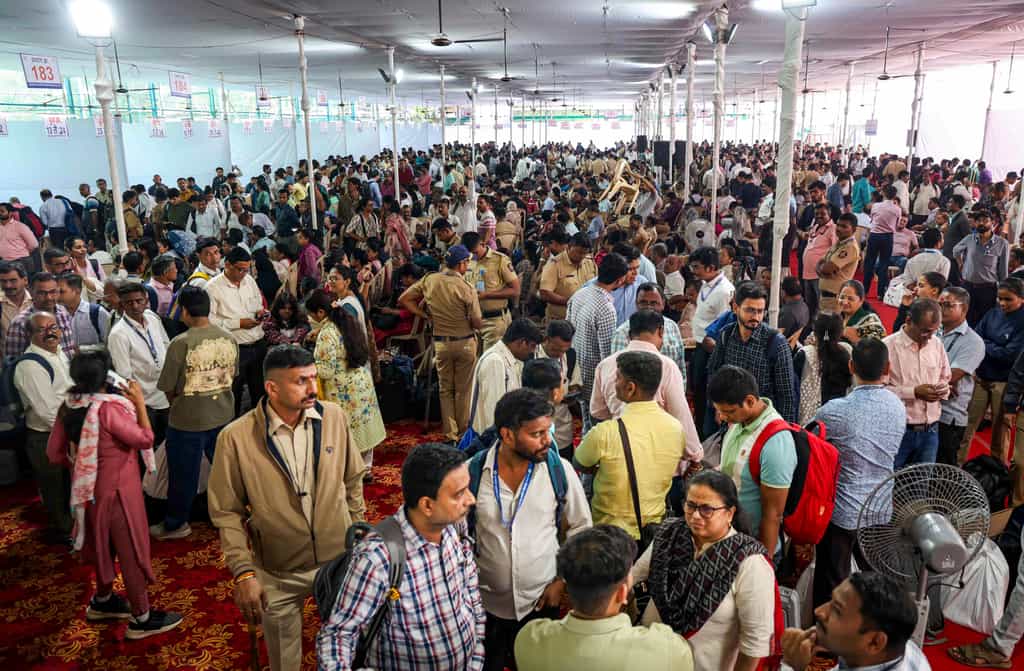
Polling officials gather to collect EVMs and other election material at a distribution centre, a day before Brihanmumbai Municipal Corporation (BMC) elections, in Mumbai, Wednesday, Jan. 14, 2026. (PTI Photo)
After a gap of more than four years, Mumbai goes to polls on Thursday to elect a new general body of the Brihanmumbai Municipal Corporation (BMC), bringing an end to prolonged administrator rule and setting the stage for a high-stakes political battle in the country’s financial capital.
Over 1.03 crore voters will cast their ballots across 10,231 polling booths to elect 227 corporators, with around 1,700 candidates in the fray. Polling will be held from 7.30 am to 5.30 pm, with counting scheduled for Friday.
The election is being closely watched as more than just a civic contest. With a 2025-26 budget exceeding Rs 70,000 crore, the BMC is India’s richest municipal body, and control over it carries enormous political and administrative influence. For several parties, the outcome will determine political relevance, identity and future survival in Mumbai.
For over two decades, the undivided Shiv Sena controlled the BMC, using it as its principal power base to build organisation and influence city politics. However, the 2022 split in the Shiv Sena, when Chief Minister Eknath Shinde rebelled against then CM Uddhav Thackeray, has transformed the civic polls into a direct contest over legacy and legitimacy.
Shinde later secured the Shiv Sena name and bow-and-arrow symbol, while Thackeray’s faction was renamed Shiv Sena (UBT) with the mashaal symbol. The split weakened the Sena (UBT) organisationally, reflected in its reduced tally in the recent Assembly elections.
For Uddhav, the BMC polls are widely seen as a fight for survival and a chance to reclaim Mumbai as his party’s traditional stronghold. For Shinde, wresting control of the civic body would cement his authority over the Sena’s original organisation and validate his rebellion.
Despite setbacks, the Sena (UBT) retains a foothold in the city. Of Mumbai’s six Lok Sabha MPs, three belong to the Sena (UBT), and the party has 10 of the city’s 36 MLAs. Political analysts say the BMC election will decide which faction can truly claim Bal Thackeray’s legacy in Mumbai.
This time, the civic polls have turned into a multi-cornered contest involving three major fronts: the BJP and Shinde-led Shiv Sena; Shiv Sena (UBT), MNS and NCP (SP) alliance campaigning on Marathi identity and unity; and Congress and Vanchit Bahujan Aghadi (VBA) aiming to consolidate minority and anti-BJP votes.
With state-level alliances breaking down at the ward level, many seats are witnessing straight fights or three- and four-cornered contests. Narrow margins are expected in several wards, making rebels, independents and local equations crucial.
The coming together of Uddhav Thackeray and Raj Thackeray has added a strong Marathi identity pitch to the campaign. The MNS, by aligning with the Sena (UBT), has emerged as a decisive factor in several wards where consolidation of Marathi votes could swing results.
Observers say even a modest consolidation could impact closely contested seats.
For the BJP, the BMC polls are about expanding its footprint and potentially breaking the Shiv Sena’s long dominance over Mumbai. Despite ruling at the Centre and in Maharashtra, the BJP has never independently controlled the BMC.
In the 2017 civic elections, the undivided Sena won 84 seats, while the BJP closely followed with 82, highlighting Mumbai’s finely balanced politics. With the Sena vote now split, the BJP hopes to emerge as the single largest party.
Party leaders see control of the BMC as key to aligning Mumbai’s civic administration with the state and Centre, enabling smoother execution of large infrastructure projects and strengthening the BJP’s long-term presence in the city.
The Congress, contesting largely on its own, is aiming to remain relevant in a fragmented contest. The VBA hopes to make gains in select pockets, while smaller parties and independents are expected to influence outcomes in several wards.
Some wards have only two candidates, while others, such as Dharavi’s ward 188, have as many as 20 candidates. Several seats are also witnessing direct contests between incumbent corporators from the 2017-2022 term.
Gearing up for the polls, the civic body has deployed 64,375 staffers across departments on election duty. In a bid to ensure cleanliness across the city’s polling stations, the BMC’s solid waste management department has pressed sanitation works, pink army teams and sweepers. According to officials, over 4,000 toilets alongside dustbins with wet and dry waste segregation will be deployed across the city with each toilet to be cleaned at regular intervals to prevent odour across the city’s polling centres.
On Wednesday, civic authorities stated that processes pertaining to distribution of ballot boxes and election material were concluded across 23 divisional centres, which are being headed by returning officers. In the upcoming polls, the civic body will be deploying new devices equipped with Printing Auxiliary Display Unit (PADU) technology across all stations. Typically, the Electronic Voting Machine (EVM) system comprises a control unit (CU) and a ballot unit (BU).
After the voting concludes, the counting process will commence on Friday across 23 zonal centres where the results for the 227 seats will be declared.
Editorial Context & Insight
Original analysis and synthesis with multi-source verification
Methodology
This article includes original analysis and synthesis from our editorial team, cross-referenced with multiple primary sources to ensure depth, accuracy, and balanced perspective. All claims are fact-checked and verified before publication.
Primary Source
Verified Source
The Indian Express
Editorial Team
Senior Editor
Aisha Patel
Specializes in India coverage
Quality Assurance
Copy Chief
Fact-checking and editorial standards compliance