The gunmen behind the mass shooting at a Jewish celebration in Sydney on Sunday were motivated by “Islamic State ideology,” Australia’s prime minister said on Tuesday.
Prime Minister Anthony Albanese said the suspects appeared to have been radicalized by beliefs associated with the Islamic State militant group.
It has been eight years since the Philippines declared victory over the Islamic State, or ISIS. But the threat from ISIS has become smaller and fragmented, with lethal attacks by militants linked to the group rocking the country intermittently.
On Tuesday, that threat came under fresh scrutiny.
The suspects in the Bondi Beach massacre in Sydney, Australia, were motivated by ISIS and had traveled to the Philippines, Australian officials said. The Philippine authorities then said that the two men had traveled to the city of Davao last month. It remains unclear what they were doing there.
Sajid Akram, an Indian national, and Naveed Akram, an Australian citizen, arrived in the Philippines together on Nov. 1 from Sydney, said Dana Sandoval, a spokeswoman for the Philippine Bureau of Immigration. The men left the country on Nov. 28, flying to Sydney via Manila, Ms. Sandoval added.
Davao is the largest city on the southern island of Mindanao, where Muslim insurgents have long sought to carve out an independent state. In 2017, ISIS fighters held siege to the city of Marawi in Mindanao for five months, prompting the Philippine government to unleash an all-out war, killing key leaders and forcing combatants to surrender.
Hundreds of Islamic State fighters remain in the Philippines, a Catholic-majority country, according to experts. The groups continue to recruit, leveraging local poverty and historical political grievances in Mindanao.
The terror groups have shifted gears — they have become smaller and factionalized, but still hold an allegiance to the Islamic State.
And they have continued to target police forces and Christian places of worship. In 2023, Islamic militants detonated an explosive device during a Catholic Mass at Mindanao State University in Marawi, killing four people and injuring dozens.
Rommel Banlaoi, an antiterrorism expert in the Philippines, said there was a shift in militancy movements in the region after the Marawi siege.
“Before, the focus was on creating an Islamic state. Now it has transformed to helping Muslims, Palestinians displaced by the Middle East violence,” Mr. Banlaoi said.
In recent years, the government has sought to offer some of these fighters opportunities for peaceful reintegration. Many of these militants have surrendered because of exhaustion and disillusionment with the failed attempt to establish an Islamic caliphate.
The Philippines also established the Bangsamoro Autonomous Region in Muslim Mindanao to give residents a sense of greater political autonomy and to strip extremist groups of their support base, even though the first local election was repeatedly delayed because of the fragile peace process.
A white Toyota Prius parked in the driveway. Boots piled by a welcome mat. Footsteps and muffled voices. A masked man briefly emerging to collect a food delivery, before vanishing back inside.
On Tuesday morning, these were the only signs of life at the family home of the Bondi suspects in Bonnyrigg, a diverse, working-class, suburb of Sydney about 30 miles west of the beachside park where Sunday’s attack took place.
Outside the home, teenagers rode past on bicycles, a couple of neighbors walked by, and a postal worker (who said he had interacted with the family but was not allowed to speak to the media) came through riding an electric vehicle. A large group of reporters was staked out nearby.
Earlier that morning, a seemingly bewildered delivery driver arrived at the house with what clearly was intended to be an offensive message to a Muslim family: a $42 half leg of ham with a message that included a racial slur, the reporters said. The ham, in a paper bag decorated with Christmas gingerbread men, remained on the footpath outside the home. The family did not answer the door.
Two neighbors said they believed the family had moved in a year or so ago, and that they had largely kept to themselves.
“No dramas,” Glenn Nelson, who lives across the road, said about his impressions of the suspects. Mr. Nelson, 65, who has been a resident of Bonnyrigg for nearly four decades, described it as a peaceful and aging community. He said that he occasionally saw a father and son outside the house, but had never spoken to him or any other members of the family.
He and another neighbor said that a few hours after the shooting on Sunday night, several police cars with flashing lights cordoned off the street. Sometime after midnight, Mr. Nelson said, the authorities told the family to come out of the house with their hands up. He said he saw three people — two women and a man — come out of the house.
Max Kim contributed reporting.
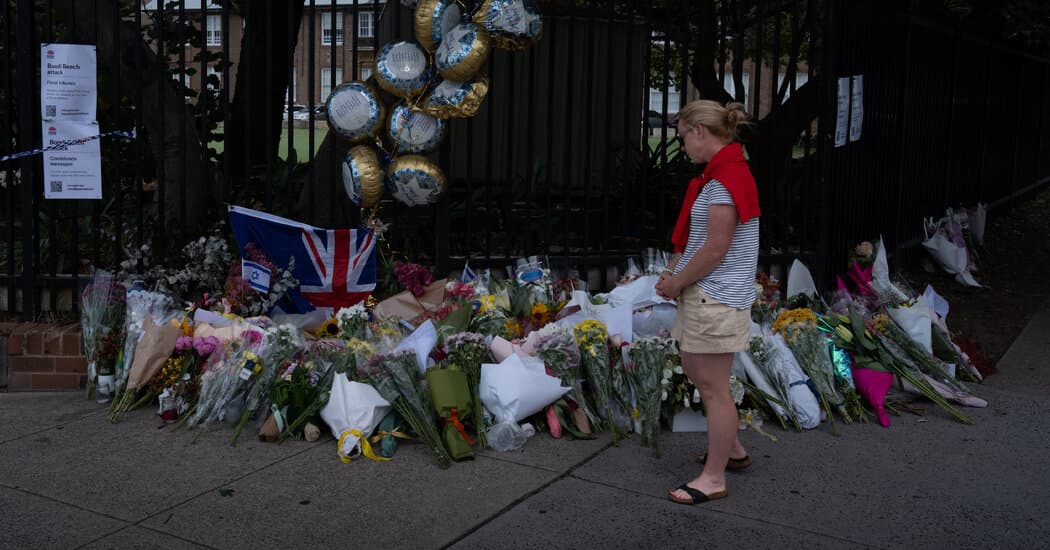
John Howard, a former prime minister of Australia, attended a vigil at Bondi Beach and laid flowers on Tuesday. Earlier, at a news conference, he criticized the Albanese government’s approach to fighting antisemitism.
The home of the Bondi suspects’ family is on a quiet residential street in Bonnyrigg, an outer suburb of Sydney. On Tuesday morning, a large group of reporters was camped outside the residence, a single-family brick home with a welcome mat. No one responded to the doorbell, but muffled voices and footsteps could be heard inside.
Chris Minns, the New South Wales premier, said two police officers who were shot during the attack remain in critical care.
The vehicle the gunmen used was registered to the younger man, Commissioner Lanyon said. It contained two homemade ISIS flags, he added.
Prime Minister Anthony Albanese said that he had met with Ahmed el Ahmed, the man who wrestled the gun away from one of the gunmen. Ahmed will undergo surgery to treat his injuries tomorrow, Albanese said.
Chris Minns, the New South Wales premier, said that there have been 50,000 appointments to donate blood in the state after the Bondi shooting.
Prime Minister Anthony Albanese vowed on Monday to toughen Australia’s already strict gun laws, after the country’s worst mass shooting in three decades killed 15 people and wounded dozens more at a Jewish holiday celebration in Sydney.
“The government is prepared to take whatever action is necessary,” he said at a news conference.
“Enough with this antisemitic violence!” Pope Leo said in a social media post on Monday, referring to the attack in Sydney. “Let us eliminate hatred from our hearts.”
Ahmed el Ahmed crouched behind a car in a Sydney parking lot on Sunday, feet away from one of the two gunmen who had just turned a beachside Hanukkah celebration into a massacre.
Then, sirens wailing in the background, Mr. el Ahmed jumped into action.
Even as the gunman fired a shot in a different direction, Mr. el Ahmed ran toward the assailant and pounced on him from behind. The two men tussled for several seconds before Mr. el Ahmed wrested a long firearm from the man, who fell to the ground. As Mr. el Ahmed pointed the weapon at him, the assailant got up and stumbled away.
Mr. el Ahmed — whose actions were caught on a video that has been verified by The New York Times and who was identified on Monday by Australian officials — is being praised as a hero in one of the deadliest terrorist attacks in Australian history.
In the aftermath of the mass shooting, which left the country and its Jewish community reeling, Mr. el Ahmed’s bravery provided much-needed solace.
Mr. el Ahmed, a Syrian-born fruit seller, risked his life and likely prevented the massacre from being even worse, officials said.
“At the best of times, what we see is Australians coming together,” Prime Minister Anthony Albanese said at a news conference, referring to the risks that Mr. el Ahmed took, adding that he had been hospitalized with a “serious injury.” It was not immediately clear how he had been hurt.
Footage of Mr. el Ahmed’s intervention was shared widely across social media and even made its way into the White House, where President Trump called Mr. el Ahmed “a very, very brave person.”
Mr. el Ahmed is an Australian citizen who immigrated from Syria in 2006 and has two daughters, aged 3 and 6, his parents told the Australian Broadcasting Corporation. He had been drinking coffee with a friend near the beach when he heard gunshots, they added.
Chris Minns, the premier of the state of New South Wales, who visited Mr. el Ahmed in the hospital, said he had “saved countless lives.” In a picture that Mr. Minns posted on social media, Mr. el Ahmed looks alert and appears to be partially upright and speaking.
A GoFundMe page that was set up to support Mr. el Ahmed has raised more than 1.4 million Australian dollars, or about $930,000 — including roughly $66,500 from Bill Ackman, the billionaire investor, according to the fund-raising company.
GoFundMe said in an email that it was working with the organizers of the page to “help ensure funds raised safely reach Ahmed and his family.”
At St. George Hospital, where Mr. el Ahmed was being treated, Talia Gill and her 10-year-old daughter, Georgie, said in an interview that they were leaving gifts and a letter for him. The attack struck close to home for Ms. Gill, who is Jewish and who had friends who were in Bondi when the shooting occurred.
Georgie said she wanted to tell Mr. el Ahmed, “Thank you so much for saving all those people you didn’t even know.” She added, “You’re probably the kindest person ever.”
It was the kind of Sunday evening cherished by the Sydneysiders who call Bondi Beach home: groups of friends lolling in the sand, surfers in dripping wet suits trudging back aground, gleeful children tittering to the backdrop of soft crashing waves.
On a grassy park with a playground on one end of the beach, a well-worn tradition was underway — an annual beachside Hanukkah celebration, where hundreds of people, from toddlers to grandparents, enjoyed the first night of the festival of lights with music, face painting, a giant menorah and barbecue.

