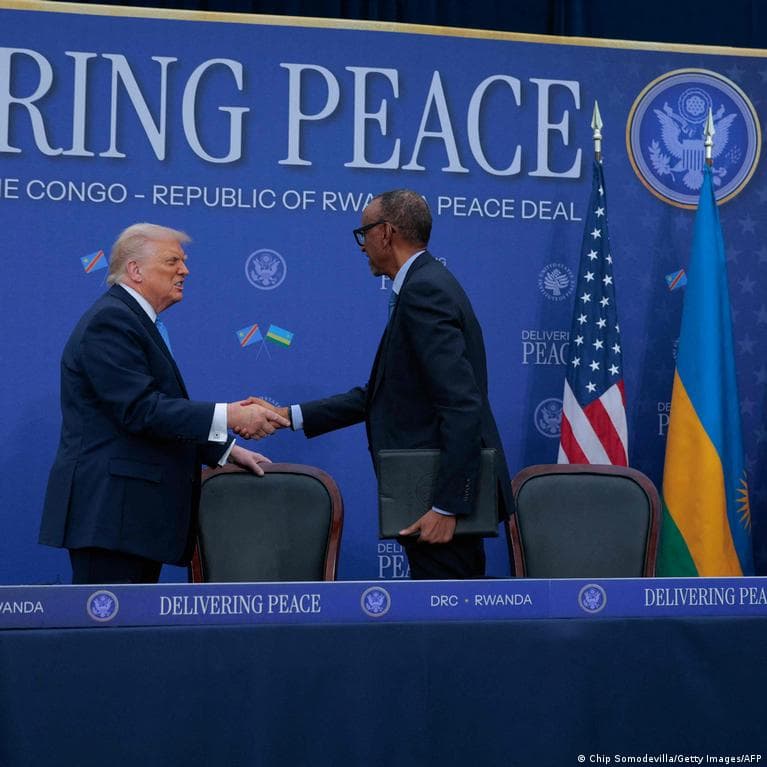
"Today we have succeeded where so many others have failed," US President Donald Trump declared jubilantly as the presidents of Rwanda and the Democratic Republic of Congo (DRC) signed a peace agreement earlier this month which, according to White House calculations, marked the eighth war ended singlehandedly by the US leader.
However, across the Atlantic, the term "peace" remains elusive in many parts of the African continent, including the DRC.
Instead of celebrating the agreement signed on December 4, people in eastern DRC remained sheltered in their homes, gripped by fear of what to expect next, as animosities continue.
In the week following the peace agreement, more than 500,000 people were displaced across the region, according to the UN Office for the Coordination of Humanitarian Affairs (OCHA).
To view this video please enable JavaScript, and consider upgrading to a web browser that supports HTML5 video
"The signing [of the peace deal] triggered renewed fighting between rebels and DRC defense forces. The result was the rebels taking control of new territories, including the city of Uvira," an anonymous source from a humanitarian organization operating in the DRC told DW. On Tuesday, reports indicated that M23 fighters were preparing to withdraw from the strategic city, following a request from US mediators.
"It seems more like a political agreement based on the result of American pressure than a real peace process or agreement," the aid worker added.
But the DRC isn't the only place where Trump's rhetoric about ending wars and establishing order seems to be smoke and mirrors.
Following a peace ceremony sponsored by the White House in October, more than half a million people have fled renewed border clashes between Cambodia and Thailand, which also held on the other side of the hemisphere, with reports on the ground pointing to continued clashes despite reassurances issued by the Trump White House to the contrary.
Violations of the ceasefire terms between Israel and Hamas have also been recorded in recent weeks, and Trump's perception of the US's role in the brief war between Israel and Iran earlier this year reflects the Islamic Republic's lack of military capabilities to retaliate against Israel rather than a true peace initiative of sorts.
Of the eight wars that Trump claims to have ended, two were not even real conflicts at all: There was no state of war between Egypt and Ethiopia nor between Serbia and Kosovo . Those 'conflicts' were merely diplomatic disagreements.
Elsewhere, even Trump allies seem to be distancing themselves from his sphere of influence: Regarding the tensions between India and Pakistan, New Delhi seeks to reduce US involvement, while Pakistan continues to woo Trump's administration.
The only conflict, which the Trump administration can demonstrably say it helped solve, is the dispute between Armenia and Azerbaijan, where the US' proactive involvement effectively led to the ending of tension that lasted for almost 40 years.
"What he calls peace were mostly temporary pauses, normalization deals, or press-conference victories that ignored the root causes of conflict," Medea Benjamin, founder of the US-based anti-war group Code Pink, said. "These were not durable peace agreements but short-term political fixes that postponed rather than prevented renewed war," he told DW.
As a man with a penchant for gold, Trump's desire to go down in history as the fifth US president to receive the Nobel Peace Prize is no secret.
However, historian Theo Zenou argued that a greater force drives the president's efforts during his second term at the White House: his "desire to be acclaimed worldwide as a great leader."
"He knows there is nothing loftier than being thought of as a peacemaker. However, he doesn't want to do the hard work of being a peacemaker, which involves overseeing lengthy processes of reconciliations between warring nations," Zenou told DW.
Eugenio Costa Almeida, a researcher at the University Institute of Lisbon (ISCTE-UL), said that there is a tactic to Trump's role as a diplomat which goes beyond the dimension of personal prestige, operating "at the intersection of geopolitical strategy, economic interests, and a logic of personal and electoral leadership affirmation."
However, Costa Almeida also noted that the US leader is failing to make that difficult intersection work effectively, stressing that the proliferation of peace initiatives promoted by Trump excludes key actors in the conflicts.
In the case of the DRC, he highlights that the M23 rebel group was completely left out of the peace deal, having signed a tentative agreement with the DRC government in Qatar months earlier.
For Benjamin, Trump's peacebuilding efforts have little to do with a genuine interest in healing a fragmented world; rather, they reflect the overt desires of his political supporters.
By appearing to end these conflicts abroad, the US President gets to live up to the "America First" slogan which got him elected by his MAGA supporters in the first place, allowing Trump to justify turning off military, development and other financial aid to foreign lands, Benjamin explained.
But then there is still the issue of the war at home: America's increasingly hegemonic competition withChina.
According to the recently presented National Security Strategy Plan, combating China's power on the international stage is now one of the US government's top priorities.
The signing of so-called peace agreements left, right and center allows Trump to "assert global leadership, and position the United States as an indispensable mediator at a time when China is expanding its diplomatic and economic influence in Africa, as well as in other regions," said Costa Almeida.
"Competition between global powers, especially for access to strategic resources such as critical minerals and rare earth minerals such as those in the DRC, suggests that reducing the sphere of influence of rivals such as China may be an underlying factor," he added.
Zenou pointed out that Trump is willing to use "all means acceptable to him" to achieve his — and the US' — goals, saying he would not hesitate to resort to "coercion or bullying to get what he wants."
Thus, the agreements facilitated by Trump might just serve the primary purpose among the unwitting participant nations "to curry favor with [Trump], and to secure lower tariffs or closer cooperation with the US on economic and security matters."

