October 7, 2023, was supposed to be Hussein al-Zuweidi’s wedding day. He had booked a large hall, invited 2,500 friends and relatives and paid the rental fee for the wedding dress. But instead of exchanging vows, he and his fiancée were forced to flee from the far north of the Gaza Strip. Zuweidi ended up with his family in a school in Jabaliya, adjacent to Gaza City. The wedding ultimately took place there a month later, without a celebration and without a dress.
The article you are reading originally appeared in German in issue 48/2025 (November 21st, 2025) of DER SPIEGEL.
A month after that, as Zuweidi tells it, he was taken prisoner by the Israeli army when it took control of the school they were sheltering in. On October 13 of this year, he was released after 22 months in captivity as part of the exchange for the last 20 living Israeli hostages that Hamas and affiliated groups had been holding in Gaza.
Now 26 years old, Zuweidi is sitting in his family's tent in Deir al-Balah, in the center of the Gaza Strip. His parents' home in the north was destroyed in the war. Several relatives were killed. Zuweidi, though, learned none of this. He says he remains shocked by the destruction and by how emaciated his parents and siblings are. But above all, he still seems traumatized by what he endured in captivity.
"I thought I was going to die. And every day I thanked God that I was still alive."
Hussein al-Zuweidi, former prisoner
Former prisoner Hussein al-Zuweidi in front of his family's tent in the Gaza Strip.
After being taken prisoner, according to Zuweidi’s account, he was brought to the Israeli camp Sde Teiman, where he spent 18 days, hands bound and blindfolded. He and the other prisoners were rarely allowed to use a toilet; most of the time they had to relieve themselves where they were crouching. They were not allowed to lie down, not allowed to speak, not allowed to raise their heads. At night they were only permitted to sleep for five hours. They were, he says, beaten over and over again.
Their meals consisted of a small piece of bread and half a spoon of canned tuna, Zuweidi says. The mattresses were thin, as were the blankets, despite the chill in the halls where the prisoners were locked up. Zuweidi says he was brutally beaten in other detention camps as well. When he came down with the chickenpox, he says, he received no medication for a long time.
"I thought I was going to die," Zuweidi says about his time in Israeli captivity. "And every day I thanked God that I was still alive." He still has nightmares – and when he eats, he reflexively kneels on the floor and bends forward, as he had to do in prison.
DER SPIEGEL has reviewed Zuweidi's social media presence. In recent years, his posts indicate possible sympathies for militant groups. On Facebook, he repeatedly posted photos of himself posing with an assault rifle, while he paid respect to fighters in some posts. There is, however, no evidence that he was a member of Hamas. In any case, none of this justifies months of abuse and torture.
Palestinian prisoners released by Israel as part of the October peace deal.
Zuweidi was one of around 1,700 Palestinians from Gaza who were captured during the war and released in mid-October. The vast majority of them were civilians who were imprisoned without charges as so-called irregular combatants. Many of them, like Zuweidi, have since told stories of hunger, abuse and unbearable detention conditions. Their accounts are consistent with reporting by international media, including DER SPIEGEL, since mid-2024 as well as reports by Israeli and international human rights organizations. Sde Teiman has since gained notoriety as "Israel's Guantanamo." But the abuse is not limited to the military camp in the Negev Desert. It also appears to be commonplace in almost all other detention camps and prisons. Israel denies that this is the case.
This article appeared previously on Substack. For our most up-to-date features, analysis, interviews and investigative reports, head over to "The German View" – from DER SPIEGEL on Substack.
All you have to do to get early access is subscribe!
"Torture has become a deliberate and widespread tool of state policy," reads a report recently submitted by several Israeli human rights organizations to the UN Committee against Torture. "It occurs throughout the detention process – from arrest to interrogation to imprisonment." Senior Israeli officials sanctioned these abuses, the report claims, while judicial, administrative and medical mechanisms have failed to intervene. Detainees, the report adds, are frequently denied access to lawyers and medical care for extended periods. The International Committee of the Red Cross has requested access to the detainees in recent years – in vain. Israel is currently holding 9,200 Palestinians as so-called "security prisoners.”
Palestinian prisoners in Sde Teiman. The photo is from a whistleblower.
But it's not just about abuse. The Israeli human rights organization Physicians for Human Rights (PHRI) has reviewed witness statements, official records and other evidence, thereby documenting 98 deaths since the start of the war. More than two-thirds of the deceased came from Gaza, according to PHRI, with the others hailing from the West Bank. The organization says that 52 prisoners died in military camps, more than half of them in Sde Teiman.
They first requested information on the prisoners through the courts in December 2023, says Naji Abbas, one of the authors of the PHRI report published last Monday: "After that, we were told informally that people were dying in Sde Teiman every week." It was only after seven months, he says, that the army mentioned a number for the first time. "And to this day, it refuses to release further information, such as causes of death," he says. He says he is convinced that the real number of deaths is far higher.
"Sites of torture and abuse, where fundamental human rights were routinely denied."
Israeli National Security Minister Itamar Ben-Gvir pursued a policy of deliberately worsening detention conditions in the prisons as a form of "additional punishment," the PHRI report states. Thus, in the wake of the terrorist attack of October 7, 2023, the detention facilities became "sites of torture and abuse, where fundamental human rights were routinely denied." This included failure to provide medical care as well as the "widespread use of daily physical violence." PHRI concludes that "the killing of Palestinians in custody has become a normalized practice."
"In the 10 instances where a doctor was able to obtain an examination of the body through the courts, signs of violence and neglect were found in nearly all cases,” Abbas says. But because no autopsy documentation was provided to the families of the dead in the vast majority of cases, the precise causes of death are not generally ascertainable.
Abbas cites the case of a 33-year-old whose ribs and sternum were broken in Megiddo Prison in northern Israel. Fellow inmates witnessed more than a dozen prison guards beating him for several minutes.
A scar on the upper arm of former prisoner Zuweidi.
Hussein al-Zuweidi, the released prisoner, confirms that violence was commonplace not only in Sde Teiman, but also in the three other detention sites where he was held. During one interrogation, he says, the men questioning him tied him to a chair for 12 hours and repeatedly beat his penis. Afterwards, he says, he had blood in his urine. He received brutal beatings, he says, in particular when he was transferred from one place to another. On one occasion, he says, a fellow inmate told him that he had been raped with a baton.
Zuweidi claims that he also witnessed a death. He spent several months with an approximately 70-year-old retired teacher in a cell in Negev Prison, he says. When news of a possible ceasefire began circulating at the end of September, the prisoners began celebrating, whereupon the Israeli soldiers beat them and fired at them with rubber bullets. The older man, says Zuweidi, was struck in the head, began bleeding and lost consciousness. They pleaded with the soldiers to take the injured man to a doctor, but fully two days passed before they took him out of the cell, says Zuweidi. "They never brought him back, and it was clear to us that he was dead." PHRI researcher Abbas is not aware of the case, but he considers it "credible because we are very familiar with the pattern of abuse and subsequent failure to provide assistance."
The Israeli Prison Service categorically rejects accusations of abuse. The army did not respond to a DER SPIEGEL inquiry by the editorial deadline.
Earlier this month, the Palestinian Center for Human Rights (PCHR) in Gaza published a report on "systematic rape and sexual torture" of prisoners. Among other forms of abuse, it describes the rectal insertion of a wooden baton in one case, and of a bottle in another. The descriptions are consistent with what several human rights organizations have reported since the beginning of the war in Gaza. A UN expert commission report from March states that the "frequency, prevalence and severity" of these offenses indicates "that sexual and gender-based violence is increasingly used as a method of war by Israel."
Witness statements and other evidence point to one single conclusion: Abuse is constant and systematic. Nevertheless, it is denied or ignored in Israeli politics and in large parts of society. Israeli media outlets rarely report on the abuse of prisoners, and when they do, it is usually presented as isolated cases. Frequently, the anger is directed not against the perpetrators, but against those who speak about the abuse.
Right-wing demonstrators trying to free soldiers locked up on suspicions of having abused prisoners.
This was exemplified in a case that triggered a scandal in Israel, and which cost the job of the military prosecutor a few weeks ago. It began in July 2024 when a prisoner from Sde Teiman was brought to hospital with serious injuries; in addition to other injuries, it was initially said that he had been raped. Later, it was revealed that he had been penetrated "with a sharp object,” injuring his rectum.
Five reservists were accused of having abused the prisoner and detained. The men belonged to a special unit responsible for guarding prisoners in Sde Teiman. Shortly afterward, a right-wing mob – which included members of the Knesset, Israel’s parliament – first stormed Sde Teiman and then another military base in an attempt to free the reservists. Security Minister Ben-Gvir, who oversees the police, called the arrests of the alleged perpetrators "nothing less than shameful."
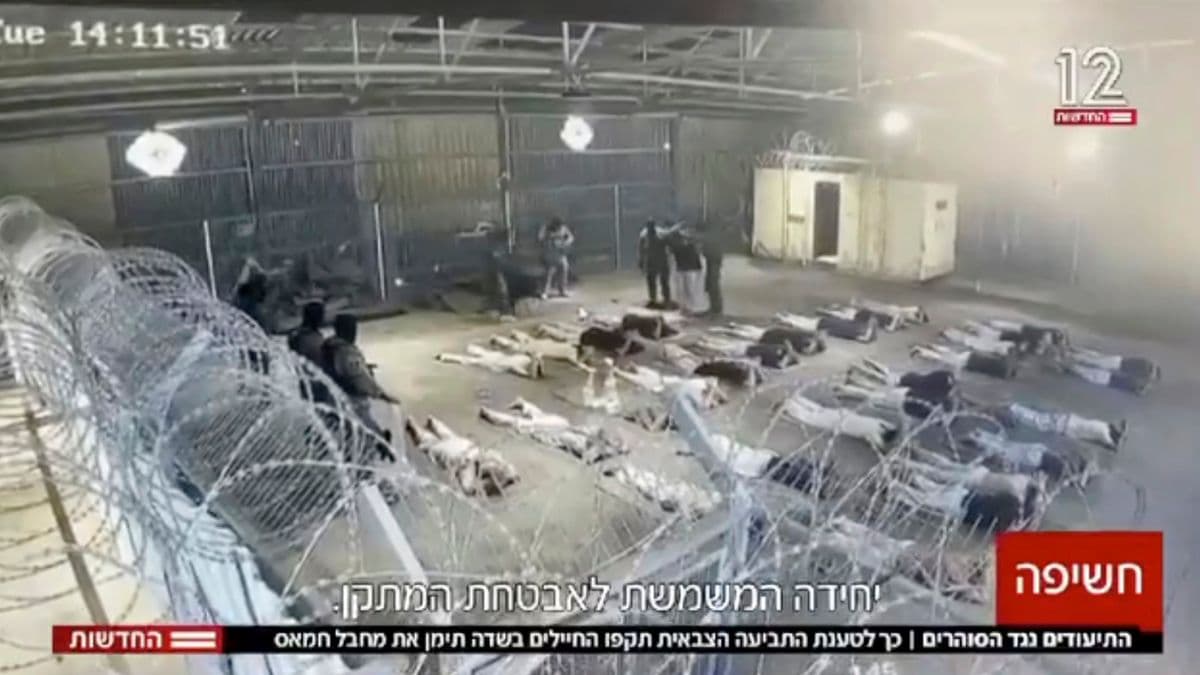
Several days later, an Israeli television station published surveillance camera footage from inside Sde Teiman allegedly showing the abuse of the Palestinian. About two dozen prisoners are visible lying on their stomachs behind corrugated metal fencing and barbed wire. Soldiers can be seen dragging a prisoner away and then pressing the man against a wall. He stands with his back to them, as if being searched. What happens next is largely hidden by the soldiers’ riot shields, used to block visibility. The man falls to the ground. It looks as though he is being beaten or kicked.
Ich bin damit einverstanden, dass mir externe Inhalte angezeigt werden. Damit können personenbezogene Daten an Drittplattformen übermittelt werden. Mehr dazu in unserer Datenschutzerklärung.
In Israel, the debate launched by the video has primarily focused on who leaked the video and less on the content of the images. In early November, more than a year after the fact, the culprit was found: the military prosecutor in charge of the case, Yifat Tomer-Yerushalmi. She had arranged for the video to be passed along to a journalist. She was briefly taken into custody and investigations are ongoing.
In her letter of resignation, the military prosecutor justified herself by saying she had approved the publication of the video "to counter the false propaganda directed against the military law enforcement authorities." Among the prisoners were "terrorists and terror operatives of the worst kind," she wrote, but that doesn’t change the fact that they may not be mistreated. "Unfortunately, this basic understanding – that there are actions which must never be taken even against the vilest of detainees – no longer convinces everyone."
In early November, Israeli Prime Minister Benjamin Netanyahu commented on the leaked video, saying: "It is perhaps the most serious public relations attack Israel has experienced since its founding.” His defense minister accused the military prosecutor of "blood libel,” anti-Semitic incitement. The military prosecutor is now seen as a traitor by the Israeli right wing – despite the fact that she protected the army for two years during the war in Gaza, elements of which were unlawful under international law.
"Instead of appreciation, we received accusations – instead of thanks, there was silence.”
The journalist to whom the videos were leaked was threatened to such an extent that his station has reportedly hired bodyguards to protect him.
The Palestinian victim of the abuse, meanwhile, has been released. He was sent back to Gaza as part of the hostage deal and was apparently not questioned by investigators. The release is unusual because there are indications that he belongs to Hamas and was possibly even involved in the attack on Israel. Israel's government had previously categorically ruled out the release of such prisoners.
Whether the proceedings can be conducted without victim testimony is questionable, and the defense team of the alleged perpetrators has already filed a motion to dismiss. Either way, the men are not being detained. One of the defendants has appeared on television several times, where he has sought to justify his actions. And in early November, four of them – wearing masks – gave a kind of press conference, in which they complained of what they see as a rush to vilify them. "Instead of appreciation, we received accusations – instead of thanks, there was silence.”
Military prosecutor Yifat Tomer-Yerushalmi prior to her resignation.
Journalist Roni Singer from Israeli broadcaster Channel 11 has taken a close look at the case. She does not see the military prosecutor as a heroine. The prosecutor, Singer believes, was afraid of reprisals and wanted to protect herself by releasing the video. "She wanted the Israelis to understand that she had no choice but to prosecute the soldiers." The military prosecutor, though, says Singer, had other options available. By leaking the video, Singer argues, the military prosecutor essentially gave the Israeli government a "gift," which it is using to continue going after the judiciary.
"Nobody is really interested in what happens in the prisons," Singer says. "Many Israelis think that these things happen. These are Hamas terrorists, so violence is to be expected." Even Singer, who is critical of the government, says that while she is convinced that there is violence in Sde Teiman, torture by no means takes place on a daily basis.
"An army that allows crimes to become the norm is unable to prosecute individual crimes."
Eitan Diamond, human rights activist
In two years of war, only one single soldier was convicted of beating Palestinian prisoners in Sde Teiman. He received a sentence of seven months in prison, a verdict that human rights organizations criticized as too lenient.
"The army is still considered sacred in Israel," says Israeli international law expert Eitan Diamond from the Diakonia International Humanitarian Law Centre. In addition, he says, the Netanyahu government has created a political culture "that feeds on hatred." As a result, he sees "a widespread dehumanization of Palestinians." All of this leads to lawless behavior becoming commonplace, he says.
His conclusion: "An army that allows crimes to become the norm is unable to prosecute individual crimes." All the more important, he says, is that the International Criminal Court continue its investigations and be supported in doing so, even against the resistance of the U.S. and Israel.

