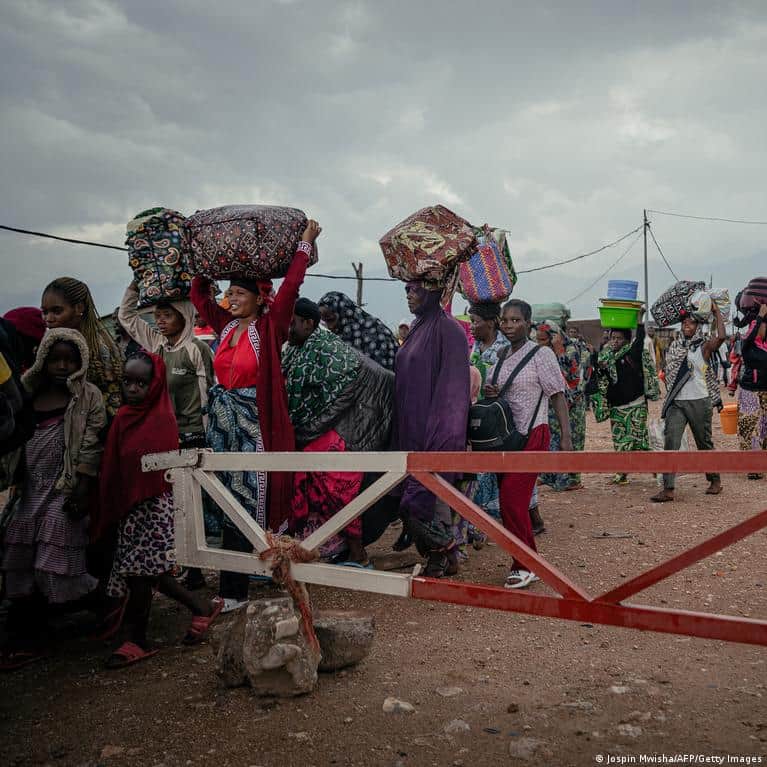
Violent fighting erupted on Saturday between pro-Kinshasa forces and M23 rebels near Uvira, a key border city connecting the Democratic Republic of Congo (DRC) to Burundi, according to local sources.
Kelvin Bwija, a civil society coordinator in Uvira, told AFP news agency that fighting was reported in the localities of Kashombe, Lubanda, Musingwe, Katongo, and Kigongo, located about 10 km (6 miles) from Uvira.
At a recent press conference, the Congolese army presented 15 prisoners of war — seven Rwandan soldiers and eight civilians from Burundi, Uganda, and Tanzania — accused of spying for M23, French broadcaster TV5 Monde reported.
The FARDC says the soldiers, arrested on different front lines, are evidence of a Rwandan army presence in the North Kivu and South Kivu provinces, alongside M23 rebels.
This comes just weeks after the DRC signed a United States-brokered peace deal aimed at ending decades of conflict and promoting development in eastern Congo.
US President Donald Trump hailed it as a "miracle" deal, however both sides have accused each other of jeopardizing the peace agreement.
In mid-December, US Ambassador to the UN Mike Waltz condemned the "scale and sophistication" of Rwanda's involvement in the eastern DRC, accusing Kigali of deploying roughly 5,000–7,000 troops there.
Since the beginning of December "Rwandan operations" have caused the deaths of around 1,500 civilians through the use of "bombs and kamikaze drones," according to a Congolese government statement.
The DRC also accused Kigali of sending "three new Rwandan battalions" into the eastern South Kivu province. Rwanda has repeatedly denied backing M23.
AFP news agency reported that while M23 had publicly said it would withdraw from Uvira on December 17, purportedly after US pressure, local sources say plainclothes M23 members remained in the city.
The United Nations estimates over 80,000 people have fled to regional ally Burundi.
M23's military strength around Uvira gives it considerable control over the DRC's land border with Burundi, and its associated trade routes.
Relations between Rwanda and Burundi have been tense since 2015, after Burundi accused its southern neighbor of harboring groups seeking to overthrow its government. Rwanda has also blamed Burundi for siding Congolese forces aiming for regime change in Burundi.
To view this video please enable JavaScript, and consider upgrading to a web browser that supports HTML5 video
Burundi's military has been involved in the DRC conflict for years, either as a member of the East African Regional Force or by allowing the Congolese military to use its resources to attack M23 positions.
"Once M23 captured Goma and Bukavu, we saw Burundi play a more logistical role where the Congolese military were deploying planes from Bujumbura Airport," said South Africa-based risk analyst Daniel Van Dalen.
"Both the Congolese military and Burundi have been relatively silent on the arrangement, referring to it relatively offhand. Burundi's been there for the past two years, actively in the conflict."
Van Dalen noted that political tensions between Burundi and Rwanda have seen a "militarized buildup along the common border areas."
"There is a spillover risk in that sense, not necessarily with full-blown conflict going into Rwanda, but we're talking accidental artillery fire, accidental skirmishes along the border," he told DW.
Van Dalen also points out there is a financial incentive for Burundi to support the DRC government.
"The DRC is paying Burundi, to my understanding, and according to United Nations documents, there is some monetary incentive. The exact figure has been speculated between $5,000 per soldier to just a flat rate of $2 million per month, but that has never been formally confirmed," he said.
Since taking up arms in 2021, M23 has seized the provincial centers of Bukavu and Goma near the Rwandan border. The rebels also control vast, resource-rich areas of the eastern DRC.
The fighting between the Congolese army, its Wazalendo affiliates, and the well-equipped M23 rebels, has caused a humanitarian catastrophe.
The UN estimates the M23's military advances have internally displaced at least half a million people within the DRC's South Kivu province alone.
The M23 denies all links to Rwanda and insists its aim is to overthrow the government of Congolese President Felix Tshisekedi.
While outwardly denying that it supports M23 militarily, Rwanda says it faces an existential threat from Congo-based armed groups linked to the 1994 Rwandan genocide, which targeted the Tutsi ethnic group, and moderate Hutus.
Recently, Congolese army spokesperson General Sylvain Ekenge was suspended from duty after a public outcry stemming comments he made on national television, which critics slammed as xenophobic.
He claimed, without providing evidence, that Rwanda was using "Tutsi women" for "strategy of infiltration."
Editorial Context & Insight
Original analysis & verification
Methodology
This article includes original analysis and synthesis from our editorial team, cross-referenced with primary sources to ensure depth and accuracy.
Primary Source
Deutsche Welle