UPSC Essentials brings to you its initiative of daily subject-wise quizzes. These quizzes are designed to help you revise some of the most important topics from the static part of the syllabus. Attempt today’s subject quiz on Polity and Governance to check your progress.
🚨 Click Here to read the UPSC Essentials magazine for December 2025. Share your views and suggestions in the comment box or at manas.srivastava@indianexpress.com🚨
With reference to the removal of a Judge, consider the following statements: 1. A judge may be removed from office through a motion adopted by parliament on grounds of ‘proven misbehaviour or incapacity’.
2. The constitution provides that a judge can be removed only by an order of the president, based on a motion passed by both houses of parliament.
3. The procedure for the removal of judges is provided in the Constitution of India.
4. The speaker or chairman decides to either admit the motion or refuse to admit it.
Which of the statements given above are correct?
Relevance: The question examines the distinction between constitutional provisions and statutory procedures, a common prelims trap. Removal of judges is a core topic under judicial independence and checks and balances, frequently tested in UPSC.
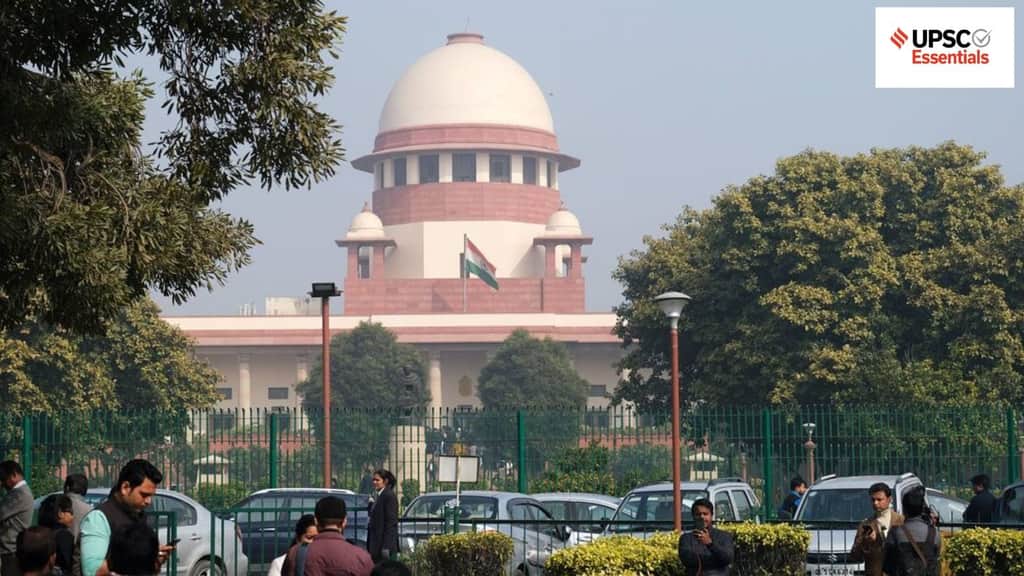
— The Justice Varma case has moved from an internal judicial inquiry to the political arena. The judge has denied the allegations and is likely to challenge every move in Parliament. The Supreme Court has agreed to hear Justice Varma’s petition challenging the action of Lok Sabha Speaker Om Birla to “unilaterally” constitute a committee under the Judges (Inquiry) Act to investigate him. If Parliament follows through, 2026 would see the first impeachment of a judge of a constitutional court.
— A judge may be removed from office by a motion passed by parliament on the basis of ‘proven misbehaviour or incapacity’. Hence, statement 1 is correct.
— According to the constitution, a judge can only be removed by an order of the president following a motion passed by both houses of parliament. The Judges Inquiry Act of 1968 elaborates on the procedures for removing judges. Hence, statement 3 is not correct.
— The constitution provides that a judge can be removed only by an order of the president, based on a motion passed by both houses of parliament. Hence, statement 2 is correct.
— The Act allows an impeachment resolution to originate in either chamber of parliament. To begin proceedings, (i) at least 100 Lok Sabha members may deliver a signed notice to the speaker, or (ii) at least 50 Rajya Sabha members may send a signed notice to the chairman. The speaker or chairman may consult with individuals and review relevant materials relating to the notification. Based on this, he or she may decide whether to admit or deny the motion. Hence, statement 4 is correct.
Therefore, option (b) is the correct answer.
With reference to the Foreigners’ Tribunal, consider the following statements: 1. The District Magistrate decides whether the Appellant is a “foreigner” or not.
2. These are quasi-judicial bodies. Which of the statements given above is/are correct?
Relevance: Questions on citizenship, foreigners, and quasi-judicial bodies are frequently asked due to their constitutional and federal significance.
— In November last year, the Assam government invoked for the first time a long-dormant 1950 law to order five people from Sonitpur district — who had been declared foreigners by a Foreigners’ Tribunal — to leave India. It did the same in December, this time ordering the expulsion of 15 people from Nagaon district
— The Foreigners (Tribunals) Order, 1964 was issued by the Central Government under Section 3 of The Foreigners Act, 1946. It is applicable to the whole country. Major amendments in the Foreigners (Tribunals) Order, 1964 were undertaken in 2013. The last amendment was issued in May, 2019. All these orders are applicable to the whole country and are not specific to any state.
— This Amendment Order also provides for reference by the District Magistrate to the Tribunal for its opinion as to whether the Appellant is a “foreigner” or not within the meaning of the Foreigners Act, 1946. The District Magistrate (DM) has the power to refer a case to the Tribunal or set up the Tribunal, the DM does not make the final adjudication. Hence, statement 1 is not correct.
— Foreigners’ Tribunals are quasi-judicial bodies. Hence, statement 2 is correct.
At present, the Sixth Schedule applies to the: Relevance: The Sixth Schedule is a recurring theme in questions related to tribal administration, federalism, and special constitutional provisions.
— The Sixth Schedule under Article 244 provides for the formation of autonomous administrative divisions — Autonomous District Councils (ADCs) — that have some legislative, judicial, and administrative autonomy within a state.
— ADCs have up to 30 members with a term of five years, and can make laws, rules and regulations with regard to land, forest, water, agriculture, village councils, health, sanitation, village- and town-level policing, inheritance, marriage and divorce, social customs and mining, etc. The Bodoland Territorial Council in Assam is an exception with more than 40 members and the right to make laws on 39 issues.
— The Sixth Schedule applies to the Northeastern states of Assam, Meghalaya, Mizoram (three Councils each), and Tripura (one Council).
With reference to the ‘Voter turnout’, consider the following statements: 1. It is represented as a percentage.
2. The concept of “Voter Turnout” is defined in the election laws.
Relevance: UPSC often tests the distinction between legally defined terms and administrative/statistical concepts used in electoral processes.
— The idea of “Voter Turnout” is not defined anywhere in the election laws, and no statute explains how statistics on voter turnout is published at the constituency, state, or national levels. It has simply emerged as a common phrase coined by psephologists, academia, media, and the general public during the previous several decades to generically define the level of electorate engagement in the voting process. Hence, statement 2 is not correct.
— “Voter turnout” is the number of electors who voted in an election in a constituency, expressed as a percentage of the total electors in that constituency. Hence, statement 1 is correct.
The Supreme Court has held that pending criminal cases do not automatically bar citizens from obtaining or renewing passports, as this right falls under the right to life protected under: Relevance: The question links passport rights with Fundamental Rights, a recurring UPSC theme. It tests understanding of Article 21’s scope as expanded by judicial interpretation.
— It distinguished between court-supervised travel restrictions and outright passport denial, emphasising that the latter requires proportionality and judicial oversight rather than blanket refusal by passport authorities.
— A Bench comprising Justices Vikram Nath and Augustine George Masih said on December 19 that liberty under the Constitution “is not a gift of the State but its first obligation”, and includes the freedom to move, travel, and pursue livelihood and opportunity.
Stay updated with the latest UPSC articles by joining our Telegram channel – IndianExpress UPSC Hub, and follow us on Instagram and X.
Editorial Context & Insight
Original analysis & verification
Methodology
This article includes original analysis and synthesis from our editorial team, cross-referenced with primary sources to ensure depth and accuracy.
Primary Source
The Indian Express