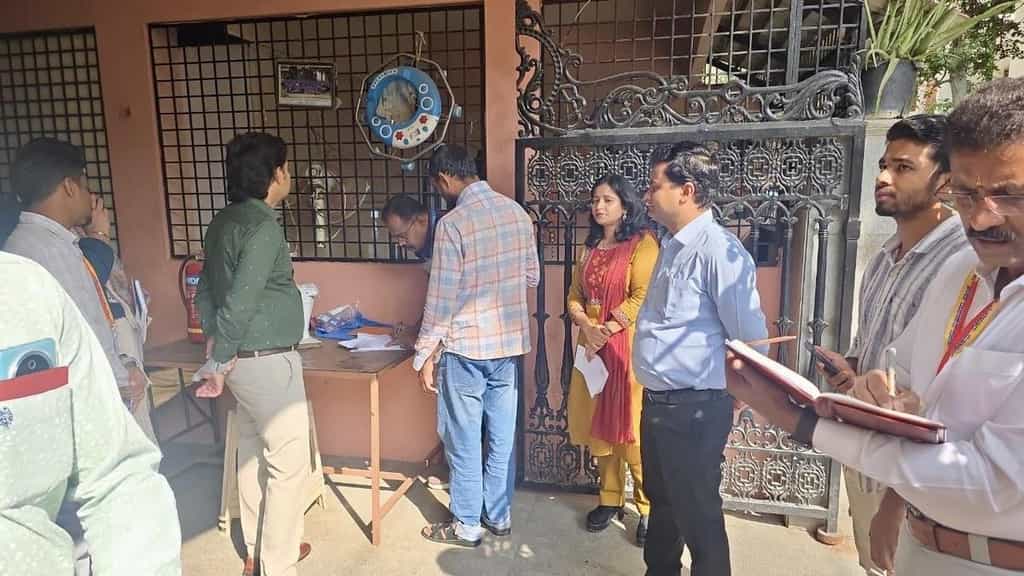
Bengaluru’s city corporations have launched a crackdown on paying guest (PG) accommodations across the city, revealing widespread violations of safety and hygiene norms. However, citizen groups have said that these inspections appear to be more of a revenue-generation exercise than a genuine effort to address the issues.
Inspections in C.V. Raman Nagar and Shanti Nagar found that all 321 establishments checked were flouting regulations, prompting the corporation to issue notices to all of them and set a seven-day deadline for compliance.
On Monday, January 12, the South City Corporation shut down 10 PGs due to poor hygiene. In the first week of January, the East City Corporation also issued notices to PGs to rectify safety violations in its jurisdiction.
Dhruv N.K., from South Bengaluru, who works on civic issues, called the entire exercise “eyewash”, citing several deeper problems.
“If the civic bodies really wanted to fix the issues, they should have looked at building code violations, parking violations, and safety issues. That would force them to shut down most of these establishments,” he told The Hindu.
R. Rajagopalan, convener of the Bengaluru Coalition, raised similar concerns, pointing to six- and seven-storeyed buildings constructed on plots that are not even 30X40 sites.
He also noted that the Revised Master Plan (RMP) 2015 norms were being widely violated, making many localities excessively dense.
“The RMP states that PGs are essentially commercial establishments and should not come up in residential areas, but this is rarely considered. Many of these establishments are coming up on roads that are less than 40 ft. wide, which is a clear violation,” he said.
Civic groups argue that the corporations’ action against these establishments is one-sided, as it focuses only on inspections inside the premises, while visible violations seen on the outside continue unchecked.
K. Karthik, a resident of S.G. Palya, a student-dominated area, said that the rent for decent PG accommodation in South-East Bengaluru was not less than ₹13,000, even for shared rooms. “The rooms are so small that they look like enclosures. Yet, students pay ₹10,000 for such rooms, and if the establishment has biometric systems, they are charged extra,” he said. He added that crackdowns should not be triggered only by incidents such as cylinder blasts or safety lapses, but should be a continuous exercise to keep the city safe.
Activists say many establishments do not have trade licences or occupancy certificates because they violate several building codes. Most PGs also depend on purchased electricity and private water supply, as they do not have occupancy certificates.
“It is mandatory for PG establishments to register with local police stations, but they rarely do,” Mr. Rajagopalan said. He added that addressing PG-related issues required coordinated efforts from multiple departments and the creation of a central repository.
He said civic authorities should make registration of all PGs mandatory, create a public repository for transparency, and share it with all stakeholder departments to facilitate inspections.
Such a revamp, he pointed out, was the only way for civic bodies to tackle the growing PG menace. If the issue was not addressed soon, city neighbourhoods would become even more densely packed, he warned.
Editorial Context & Insight
Original analysis and synthesis with multi-source verification
Methodology
This article includes original analysis and synthesis from our editorial team, cross-referenced with multiple primary sources to ensure depth, accuracy, and balanced perspective. All claims are fact-checked and verified before publication.
Editorial Team
Senior Editor
James Chen
Specializes in India coverage
Quality Assurance
Associate Editor
Fact-checking and editorial standards compliance