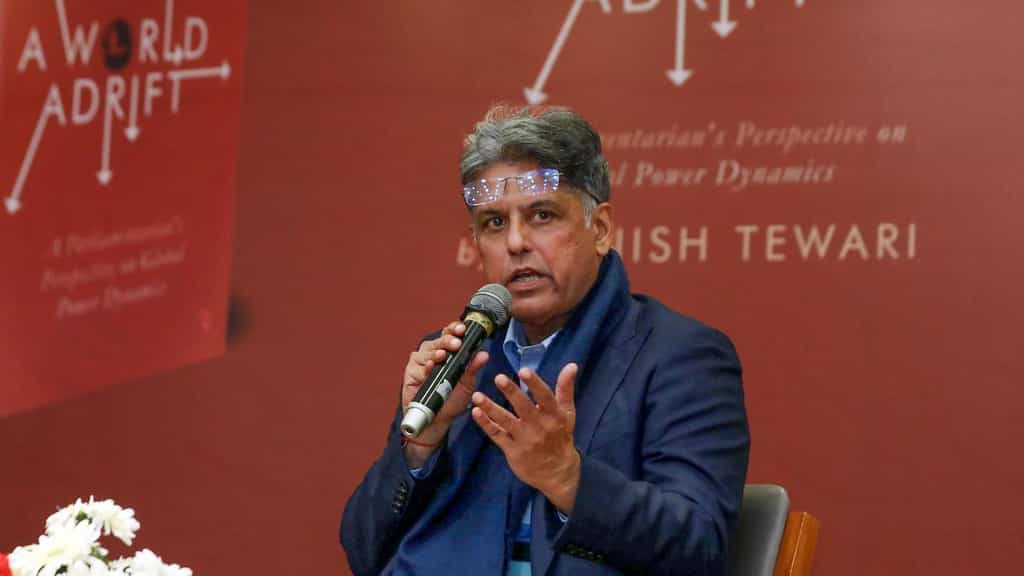
Senior Congress MP Manish Tewari on Monday (January 12, 2026) said if India had to preserve its strategic autonomy, it must remain internally cohesive. He noted that pluralism was no longer a luxury that could be taken for granted, and India’s cohesion was its biggest antidote to the external challenges that would continue to buffet it.
Following the release of his book A World Adrift by former Union Minister Yashwant Sinha, Mr. Tewari said India had an extremely robust democratic tradition and, despite all its problems, contradictions, and the kind of politics witnessed over the past decade, continued to be a beacon even as the old world was dying and the new one struggled to be born.
“What worries me is pushing the entire spectre of religious polarisation to such an extent that it weakens our social fabric so immeasurably that we are unable to retrieve it. We think that because it gives us electoral dividends, we can continue pushing the envelope, but there is a limit to that. Therefore, if India believes it has a certain exceptionalism in the world today, and if it wants to preserve and protect its strategic autonomy and engage with the world on its own terms, that strength must come from internal cohesion,” he said during a discussion.
Stating that he saw an “endeavour” in today’s India for strategic autonomy, he noted that, for any government or foreign minister, the current situation was far from enviable, with the world moving so quickly. Mr. Tewari said: “Therefore, for anyone at the helm, what they really need to do — and I believe this is what any government would do, and what governments around the world are doing — is to ensure that whatever space they have remains preserved and protected.”
Highlighting the five major themes running through his book, he said the first focused on the complete collapse of the post-World War II order and the current “orderless” world, making the transition extremely messy; the second dealt with the rise of China since 1978; the third examined India’s approach to preserving its strategic autonomy; the fourth addressed a revolution in military affairs; and the fifth highlighted a “vacuum” that has opened up.
Mr. Tewari noted the United States, in a unilateral manner, recently withdrew from 66 multilateral institutions and referred to its actions in Venezuela. “The main challenge would be Greenland, as how the Europeans react on Greenland is really going to determine whether even NATO survives,” he said, adding that the developments in the last one year indicated a scenario wherein every nation would act in its own best interest and in doing so, a new world order would emerge.
On the turmoil in Bangladesh and its relationship with India, the Congress MP said the Prime Minister said India had invested blood and bone in creating the country under the leadership of the then Prime Minister Indira Gandhi. “That reality is not lost on the people of Bangladesh. Unfortunately, the transitional government in Bangladesh, for inexplicable reasons, seems to be belligerent towards India,” he said, asserting that India had a great emotive connect with Bangladesh.
About the tumultuous regime changes in Sri Lanka (2022), Bangladesh (2024), and Nepal (2025), he said they took place due to weaponisation of social media, which tapped into grievances that might have been real or manufactured narratives. “That’s something which should worry all of us, because there is a capacity gap between the aspirations of the people and what governments are able to deliver,” he said, urging that these instances must be studied deeply to determine if they were outcomes of movements that sprung up organically or due to extraneous reasons.
Stating that there was strategic continuance in India, he said the current approach of multi-alignment was nothing but Nehru’s concept of non-alignment.
Speaking on the occasion, Mr. Sinha referred to the recent developments in Venezuela, stating: “On the one side, it has made the post-war global, so called international order completely irrelevant, and it has once again established the imperialism of the world’s most powerful democracy. How would the world deal with it remains to be seen.”
He questioned the role of the United Nations with respect to the happenings in Gaza. Given the rapidly changing world order, he said India needed to navigate through choppy waters with a great deal of dexterity. Describing Mr. Tewari as a scholar parliamentarian, he said his book was a must read.
Editorial Context & Insight
Original analysis and synthesis with multi-source verification
Methodology
This article includes original analysis and synthesis from our editorial team, cross-referenced with multiple primary sources to ensure depth, accuracy, and balanced perspective. All claims are fact-checked and verified before publication.
Editorial Team
Senior Editor
Aisha Patel
Specializes in India coverage
Quality Assurance
Fact-Check Editor
Fact-checking and editorial standards compliance