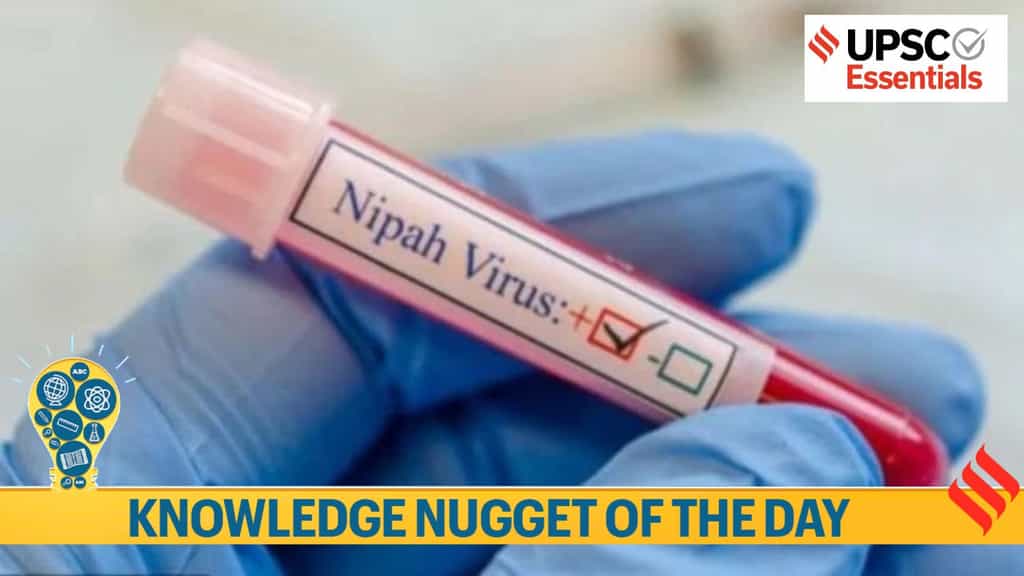
Take a look at the essential events, concepts, terms, quotes, or phenomena every day and brush up your knowledge. Here’s your UPSC Current Affairs knowledge nugget for today on Nipah virus.
(Relevance: UPSC has consistently included questions on health and diseases in its examinations over the years. For instance, in 2014, a question about the Ebola virus appeared in the Prelims, and in 2017, a question about the Zika virus was featured. Therefore, it is crucial to stay updated on diseases that are currently in the news.)
The West Bengal government on Monday said that two cases of Nipah virus have been detected in the state. Both the affected individuals are medical staffers of a private hospital in Barasat in North 24 Parganas district and are admitted there, the government said. A National Joint Outbreak Response team is being sent to West Bengal to help the state in preventing the spread of the infection, sources in the Union Health Ministry said. In this context, it becomes essential to know about this Nipah virus.
1. Nipah is a viral infection that mainly affects animals such as bats, pigs, dogs, and horses. Being zoonotic, it can jump to humans who come in contact with the infected animals and cause serious disease.
2. Nipah can spread to humans after close contact with infected animals or secretions containing the virus on fruit trees, fruits, date palm sap, juice or toddy. It can spread from human to human through close contact at home or in hospitals. It can spread from handling dead bodies of those with Nipah
3. According to the US Centers for Disease Control and Prevention (CDC), its symptoms are fever, headache, cough, sore throat, difficulty in breathing, and vomiting. In severe cases, disorientation, drowsiness, seizures, encephalitis (swelling of the brain) can occur, progressing to coma and death.
4. A real-time polymerase chain reaction (RT-PCR) test can confirm nipah virus through nasal or throat swabs, cerebrospinal fluid (CSF), urine and blood samples. Doctors can diagnose the infection in its later stages or after recovery by testing your blood for certain antibodies through the ELISA test.
5. There are no antivirals and there is only symptomatic management. Options are drinking water, resting, using medication to control nausea or vomiting, inhalers and nebulisers for breathing and anti-seizure medication in extreme cases are the present options.
6. Outbreaks of Nipah are not very common in India, with the latest cases being reported from Kerala. West Bengal had seen a Nipah outbreak in 2001 in Siliguri.
7. Notably, the first outbreaks of the Nipah virus among humans was reported from Malaysia (1998) and Singapore (1999). The virus takes its name from the village in Malaysia where the person in whom the virus was first isolated died of the disease.
1. According to the World Health Organisation website, One Health is an integrated, unifying approach that aims to sustainably balance and optimize the health of people, animals and ecosystems.
2. It recognizes that the health of humans, domestic and wild animals, plants, and the wider environment (including ecosystems) are closely linked and interdependent.
3. While health, food, water, energy and environment are all wider topics with sector-specific concerns, the collaboration across sectors and disciplines contributes to protect health, address health challenges such as the emergence of infectious diseases, antimicrobial resistance, and food safety and promote the health and integrity of our ecosystems.
4. By linking humans, animals and the environment, One Health can help to address the full spectrum of disease control – from prevention to detection, preparedness, response and management – and contribute to global health security.
5. The approach can be applied at the community, subnational, national, regional and global levels, and relies on shared and effective governance, communication, collaboration and coordination. Having the One Health approach in place makes it easier for people to better understand the co-benefits, risks, trade-offs and opportunities to advance equitable and holistic solutions.
1. It is a zoonotic disease that was first reported in Ethiopia in the late 1990s.
2. There’s no vaccine or medications to cure nipah virus. Which of the statement(s) given above is/are correct?
🚨 Click Here to read the UPSC Essentials magazine for December 2025. Share your views and suggestions in the comment box or at manas.srivastava@indianexpress.com🚨
Editorial Context & Insight
Original analysis and synthesis with multi-source verification
Methodology
This article includes original analysis and synthesis from our editorial team, cross-referenced with multiple primary sources to ensure depth, accuracy, and balanced perspective. All claims are fact-checked and verified before publication.
Primary Source
Verified Source
The Indian Express
Editorial Team
Senior Editor
Aisha Patel
Specializes in India coverage
Quality Assurance
Associate Editor
Fact-checking and editorial standards compliance