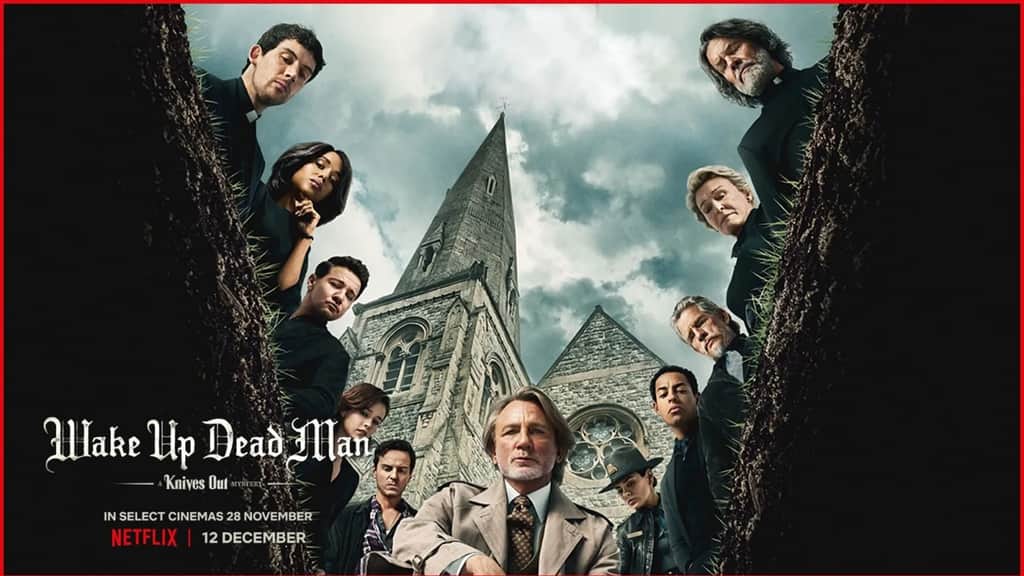
In the secluded church in Wake Up Dead Man: A Knives Out Mystery, Benoit Blanc lays down a few mystery novels on the table, John Dickson Carr’s The Hollow Man, which heavily influences the film’s impossible crime plot, alongside Agatha Christie’s The Murder of Roger Ackroyd and The Murder at the Vicarage, Dorothy L Sayers’ Whose Body?, and Edgar Allan Poe’s The Murders in the Rue Morgue.
For a moment, the film’s hyper-modern veneer parts, revealing the skeletal framework of a genre that has, for over a century, turned murder into metaphysics. Carr’s 1935 novel The Hollow Man—published in the US as The Three Coffins—contains what may be the most famous single chapter in detective fiction: a “locked room lecture” in which the detective Gideon Fell lays out, with academic precision, the seven ways a person might be killed inside a sealed space with no visible means of entry or escape.
It is a taxonomy of the impossible, a blueprint for miracles performed in reverse. And nearly a century later, it continues to shape whodunits and the possibilities of what a mystery can become.
In Carr’s formulation, the locked room is a character, an accomplice in deceit. The seven methods he outlines range from the brutally simple (an accident disguised as murder) to the diabolically elaborate (a murderer who impersonates the victim, or one who strikes only after the room has been broken into). Some rely on outdated technologies (poison gases, clockwork guns), while others feel eerily contemporary in their psychological cruelty. What unites them is a shared commitment to what Carr called “the illusion of the impossible,” the notion that a crime can defy logic until the moment the mystery unravels.
For Carr, the locked room was a philosophical stance. In The Hollow Man, Fell addresses the reader directly, breaking the fourth wall to defend the genre against charges of improbability. “I like my murders to be frequent, gory, and grotesque,” he declares. “I like some vividness of colour and imagination flashing out of my plot.” Here, Carr suggests that the best mysteries are not simulations of reality but celebrations of artifice. They are games in which the reader is both player and spectator, invited to marvel at the magician’s skill even as they search for the trapdoor.
Carr’s influence radiates outward in concentric circles. Agatha Christie, his contemporary and occasional rival, employed locked room scenarios in classics such as And Then There Were None and Murder on the Orient Express. Later auteurs like Soji Shimada and Paul Halter expanded the form, weaving in elements of horror and surrealism. But it is in film and television that Carr’s legacy has found its most visible revival.
Rian Johnson’s Knives Out series is saturated with Carr’s spirit, whether its elaborate plots or its willingness to treat the detective story as both homage and critique. In Wake Up Dead Man, the killer’s scheme is explicitly modeled on Carr’s playbook, turning The Hollow Man into a narrative cheat code, a “syllabus for the perfect crime.” The locked room’s constraints force ingenuity, while its impossibilities reveal human truths such as greed, fear, the longing for order in a chaotic world.
In Wake Up Dead Man, the killer’s scheme is explicitly modeled on Carr’s playbook. (Wikimedia Commons)
Critics have sometimes dismissed his characters as pawns on a chessboard, less flesh-and-blood individuals than variables in an equation. But this critique may misunderstand Carr’s project. In a locked room mystery, the room itself is the primary character, its walls, its locks, its hidden geometries. The people within it are functions of the puzzle, their motives secondary to the sheer audacity of the crime. There is a deliberate narrowing of focus.
That said, Carr at his best—as in He Who Whispers—proves he could weave psychology and atmosphere into the puzzle without diluting its purity. The locked room, in such works, becomes a metaphor for an enigmatic mind haunted by its own secrets.
In an age of forensic realism and psychological thrillers, why does the locked room retain its grip on our imagination? Perhaps because it represents mystery in its most crystalline form. There is no DNA evidence to wait for, no digital footprint to trace, only reason, observation, and the slow, satisfying click of logic falling into place. It is the literary equivalent of a escape room. It is essentially a confined space where every detail matters, and the solution is always, maddeningly, just out of reach until it isn’t.
Carr died in 1977, but his lecture lives on—in blogs, in podcasts, in screenplays and novels and late-night conversations between mystery lovers. It persists because it is a manifesto for wonder. In a world increasingly explained, quantified, and laid bare, the locked room offers a brief, delicious return to the era of the inexplicable. It reminds us that some doors are meant to be locked, if only for the pleasure of watching someone clever enough to open them.
Editorial Context & Insight
Original analysis & verification
Methodology
This article includes original analysis and synthesis from our editorial team, cross-referenced with primary sources to ensure depth and accuracy.
Primary Source
The Indian Express