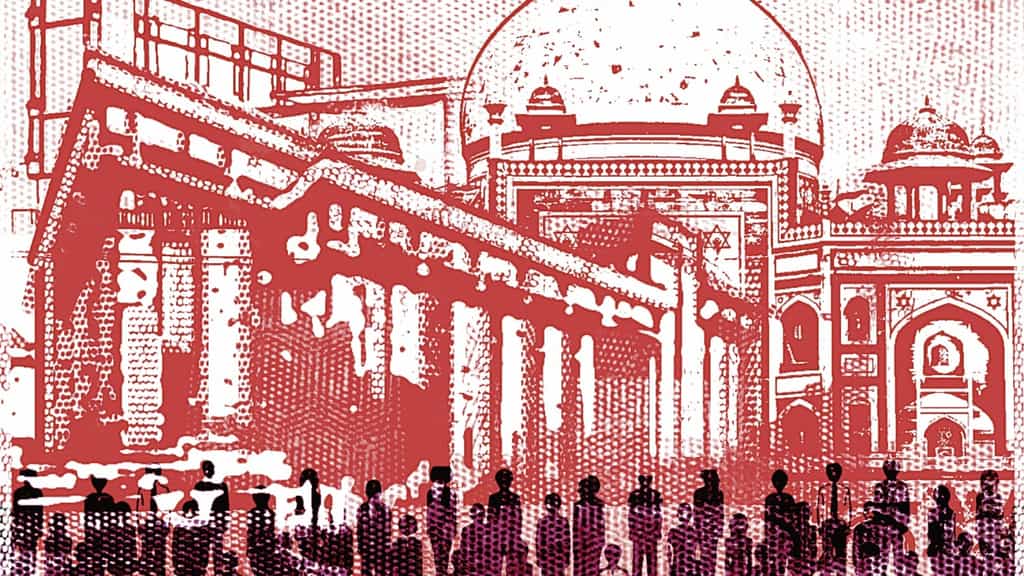
After the restoration of Humayun’s Tomb, remnants of red sandstone weighing several thousand kilograms were left over. These discards inspired our design for the museum façade, created by stacking the salvaged stone in horizontal courses (Illustration: C R Sasikumar)
Joseph Stein, the architect of much-loved buildings in New Delhi such as the Triveni Kala Sangam and the India International Centre, maintained an abiding respect for ecology. As an apprentice architect, working in his office on the design of the India Habitat Centre, I accompanied him for visits to the building site. In the torrid heat of June, amplified through the windows of now-extinct yellow and black taxis that ferried us to the construction zone, he carefully paced his walk to each tree — neem, arjun and jamun. He dutifully recorded in his notebook their distance from the edges of the proposed building, taking a measure of their canopies and the accompanying arcs of shade. In conversations over those summer months, he illuminated an essential truth: A building designed for people remains incomplete without a garden, that any architectural act is bereft without an engagement with the landscape. This lesson in placemaking anchors the India Habitat Centre as an urban catalyst — its courts and plazas shaded from the sun and cooled by the breeze, a melding of foliage and façade, light and shadow. A generous and welcoming arena for gatherings, it reaffirms the beauty of building with a garden, a hallmark of beloved public places in cities across the globe.
In the past few months, Delhi’s residents and visitors from across the globe have endorsed another such place — the Humayun’s Tomb Site Museum, a UNESCO World Heritage Site. As the architects of this project, working with a client team consisting of the Ministry of Culture, the Ministry of Tourism, the Archaeological Survey of India, and the Aga Khan Trust for Culture, we envisioned this project as an urban node, a link between the historic site of Humayun’s Tomb, the restored landscape of Sunder Nursery, and the vitality of Nizamuddin Basti. The late Aga Khan, Prince Karim, entrusted us with a mandate to design a building that would link the past with our present, unify the natural and the built environment, and facilitate an understanding of our built heritage.
Organised in two distinct and interlinked zones — the entrance plaza and the subterranean galleries — the Humayun’s Tomb Site Museum is anchored by a red sandstone building adjacent to Sunder Nursery. The entrance plaza, situated beneath the foliage of mature trees, offers a range of amenities — cafés and restaurants, a gallery and an auditorium.
Geometry manifested a cosmic order for the Mughals, the arrangement of carefully proportioned spaces imposing a discipline for construction and for inhabitation. The fusion of form with the refinement of craft — plaster and stone surfaces adorned with texture and colour, illuminated by light filtered through stone screens — is characteristic of the architecture of Humayun’s Tomb.
The material selection for the museum echoes the language of this architectural history. After the restoration of Humayun’s Tomb, remnants of red sandstone weighing several thousand kilograms were left over. These discards inspired our design for the museum façade, created by stacking the salvaged stone in horizontal courses. To celebrate the procession of visitors from the entry plaza into the museum courtyard, the red sandstone façade transforms into a delicately carved, white marble screen, stirring memories of historic jaalis. The fine stone craftsmanship — a defining feature of Mughal architecture — finds renewal in this contemporary expression, enabling stone craftsmen to sustain their livelihoods with a centuries-old technique.
From the arrival plaza, the procession to the museum commences as a measured descent. Evoking citadels of centuries past, the stone ramp’s gentle gradient leads visitors from the gradually disappearing horizon of the present into the subterranean presence of the past. This is an invitation to wander, to pause and to contemplate our cultural history. Inspired by the architecture of baolis — medieval stepped wells that presented a cool, skylit refuge for travellers and served as reservoirs for fresh water — we designed high-ceilinged underground galleries, arranging them as a sequence of intersecting squares, softly illuminated through skylights and open courtyards. Imperceptible to visitors, the galleries are sited around the roots of existing trees, enabling the museum to slip into the horticultural fabric with minimal impact.
Flanking the central exhibition gallery, a courtyard, conceived as a sunken garden, serves as a threshold between the interior and the exterior. Patterned with marble chinikhana fountains and plants, it allows natural light to wash across the marble-clad columns and floors of the gallery. The gallery features skylit niches — dedicated to full-scale reconstructions of architectural details from Humayun’s Tomb, elements that facilitate an understanding of historic construction techniques and the skill of the mediaeval craftsmen. Light animates the space, reflecting shadows from the installations on the surface of the pleated concrete ceiling and on the patterned teak doors. This architecture of the present continues a lively conversation with artifacts of the past.
The commitment to creating a place for the people is best expressed in the design of the terrace plaza, the museum’s roof, and its mirror to the sky. Inspired by the garden motif of Persian carpets, the paved plaza, animated by the ever-changing pattern of light and shadow on its planters, reveals only a hint of the museum, as the skylights framed within sandstone planters glow with light from the galleries below.
Architecture that evokes an emotive connection with people — especially so in works designed for the public — endures as a cherished memory of our bond with a place. India’s rich historic legacy is ripe for more such interventions — buildings and gardens where people may gather, reflect on our past, and create visions for our future.
Editorial Context & Insight
Original analysis & verification
Methodology
This article includes original analysis and synthesis from our editorial team, cross-referenced with primary sources to ensure depth and accuracy.
Primary Source
The Indian Express