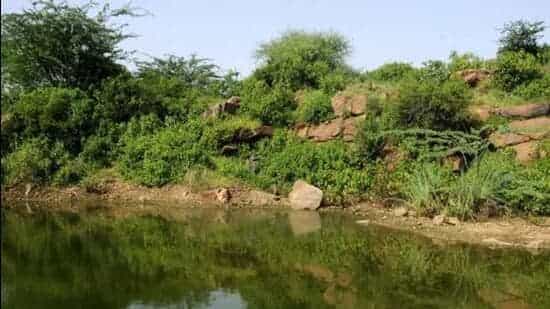
Organisations can approach the Union environment ministry to take up afforestation in the Aravallis under the Green Credit scheme, Union environment minister Bhupender Yadav said on Wednesday.
“If any organisation wants to take up afforestation in degraded forest land as per the management plan of the forest department and is able to achieve 40% canopy cover in four to five years, it can obtain green credits,” Yadav said.
He added that the process has already started in the Aravallis, covering 750 acres in Gurugram and 250 acres near the Manesar Industrial Area.
Yadav said: “Many misconceptions have been spread, but neither is mining allowed in the Aravalli region in Delhi, nor will it ever be allowed.” Mining would also not be allowed in most districts of Haryana, he added.
He noted that around 97sq km of Aravalli revenue land in Haryana, from Naurangpur to Nuh, has been identified for afforestation and declared a Protected Forest. The Green Credit programme can be taken up in many degraded patches in the Aravallis, he said.
HT reported on January 8 that the environment ministry has cleared the way for private and government entities to lease forest land for afforestation and timber projects without paying mandatory environmental compensation fees, marking a significant shift in India’s forest conservation policy.
In a letter to state governments dated January 2, the ministry stated that afforestation and silvicultural activities — the practice of controlling forest growth and quality — undertaken under approved state plans will now be classified as “forestry activities”. Because of this new classification, these projects will be exempt from compensatory afforestation requirements and net present value fees. These are significant financial mandates typically charged to developers to offset the loss of forest land and ecosystem services.
Yadav on Wednesday released an eco-restoration framework for the Aravalli landscape based on pilot projects in four Gurugram villages, proposing a replicable model to address degradation across the 670-km mountain range.
The report, “A Report on Eco-restoration of the Aravalli Landscape”, was drafted by Sankala Foundation, a Delhi-based think tank, following field studies and stakeholder consultations in Sakatpur, Naurangpur, Shikohpur and Gairatpur Bas villages.
The framework proposes restoration through forest and biodiversity management, invasive species control, water resources management, livelihood diversification, urban planning and adaptive monitoring.
“The proposed eco-restoration model offers a robust framework for rehabilitating degraded forest patches in urbanising regions of the Aravalli range. Rooted in site-specific data, community engagement and alignment with policy frameworks, this model is highly adaptable across the Aravalli landscape. It balances ecological restoration with social, economic and environmental priorities to foster sustainable development and improve quality of life,” the report stated.
The report will be used to develop a model eco-restoration plan for the Aravalli landscape which can be replicated in all four participating states across 29 districts, officials said.
Field surveys in the four Gurugram villages found that forest patches in the project area are highly degraded, fragmented and invaded by species such as Prosopis juliflora, Lantana camara and Parthenium hysterophorus. These invasive species have significantly suppressed native biodiversity, the report said.
All villages report complete reliance on groundwater for irrigation, which has contributed to the depletion of aquifers and adversely affected forest health. Over 43% of households rely on forests for firewood, medicinal plants and fodder. Women play a key role in resource management, but alternative livelihoods remain limited.
The report synthesises data showing extensive degradation of the Aravalli range, which spans Delhi, Haryana, Rajasthan and Gujarat and acts as a climate barrier preventing the Thar Desert’s eastward expansion.
The range has lost over 40% of its forest cover since 1970, with tree felling and illegal construction fragmenting habitat continuity. In Haryana and Delhi, ridge forests are now interspersed with real estate developments and highways.
Extraction of building materials, including granite, quartzite and sand, has devastated thousands of hectares. In Rajasthan alone, 2,400 mining leases operated within or near the Aravalli hill system until judicial interventions halted activity. Between 1999 and 2019, forest cover declined by 0.9%, with the central Aravallis losing 32% since 1975.
In Rajasthan, 25% of hills have been degraded since 1967-68. According to a Supreme Court-appointed Central Empowered Committee report of 2024, 31 out of 128 hills in Rajasthan vanished due to anthropogenic factors. In Haryana, desertification is affecting 8.2% of the state’s land as of 2018-19, with 5,77,270 hectares of the Aravalli lost by 2019. Projections suggest a further 22% degradation by 2059.
Editorial Context & Insight
Original analysis and synthesis with multi-source verification
Methodology
This article includes original analysis and synthesis from our editorial team, cross-referenced with multiple primary sources to ensure depth, accuracy, and balanced perspective. All claims are fact-checked and verified before publication.
Editorial Team
Senior Editor
Aisha Patel
Specializes in India coverage
Quality Assurance
Associate Editor
Fact-checking and editorial standards compliance