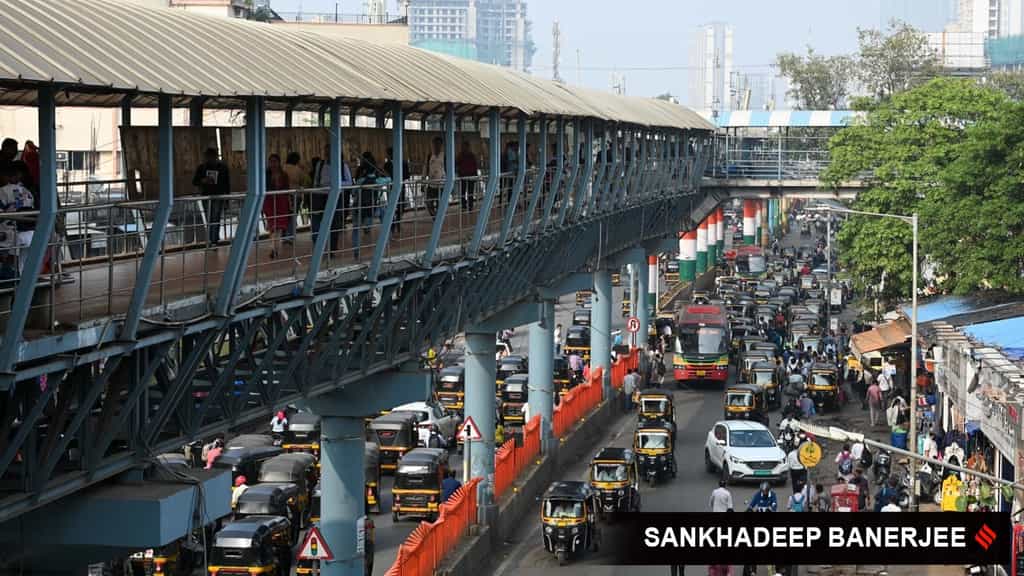
With the Brihanmumbai Municipal Corporation (BMC) heading to polls after an over-three-year delay, the residents of R-South and R-Central wards in Mumbai are hopeful of finally having elected public representatives to raise questions with, instead of having to approach respective ward offices with their issues. However, whether their long-standing problems will actually be resolved remains uncertain, as many complain that they have been grappling with the same civic issues for over a decade now.
The two wards, which cover two densely populated western suburbs of the city–Kandivali and Borivali–are largely residential and blessed with green spaces, including the Sanjay Gandhi National Park. But residents continue to face routine civic issues such as hawkers’ menace, encroachment on public spaces, unfinished infrastructure works such as half-concretised or dug-up roads, and chronic traffic congestion.
“Roads connecting Lokhandwala to the highway have become bottlenecks due to hawkers and other public space encroachments. Adding to this is the autorickshaw menace. It is a daily struggle to reach the metro station or Kandivali railway station,” said Santy Shetty, founder of citizens’ group We All Connect, which is active in the Kandivali Lokhandwala Township.
“A new DP road that was meant to solve this issue remains incomplete. The 70 per cent completed stretch is now being used for illegal parking of heavy vehicles, leading to security concerns,” Shetty added. The group has launched a voters’ awareness campaign in Lokhandwala Township, listing these civic issues and urging residents to vote for those most likely to resolve them.
Another citizens’ group from Thakur Village in Kandivali, Soch Nayi, has prepared a detailed 11-category manifesto for Ward 25 under R-South. The manifesto covers issues ranging from regulated hawking, traffic management, safety and infrastructure to climate concerns, community well-being and animal welfare.
Group founder Harsha Udupi said, “We have two Metro stations nearby and a railway station. But the last-mile connectivity is a real struggle. Despite having multiple gardens, reaching them is difficult due to encroachment on footpaths, making it difficult for pedestrians, especially senior citizens.”
Highlighting environmental concerns, environmentalist Milly Shetty, a citizen activist from Charkop under R-Central ward, spoke about garbage dumping on mangroves in the locality. “There is a wall between 90 Feet Road and the mangroves. Often, I see garbage being dumped behind the wall, sometimes even by BMC cleaners, without realising the damage it is causing. Thanks to mangroves, we have not suffered flooding or waterlogging yet, but you never know about the future,” Milly complained.
Raising concerns about transport planning, Milly said, “The Versova-Dahisar coastal road is being constructed through Charkop. This will certainly benefit those travelling by car to South Bombay for work. But what about middle-class residents struggling to reach Kandivali railway station or Metro station, due to reduced BEST buses and the autorickshaw menace?”
Rampant redevelopment projects of residential buildings have resulted in excessive dust and pollution, which is a major concern in the R-Central ward. A citizen activist from Chikuwadi, Suresh Lad, said, “This, coupled with incomplete civic works, has worsened the living conditions.”
Shankar Jamsandekar, a citizen activist from Charkop, highlighted how multiple unfinished civic works are left unattended. “There is no platform where people can raise issues,” he said.
According to many residents, corporators have been the missing link for over three years now and with civic elections, that gap may finally be filled. But not everyone is convinced. Arun Kejariwal, a resident of Mahavir Nagar, which falls under R-South as well as R-Central wards, questioned the effectiveness of corporators. “When have corporators actually resolved issues? We have been facing the same civic issues for over a decade now. And with the increased population, those issues have only multiplied. Now there is all this buzz due to elections…but what about concrete actions afterwards?” he questioned.
Kejariwal, who was part of the BMC’s Advanced Locality Management (ALM) initiative before the COVID-19 pandemic, said that the absence of such citizen engagement platforms had widened the communication gap between residents and the civic body.
Records from the last BMC elections indicate that the political landscape in these two wards is largely dominated by Bharatiya Janata Party (BJP), which won 17 out of 23 corporator seats in these two wards combined. While the Shiv Sena had secured five, one went to the Congress. But this was when the Shiv Sena was still undivided and in alliance with the BJP.
With the changed political equations in the state, Marathi votes are likely to be divided between the two Sena factions and the BJP. This could work in BJP’s advantage, given the sizable Gujarati and North Indian population in these two wards.
Editorial Context & Insight
Original analysis & verification
Methodology
This article includes original analysis and synthesis from our editorial team, cross-referenced with primary sources to ensure depth and accuracy.
Primary Source
The Indian Express