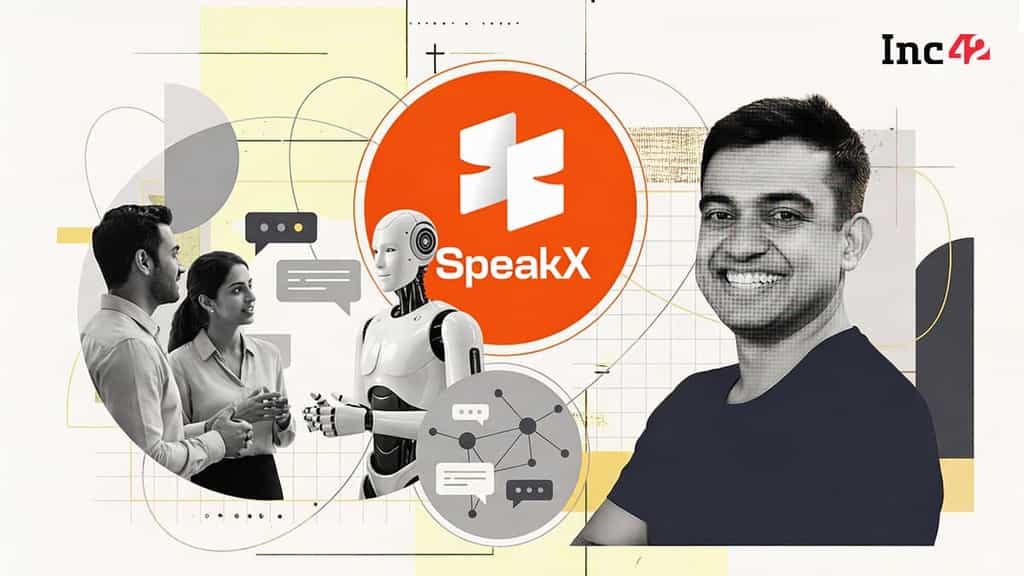
India has had a complex relationship with English, from its colonial history to an essential skill. But there has been a lot of friction in getting people to speak English without the fear of judgment or being ridiculed.
Millions can read and write the language well enough to clear exams and function at work. But when conversation begins, hesitation takes over. Fear of judgment slows confidence and fluency.
This gap has survived coaching centres, online courses, and multiple edtech cycles. Spoken English requires practice and feedback, which historically depended on human tutors. That structure limited scale and kept costs high.
SpeakX.ai says generative AI has removed that constraint.
Founded by Arpit Mittal and Anshul Gupta, in its earlier Yellow Class avatar, SpeakX had also raised a $6 Mn Series A funding round led by Elevation Capital in 2021. Additionally, Meesho cofounder Vidit Aatrey and PropTiger CEO Dhruv Agarwala were among the angel investors who took part in the fundraising, along with investors India Quotient, Titan Capital, and First Cheque.
Right after rebranding to SpeakX to build a spoken English platform, Gupta stepped down from his operating role as a CEO. Mittal took the reins.
Mittal says that since 2023, SpeakX’s mission has been to help learners practice everyday conversations with an AI tutor.
For founder and CEO Mittal, the problem was familiar long before SpeakX existed.
Despite studying in English-medium schools and colleges, Mittal struggled with confidence during college and early corporate life. He understood the language, knew grammar but was hesitant in speaking it. For many, it’s a matter of gaining confidence, which a tutor can help with.
That insight deepened after he met a mother whose children studied in an English-medium school. She avoided parent-teacher meetings because she could not converse in English. Her children, she said, felt uncomfortable in social settings because of it.
The episode shaped SpeakX’s core problem, where spoken English affects social participation and confidence, not just employability.
Before GenAI, conversational learning was not very intuitive, used hard-coded lines and was difficult to scale because of the lack of personalisation.
Many edtech companies have dealt with this dilemma and this is why despite once being one of the most diverse sectors in the startup ecosystem, today edtech is restricted to test prep, certification and a handful of soft skilling platforms.
SpeakX falls in the last category and GenAI allows the company to be a more proficient tutor than any conversational system before. Mittal’s core insight is that learners need someone to speak with who will not admonish them for their mistakes.
AI removes the cost barrier that such one-on-one practice requires. Early voice assistants like Siri and Alexa could respond but could not hold sustained conversations. They failed to replicate real dialogue.
According to him the problem was never solved and led to many companies falling away. 2023 was the turning point, he says, when generative AI models became capable of continuous, context-aware conversation.
SpeakX built its product around this shift. Learners engage with an AI tutor across common scenarios such as workplace discussions, daily interactions, and social conversations. The system is designed to allow repetition without embarrassment, removing the social pressure that often slows learning.
In terms of its AI stack, SpeakX seems to be making a deliberate infrastructure choice by leaning on Google’s AI and cloud ecosystem to support that approach, rather than opting to build LLMs for its English learning engine.
It’s a choice that’s born out of the fact that large language models from OpenAI or Google are already the best in the world for English language generation, so building something custom would be like reinventing the wheel.
When it began, SpeakX ran a multi-model AI architecture, using a mix of internal systems and third-party models. Over time, the company has shifted much of its AI workload and infrastructure to Google Cloud Platform.
More and more startups are beginning to make this choice, with both Google and Microsoft Azure (for OpenAI) staking a claim for a piece of the AI action. SpeakX’s choice was simply a matter of Google Gemini pulling ahead of OpenAI’s models in recent months.
According to the CEO, Google’s platform is designed to operate with minimal human intervention. Onboarding, engagement, and learning workflows are handled through automated systems, allowing the company to scale usage without expanding its team proportionally.
Mittal said the decision to go with Google rather than OpenAI or any other LLM was also driven by Google’s progress in AI infrastructure and tooling for AI-native applications. The company continues to switch between models depending on specific use cases but relies on Google for most hosting and orchestration.
He remarked, “Google is now at a cutting edge; they are the most cutting-edge technology stack when it comes to native AI companies. Although I believe earlier in the race, they were lagging. But lately, we are amazed to see the kind of evolution that has happened in the ecosystem.”
SpeakX claims around 140,000 paying subscribers in India have gone through its programmes. Learning, Mittal said, takes time. Instead of completion rates, SpeakX points to changes in user outcomes. SpeakX’s subscription model is priced at INR 299 per month for individuals.
He gave us an anecdote of a taxi driver in Patna reportedly seeing an increase in his monthly income by INR 3,000 after gaining confidence in spoken English. Inc42 could not verify or corroborate this claim, but Mittal looks at indicators such as increased confidence and participation among the user base to track outcomes.
Mittal attributed the profitability to strong demand and a cost structure built around automation. SpeakX operates with a 20-member team and reports no human-led learning delivery.
The company said it did not need aggressive sales efforts to acquire users, as demand for spoken English practice already existed.
In terms of competition, there’s Airlearn, Duolingo, Josh Skills and others but Mittal claims SpeakX is focussed on getting people to improve everyday English rather than for certification, or learning a new language or exam preparation.
The basic assumption is that the user already knows English and wants to use an app more confidently in everyday situations.
While currently the startup is focussed on India, the company plans to expand internationally after strengthening its product and engineering capabilities in the country. “We want to go deep in a market, solve it, and then look at other markets. We don’t want to skim the market from the top.” Mittal told Inc42.
SpeakX recently raised $16 Mn in a pre-Series B funding round. It was led by WestBridge Capital with participation from Goodwater Capital and existing investor Elevation Capital, alongside angels including OpenAI executive Shyamal Anadkat and upGrad cofounder Ronnie Screwvala.
The company plans to use the capital to hire senior engineering talent and further develop its platform.
Mittal described English fluency as a lifelong process, citing public figures known for strong oratory skills as benchmarks for continued improvement.
He sees AI taking on more execution-heavy roles in education, including delivery, feedback, and practice. Humans will continue to decide what should be taught and how learning frameworks are designed, but AI is getting better and better, which definitely is an advantage for smaller teams.
Editorial Context & Insight
Original analysis and synthesis with multi-source verification
Methodology
This article includes original analysis and synthesis from our editorial team, cross-referenced with multiple primary sources to ensure depth, accuracy, and balanced perspective. All claims are fact-checked and verified before publication.
Primary Source
Verified Source
Inc42 Media
Editorial Team
Senior Editor
James Chen
Specializes in Technology coverage
Quality Assurance
Copy Chief
Fact-checking and editorial standards compliance