The Australian government updated its directive, known as Ministerial Direction 115, which has replaced the existing Direction 111. It was designed to align with the 2026 National Planning Level (NPL), which establishes targets for international student enrolments at Australian universities. The directive came into effect from November 14, aiming to strengthen and balance the distribution of international students across education providers in both regional and metropolitan areas.
In this backdrop, let’s see how international students can study in Australian universities, what visas, documents, and permits they need, and whether the country allows post-study work opportunities. As per the Ministry of External Affairs 2025 data, there are 1,96,108 Indian students in the country.
In a nutshell, studying in Australia begins with choosing a course and securing admission to an institution. Once selected, the institution issues a Letter of Offer, followed by a Confirmation of Enrolment (CoE).
With the CoE, students can apply for the student visa (subclass 500), demonstrating adequate financial resources, overseas student health cover (OSHC), English language proficiency, and compliance with the Genuine Student (GS) and character requirements.
The overall process involves applying to an education provider, obtaining the CoE, and completing the visa application.
Now, let’s break down the process in a more detailed way to make you understand how you can make your way and get a seat in a favourable Australian university, and that too in a choice course.
Introduced on July 1, 2016, the Student Visa (subclass 500) allows international students to reside in Australia for the duration of their study programme—typically up to six years, depending on their enrolment. As mentioned on the official website, the cost is from AUD 2,000.00 (unless exempt), that is, roughly Rs 1.20 lakh.
With an Australian Student Visa (subclass 500), international students are permitted to pursue an eligible course of study in Australia while enjoying the flexibility to travel in and out of the country during the visa period. In addition, the visa allows students to work up to 48 hours per fortnight while their course or training is in session, providing valuable opportunities to gain practical experience and support living expenses alongside their academic journey.
To apply for a visa, you must submit your application online or create an ImmiAccount at online.immi.gov.au/lusc/login, either from within Australia or overseas. Applicants are required to be enrolled in a course of study in Australia and hold a valid Confirmation of Enrolment (CoE) at the time of visa decision.
They must also maintain Overseas Student Health Cover (OSHC) unless exempt, be at least six years of age, and provide evidence of a welfare arrangement if they are under 18. If applying from within Australia, they must hold an eligible substantive visa. It is important to note that a CoE becomes invalid once cancelled or upon completion of the course, and a substantive visa ceases to be effective if another substantive visa is granted.
Applications are processed according to Australian Eastern Standard Time (AEST) or Australian Eastern Daylight Time (AEDST), as applicable. To know more about the visa or to apply, study abroad aspirants can apply-immi.homeaffairs.gov.au/visas/getting-a-visa/visa-listing/student-500
When applying for a student visa to study in Australia, applicants are generally required to provide the following; however, for applicants under 18 years of age, additional documents such as parental consent must also be submitted.
–Evidence of English proficiency – e.g., IELTS test scores
–Proof of financial capacity – covering tuition fees, living expenses, dependent costs, and return airfare
Here is the list of the top universities in Australia based on QS University Rankings.
To obtain an Australian Student Visa (subclass 500), applicants must have proficiency in the English language, typically by passing a secure English language test. This ensures they have the necessary communication and correspondence skills to succeed in their studies.
The International English Language Testing System (IELTS) is the most widely accepted test for this purpose. For visa eligibility, the minimum IELTS requirement is 6.0. However, higher scores are necessary for admission into leading universities, and the course opted for by the student.
After completing studies on a Subclass 500 Student Visa, international graduates in Australia can explore a range of post-study opportunities through the Temporary Graduate Visa (Subclass 485). This visa grants 2 to 6 years of work rights, with extended durations available for those who studied in regional areas or pursued higher-level qualifications.
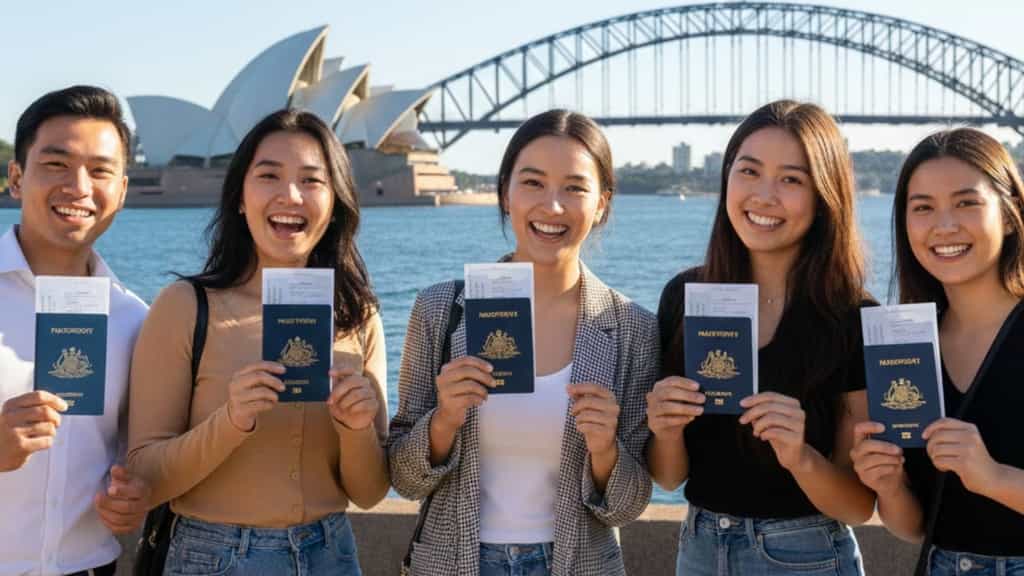
If we tell you in a nutshell, what it takes to study in Australia, then the first step is selecting a course and getting admission to an institution, which provides a Letter of Offer, followed by a Confirmation of Enrolment (CoE). (Image: AI Generated)
It also serves as a pathway to permanent residency via skilled migration visas such as Subclass 189, 190, and 491, or through employer-sponsored options like Subclass 482. In addition, graduates may consider short-term alternatives, including Working Holiday Visas (Subclass 417/462), to gain further experience and flexibility in Australia
Editorial Context & Insight
Original analysis & verification
Methodology
This article includes original analysis and synthesis from our editorial team, cross-referenced with primary sources to ensure depth and accuracy.
Primary Source
The Indian Express