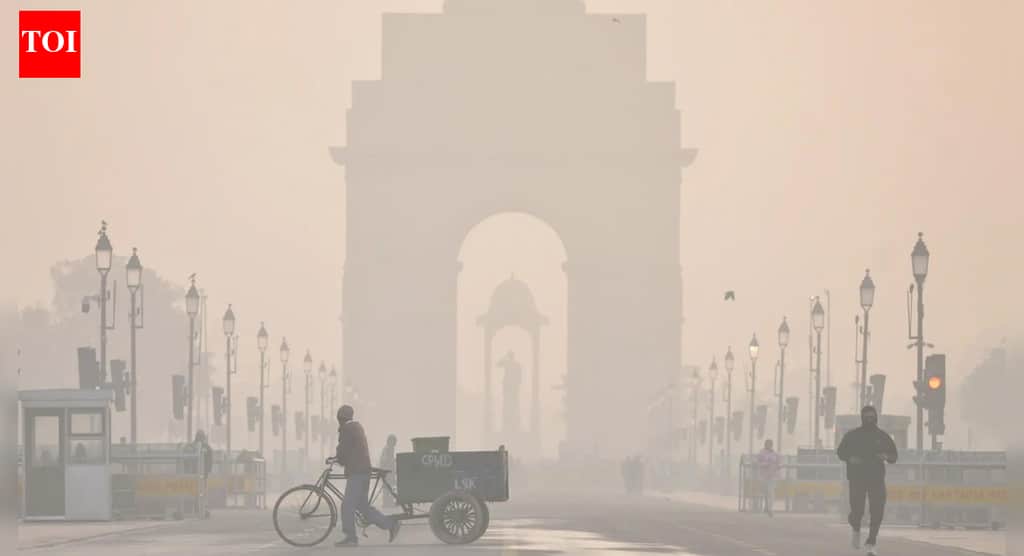
NEW DELHI: The Supreme Court on Tuesday pulled up the Commission for Air Quality Management (CAQM) for "failling to do its duty" as the AQI in the national capital remained in 'poor' category."Have you been able to identify the causes of pollution? During all these days, a lot of material is coming in public domain, experts are writing articles, people are having opinions, they keep on sending to us on mail," the bench remarked, as reported by PTI.
"Heavy vehicles are contributing a large part, so the first question is how do we address that... By holding a meeting on January 2 and telling us that we will come after two months, that is not acceptable to us.
The CAQM is failing in its duty," the bench observed.The top court directed the CAQM to convene a meeting of experts in two weeks and submit a report on the major causes of "worsening" pollution.The court’s remarks came as it rejected CAQM’s request for a two-month adjournment on key measures, including the temporary closure or relocation of toll plazas at Delhi’s borders.In view of the prevailing circumstances, the Court stated that it was compelled to issue specific directions aimed at identifying both the causes of the AQI crisis and its long-term remedies.
It observed that the Commission for Air Quality Management (CAQM), as an expert body, bears the primary responsibility of bringing together domain specialists to arrive at a shared understanding of the factors contributing to deteriorating air quality. The Court noted that this exercise would not be time-consuming, as it would mainly involve sharing reasons and consolidating existing research and data from institutions such as IITs and TERI.
Such an effort would enable CAQM to assess the real causes and develop proportionate, source-specific solutions. The bench further noted that, “Ideally, these reasons should be placed in the public domain with a citizen-centric approach so that people are aware of the causes and can offer suggestions. Some of the causes are inevitably attributable to citizens of the NCR, and public awareness programmes could help curb such factors.”The remarks came against the backdrop of deteriorating air quality in the capital. Delhi’s average Air Quality Index (AQI) stood at 293 on Tuesday morning, placing it firmly in the ‘poor’ category, according to the Central Pollution Control Board. Chandni Chowk recorded the worst reading at 352, while 20 monitoring stations logged ‘very poor’ air quality. Forecasts suggest pollution levels are likely to remain poor to very poor over the next six days.During the December 17 hearing, the apex court had directed the Municipal Corporation of Delhi (MCD) and the NHAIto consider temporarily shutting or relocating nine toll plazas at the city’s borders.
Editorial Context & Insight
Original analysis & verification
Methodology
This article includes original analysis and synthesis from our editorial team, cross-referenced with primary sources to ensure depth and accuracy.
Primary Source
Times of India