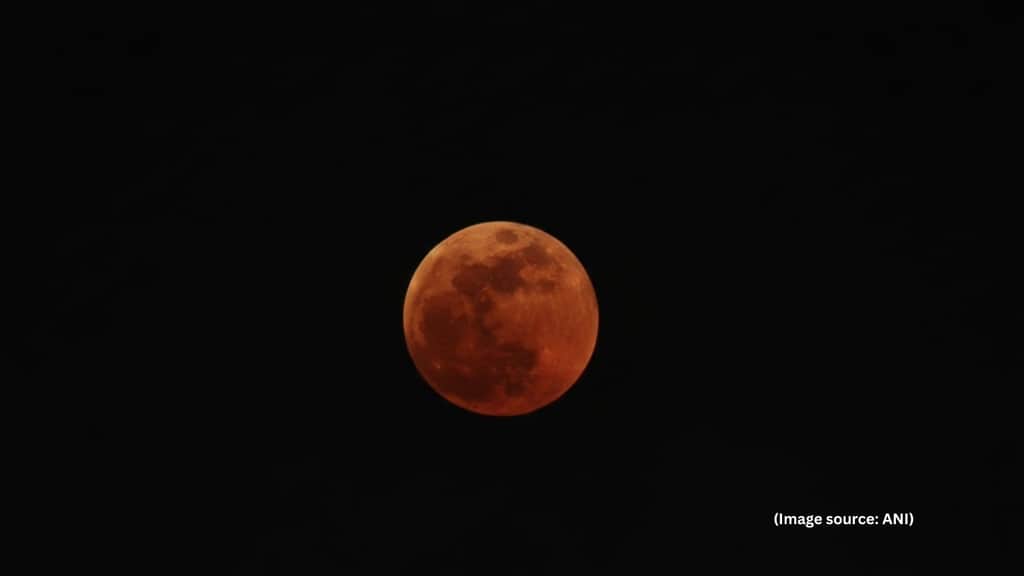
In India, the supermoon was visible shortly after sunset, giving skywatchers a striking early-evening view (Image source: ANI)
The first supermoon of 2026, also known as the Wolf Moon, lit up the night sky on Saturday, offering skywatchers a brighter and slightly larger-than-usual full Moon. In the evening, the Moon appeared about 30 per cent brighter and roughly 14 per cent larger than the most distant full Moon of the year, making it one of the most visually impressive lunar events of the year.
According to National Geographic, a supermoon generally occurs when the Moon’s full phase coincides with its close approach to Earth, known as perigee. During these events, the lunar orb can look up to 14 per cent larger and 30 per cent brighter than a micromoon. At its closest point during this event, the Moon was about 362,641 km from Earth.
In India, the lunar event was visible shortly after sunset, giving skywatchers a striking early-evening view. The most breathtaking views were reported between 5.45 pm and 6 pm IST, when the Moon was near its full phase and close to perigee, as noted by Nasa. The supermoon was witnessed illuminating the night sky over cities like Bhubaneswar and Guwahati.
#WATCH | Odisha: The first ‘Supermoon’ of 2026, popularly known as the ‘Wolf Moon’, witnessed in Bhubaneswar.
During this celestial event, the moon will appear 30% brighter than an average full moon. pic.twitter.com/xpyUOEibao
#WATCH | Assam: The first ‘Supermoon’ of 2026, popularly known as the ‘Wolf Moon’, witnessed in Guwahati.
During this celestial event, the moon will appear 30% brighter than an average full moon pic.twitter.com/KCsr66V2kq
As the Moon rose close to the horizon, it lit up with a warm orange-yellow tint. According to Nasa, this colouration happens because moonlight passes through a thicker layer of Earth’s atmosphere when the Moon is low in the sky. Blue wavelengths scatter, while longer red wavelengths pass through, giving the Moon a tangerine tint.
Globally, the supermoon reached its peak at 5.30 am EST (4 pm IST) on January 3, according to Space.com. It peaked at 10.03 am GMT in London, around 7.30 pm local time in Tokyo, and about 9.03 pm in Sydney.
This event marked the conclusion of a four-month supermoon run that began in October 2025, with the next supermoon not expected until the end of 2026.
Editorial Context & Insight
Original analysis & verification
Methodology
This article includes original analysis and synthesis from our editorial team, cross-referenced with primary sources to ensure depth and accuracy.
Primary Source
The Indian Express