


Key takeaways
- Surgical robotics is moving quickly from teleoperation toward increasingly capable vision-language-action policies.
- World foundation models offer a different path.
- Today, we are introducing the next step: Cosmos-H-Dreams, a real-time, action-conditioned generative simulator for surgical robotics.
What happened
Surgical robotics is moving quickly from teleoperation toward increasingly capable vision-language-action policies. But evaluating and training these systems remains difficult. Physical robotic platforms are expensive to operate, experiments are slow to reproduce, and failures can damage instruments or biological material. Conventional simulators provide a safer alternative, but surgical scenes are exceptionally difficult to model: deformable tissue, fine instrument interactions, specular surfaces, sutures, needles, smoke, and occlusions all matter.
The bidirectional teacher begins from the Cosmos-H-Surgical-Simulator Open-H checkpoint, which uses a unified 44-dimensional action representation. For the released dVRK tabletop model, the dual-arm dVRK action content, consisting of relative end-effector translation, rotation, and gripper state, is mapped into this common representation.
The teacher is then fine-tuned on the JHU dVRK tabletop mixture, including successful demonstrations as well as failure and out-of-distribution episodes such as needle drops, missed throws, and unsuccessful knot ties. These failures are important: a simulator intended to evaluate policies must reproduce the consequences of poor actions, not only ideal demonstrations. To improve stability during long rollouts, the training process progressively increases the teacher's temporal horizon.
We start training on a 12-frame horizon and progressively increase this number until 72 frames. At each horizon bump, we initialize the warmed-up model with pretrained weights. The teacher's denoising trajectories are first precomputed and cached. A causal student is initialized from the teacher and trained to imitate these cached trajectories.
This warmup stage teaches the student to operate with causal attention and a streaming key/value cache before it begins learning from its own generated history. Autoregressive models face a familiar problem: during training they may see clean, ground-truth context, while during deployment they must condition on their own imperfect outputs. Small errors can therefore compound over time. Cosmos-H-Dreams addresses this mismatch with self-forcing distillation.
Why it matters
World foundation models offer a different path. Instead of manually authoring every object and physical interaction, they learn visual dynamics directly from synchronized video and robot kinematics. NVIDIA's Cosmos-H-Surgical-Simulator demonstrated this approach by generating future surgical video from an initial scene and a sequence of robot actions. It enabled faster-than-physical evaluation and synthetic data generation across the Open-H-Embodiment ecosystem.
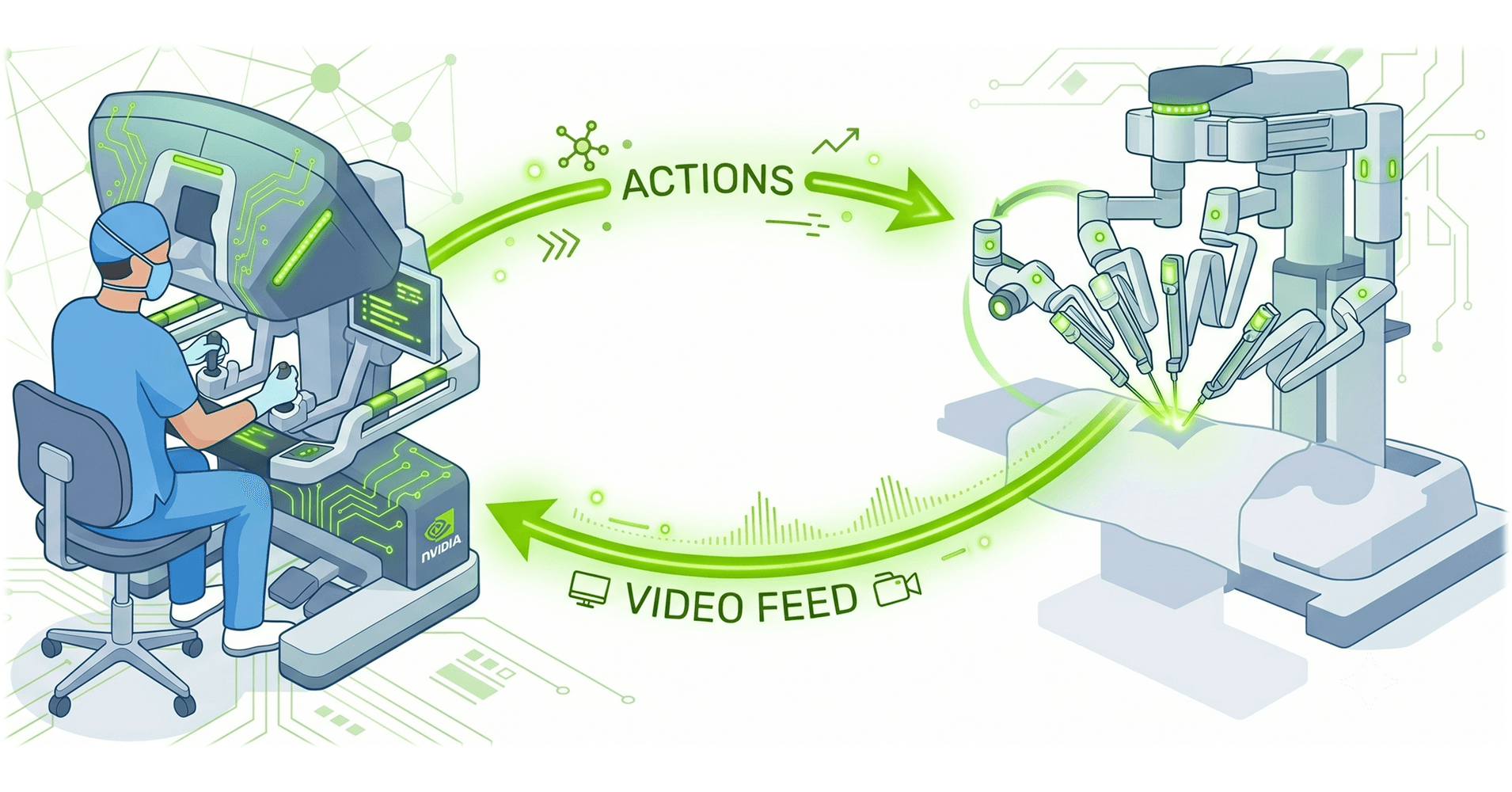
Today, we are introducing the next step: Cosmos-H-Dreams, a real-time, action-conditioned generative simulator for surgical robotics. Cosmos-H-Dreams distills the capabilities of Cosmos-H-Surgical-Simulator into a causal, few-step student model and serves it through FlashDreams, NVIDIA's accelerated streaming-inference library. Running on a single NVIDIA RTX PRO 6000 GPU, the result is an interactive environment that a person or a learned policy can control in a closed loop.
5-2B and post-trained on the Open-H-Embodiment dataset. Given a surgical context frame and a future robot trajectory, it generates video showing the likely visual consequences of those actions. This makes it useful for offline policy evaluation and synthetic data generation.
A recorded or policy-generated trajectory can be sent to the model, the corresponding rollout can be generated, and the result can be inspected or scored without repeatedly executing the motion on a physical robot. Cosmos-H-Dreams moves the model into the real-time regime.
Starting from the multi-embodiment surgical priors learned by Cosmos-H-Surgical-Simulator, we specialize the model for da Vinci Research Kit (dVRK) tabletop suturing and distill it into a causal student that generates the scene autoregressively. The released model receives an initial RGB frame and a live stream of robot kinematics, then produces the next chunk of frames before continuing with the following action block.
We have also demonstrated the versatility of Cosmos-H-Dreams by collaborating with CMR Surgical and Cambridge Consultants to integrate it with the Versius surgeon controller, enabling real-time operation on the Versius platform. The key challenge is preserving useful surgical dynamics while reducing the cost of generation. Cosmos-H-Dreams uses a teacher-to-student training pipeline designed for long, autoregressive rollouts.
What to watch
During training, the student rolls forward using its own generated context. Distribution-matching supervision from the frozen teacher then guides those self-generated rollouts toward realistic surgical video. This prepares the student for the same conditions it will encounter during interactive inference. The resulting model supports few-step diffusion, with as few as two denoising steps per latent frame, rather than the many-step process used by the full teacher.
It combines the teacher's surgical priors with the causal structure needed for streaming. Model distillation is only part of the real-time story. Cosmos-H-Dreams is served through FlashDreams, an accelerated inference library for autoregressive world and video models.