



Key takeaways
- Overview of ABBEL compared to traditional recursive summarization.
- For language models to effectively assist with increasingly complex tasks such as software development, they must be able to interact with…
- 5-397B),1 still found it necessary to employ context summarization.
What happened
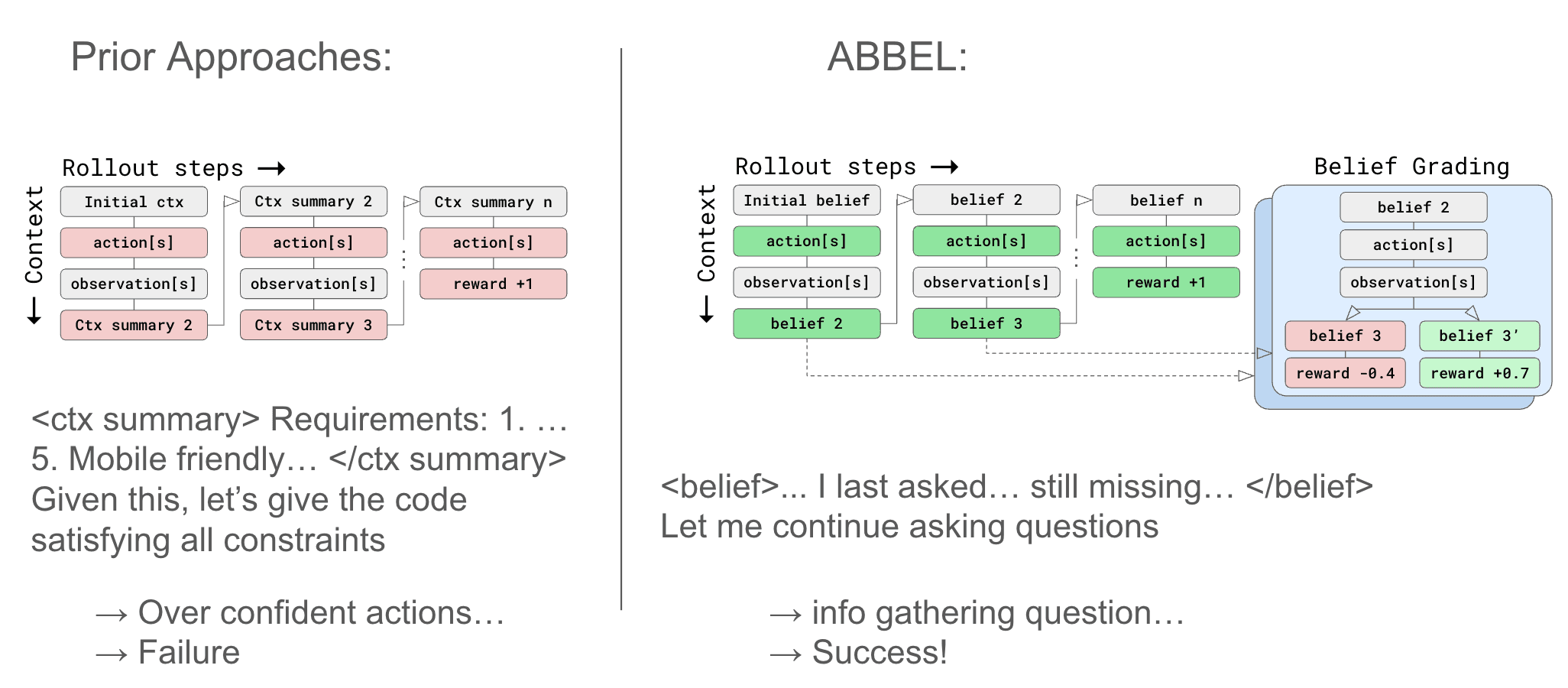
Overview of ABBEL compared to traditional recursive summarization. Beliefs replace the full interaction history as the agent’s working context, and belief grading improves performance by supervising the contents of each belief state.. As task horizons grow, LLM contexts can’t scale forever. , collaborative code generation. We address this with ABBEL: a framework that isolates and supervises the information content of summaries in the form of natural-language belief states.
An example heuristic for coding could be shorter is better, but closer to being able to reconstruct the git diff is also better, so balancing these would yield a good belief.
In domains where good heuristics are hard to define, we propose a general autoencoding-inspired grading function, which treats the current language model πθ as both encoder and decoder of information from the history, and the belief states as the codes. We grade each belief bt+1 by how well it can be used by the current model πθ to reconstruct the most recent observation ot: Eq. 1: Reconstruction grading objective.
Here bt+1 is the updated belief, ot the latest observation, at the action just taken, bt the prior belief, pI the task prompt, and πθ the current model. Higher grades reward beliefs that retain information needed to decode the latest observation. , 2025). Fig. 4: CollabBench collaborative coding environment. The agent asks clarifying questions, then submits a function scored against hidden unit tests.
With reconstruction belief grading, ABBEL-rec-BG recovers about half the gap to full context while using fewer peak tokens, and trains in 50 steps instead of 100.
Why it matters
For language models to effectively assist with increasingly complex tasks such as software development, they must be able to interact with us over hundreds or even thousands of steps. For such long tasks, it is impractical to keep the history of the entire interaction in context. The heuristic approach used so far has been summary generation, sometimes called context compaction. , 2026).
5-397B),1 still found it necessary to employ context summarization. But compaction has a problem. , 2026). 2 Though both model types improve over the course of training, the summary model never closes the gap. Fig. 1: Average attempts to guess the target word on Combination Lock over RL fine-tuning (lower is better). Context-summary policies improve with training but do not close the gap to full-context policies.
Making models self-summarize while completing a task increases the complexity of the learning problem. , 2025). Thus, the better you can learn to summarize on the limited and messy multiturn interaction trajectories you can collect, the better off your model will be for downstream users. Fig. 2: Autoencoder-inspired belief grading.
The model encodes prior belief, action and observation (bt, at, ot) into posterior belief bt+1 and is rewarded for how well select information from the history can be reconstructed from that belief. To address poor learning efficiency, we isolate the summary generation task. 3 Fig. 3: ABBEL rollout. Belief updates from the latest observation alternate with action selection conditioned only on the current posterior belief.
We then extract and supervise the contents of the belief states (Fig. 2, Belief Grading). Belief grading can be thought of as adding an auxiliary RL task, using heuristics designed to capture what makes a good belief as the reward.
What to watch
We see that with the general reconstruction-based belief grading function we reduce the performance gap from full context models by about 50%, and train in 50% fewer steps compared to training models to summarize without belief grading (no BG). After training, ABBEL still uses significantly less memory than the full context setting, as measured by the peak context token length (Peak Tokens). Fig. 5: CollabBench results.