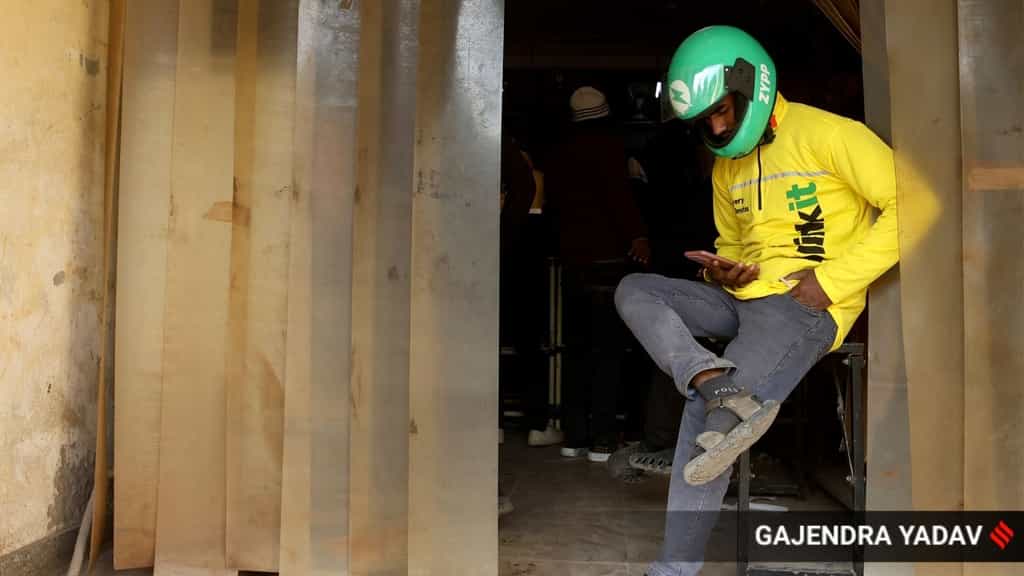
The phone screamed. Not buzzed, not chimed. A harsh alarm bell erupted from the Swiggy app, the kind that makes your stomach drop. It was a jarring auditory reprimand for an order that had been turned down. Within seconds, Rs 30 had disappeared from the day’s earnings. Gone.
For three days last week, I signed up as a delivery worker, navigating Delhi’s traffic and the architecture of India’s gig economy. My experience of working for a day each across Zomato, Blinkit and Swiggy platforms laid bare a grim reality: India’s convenience economy runs on the backs of delivery workers, and the costs – financial, physical, psychological – are theirs alone to carry.
The numbers were stark. Across three days, I rode 105 km on a TVS 125 cc scooter to complete more than 20 deliveries and clocked over 15 hours of work. Total earnings: Rs 782. After fuel costs of Rs 250, I was left with Rs 532, or roughly Rs 34 per hour — well below minimum wage standards in most formal sectors — without accounting for vehicle maintenance, phone bills, or the physical toll of spending hours navigating Delhi’s roads, waiting for orders and lugging heavy loads up buildings.
With a low base pay (around Rs 35-Rs 55 per order, depending on distance), algorithmic systems that nudge delivery workers to accept more orders and cover longer distances, rising fuel costs, no social security benefits and a largely faceless management, the growth of India’s quick-delivery economy — which is expected to employ over 23 million by 2030 — has come at the cost of increasingly precarious worker earnings.
Workers have gone on strikes, most recently on New Year’s Eve, seeking, among other things, fairer pay structures, regulation under labour protection and minimum-wage frameworks, and protection against extreme deadlines and penalties.
But most delivery workers cannot afford to join these protests, as that would mean losing out on a day’s pay and a potential ban by the company.
Emails sent to Eternal (Zomato and Blinkit’s parent company) and Swiggy for comments did not elicit replies.
Over three days, I carried out 23 deliveries — six each for Zomato and Swiggy, and 11 for Blinkit.
Delivery workers can choose one or more time slots during which they will make themselves available to make deliveries. I chose the 12 pm-6 pm slot for Swiggy (January 9), 1 pm-7 pm for Blinkit (January 10), and 1 pm-7 pm (January 11) for Zomato.
At Rs 355 at the end of six deliveries, Zomato yielded the most earnings, followed by Blinkit at Rs 313.27 (11 deliveries), while Swiggy brought in just Rs 114 (6 deliveries) — a figure diminished by the platform’s penalty system that docks Rs 30 every time a worker turns down an order.
I turned downed four orders on Swiggy. While the first rejection did not carry a penalty — only the shrill, angry bell — my three subsequent rejections resulted in fines of
Rs 30 each. The fourth rejection led to Swiggy disabling my account until the next day.
Though I did not face penalties on Blinkit and Zomato, the latter put my account on hold for 15 minutes when I rejected some orders. Workers say the two platforms impose costs if they log out or don’t turn up in the scheduled time slot.
Following the recent strike, Zomato CEO Deepinder Goyal had said that the average earnings per hour for Zomato and Blinkit workers in 2025 was Rs 102 per hour. In a tweet on X, he went on to say, “If someone were to work for 10 hours/day, 26 days/month, this translates to ~₹26,500/month in gross earnings. After accounting for fuel and maintenance (~20%), the net earnings for the partner are ~₹21,000/month.”
According to Eternal’s Q3 FY25 shareholder letter, average monthly earnings for delivery workers of Zomato and Blinkit who logged in at least eight hours a day and 26 days a month was Rs 27,726 in 2024, excluding fuel costs.
While it may not be impossible to achieve these numbers, it requires workers to commit to impossibly long hours, stay logged in during peak hours, accept most orders, and work with minimal breaks. All of which takes away from the flexibility of gig work and makes it resemble formal, full-time work, without any of the corresponding benefits or safety nets.
The quick delivery ecosystem is designed to extract maximum compliance: one mistake, one moment of refusal, and the promise of adequate earnings evaporates. My life didn’t depend on this gig, so I could afford to press ‘reject’ on the app.
If a worker does not spend 12-14 hours on the app in a day and complete at least 25-30 deliveries, the avenue to make money is very limited. But at that level, the job no longer is about flexibility; it requires a commitment of over half a day. Only a little over 2 per cent of the company’s delivery fleet falls under this category of workers who clock over 200 days as Zomato’s Goyal said; the average worker is engaged with the company’s platforms for 38 days a year, seven hours a day.
There are onboarding costs as well. Workers have to pay for the companies’ jerseys and carrying bags, even though they end up becoming hyperlocal advertising boards for the aggregators. On Swiggy, I paid Rs 1,201 to get on to the app, and on Zomato, Rs 1,799. Both offered an option for the fee to be paid in instalments, which would have been deducted from the worker’s earnings over time.
I spoke to workers at Blinkit’s dark store in Vasant Kunj and others like me who were hanging outside restaurants waiting to pick up orders. They were frank about the economics: base pay alone makes no financial sense. Survival in this industry depends on chasing incentives — bonuses, typically structured around completing a set number of deliveries within a time frame or earning a certain threshold of base pay. For instance, on Blinkit, if you earned
Rs 1,025 as base pay, you were eligible for an incentive of around Rs 450. But these incentives come laden with conditions. Even a single cancellation can disqualify a worker from these incentives, rendering hours of effort unrewarded beyond the meagre base rate.
On Swiggy, there was no option to click on the insurance tab. But a source at the company said that while workers are insured from Day 1, the policy “might take some time” to reflect on the app. In my case, it remained unavailable on the app even after working for over five hours. Blinkit and Zomato provide some form of insurance coverage from day one, including Rs 1 lakh for outpatient treatment and Rs 10 lakh for accidental death.
It’s this exploitative nature of India’s gig economy that has forced the government to notify the long-awaited reforms to the country’s labour codes. These codes, for the first time, legally recognise platform workers, and open access to schemes covering health, disability, accident insurance and old-age support. Aggregators such as Swiggy and Zomato will have to contribute 1-2 per cent of their annual turnover towards this fund, with the total contribution capped at 5 per cent of the amount payable by them to the workers.
The government has also intervened to stop these platforms from carrying out 10-minute deliveries, amid concerns that the promise puts pressure on workers to deliver faster, thus making them susceptible to breaking traffic laws.
But workers are in a rush not because they want to deliver one order faster, but because they have to deliver several orders throughout the day, failing which they may lose out on the incentives from delivering at least 25-30 orders.
The arithmetic tells only part of the story. Working for Swiggy, I had to pick up an order from Taco Bell in Vasant Kunj’s Ambience Mall. The path to the restaurant begins where most shoppers never look: a nondescript entrance at the rear of the building, far from the gleaming glass facade and valet parking in the front. Inside, a service lift — simply marked “garbage lift” — carried delivery workers to the third floor.
The lift at Ambience Mall in New Delhi’s Vasant Kunj that’s reserved for delivery workers and cleaning staff. (Express photo by Soumyarendra Barik)
The waiting area at the top was a buffer zone where workers collected orders before retreating the way they came. I saw a glimpse of the mall’s shopping floor, but a guard had been positioned there to ensure that the boundary remained uncrossed. The design wasn’t accidental. Delivery workers often move through a parallel infrastructure, unseen by the customers they serve.
I got no tips for the 23 orders I delivered, but customers making eye contact and saying thank you after receiving their orders were equally rare.
When Zomato’s Deepinder Goyal argued that discomfort with the gig economy stemmed from the visibility it gave to urban inequality, the back-door entrances of high-end establishments and the segregated lifts of apartment complexes told a different story. While these walls are erected by the very users of these services, companies such as Zomato and Swiggy have no incentive to pull them down.
There is also a degree of unpaid labour involved in the life of a delivery worker.
At a Blinkit dark store in Vasant Kunj, I had to help a harried packer assemble a larger order while his other orders piled up. The work was not assigned or requested; it simply became necessary. Pack the groceries, load them onto the bike, deliver them. The app recognises only the final step.
Two of the 11 orders on Blinkit weighed between 10 and 15 kg, and I had to lift them up three-four floors in apartment complexes without elevators in Vasant Kunj. For one such delivery — 2.5 km of riding followed by a slow climb up narrow staircases — I was paid Rs 33.11. This included a weight-based incentive of Rs 1.24 — I am not sure I could have bought a chewing gum with that.
Unpaid labour exists in traditional employment too, but there, stepping-up is often rewarded: a promotion, recognition, goodwill that accrues over time. But the gig economy operates on a different premise: direct transaction, immediate payment, no accumulation of favour or future return. You deliver, the app pays. There is no manager noting the extra effort, no career ladder to climb by proving reliability. Packing someone else’s orders, hauling excessive weight up endless stairs — these labours vanish into the algorithm, unrecorded and uncompensated.
Every time I rejected the prompt to accept an order on Swiggy, it triggered the alarm — a sharp, insistent bell that erupted from the app. The next day, on Blinkit, a similar sound blared when I drove past a delivery location by a few hundred metres without marking the order complete. The sound, accompanied by strong vibrations on the phone, cuts through the ambient noise of traffic.
After two rejections, Swiggy ordered me to “complete a training” before accepting a new order. The training included a short video, where a Swiggy employee explains how canceling orders can affect payouts, and also lead to a permanent blocking of the account. A graphical short video ran too, with one of the slides reading: “rejecting orders is bad behaviour”.
These are not gentle notifications. They are designed to unsettle, to create a sense of crisis where none may exist. The psychology is deliberate: sound as discipline, alarm as control. In an industry where workers operate on their own, with no supervisor watching over their shoulder, the app itself becomes the manager — monitoring, correcting, punishing through deliberately calibrated audio cues.
What might be a simple mistake in any other workplace becomes, through sound alone, an emergency requiring immediate rectification. The worker learns quickly. The algorithm watches, listens, and when necessary, screams.
The roads, for all their chaos and crowds, offer little companionship. Workers spend their shifts navigating traffic or wait for the next pickup, the next delivery. There are no water-cooler conversations, no shared lunch breaks, no colleagues to commiserate with when an order is cancelled or a customer complains. The algorithm assigns tasks, the worker completes them. This cycle continues: It’s transactional, impersonal, faceless and relentless.
Editorial Context & Insight
Original analysis and synthesis with multi-source verification
Methodology
This article includes original analysis and synthesis from our editorial team, cross-referenced with multiple primary sources to ensure depth, accuracy, and balanced perspective. All claims are fact-checked and verified before publication.
Primary Source
Verified Source
The Indian Express
Editorial Team
Senior Editor
Dr. Elena Rodriguez
Specializes in India coverage
Quality Assurance
Fact-Check Editor
Fact-checking and editorial standards compliance