

Key takeaways
- LFM2.5-VL-3B is our most capable vision-language model you can run on your own hardware.
- 5-VL-3B is our most capable vision-language model you can run on your own hardware.
- To support non-Latin scripts, we doubled the vocabulary to 128K by extending the tokenizer in place rather than retraining from scratch.
What happened
5-VL-3B is our most capable vision-language model you can run on your own hardware. It understands documents and screens alike, grounds objects, and can call tools. It answers directly instead of reasoning, so responses stay fast in real-time and on-device apps. 6B text model. It is pre-trained on about 34T tokens, with 4x more vision data than before, drawn from curated and synthetic image-caption, OCR, grounding, and instruction-following sets.
It even reaches 20 tokens/s on a Galaxy S26 Ultra, so you can run it fully on-device. GPU inference. 5-VL-3B keeps latency consistently low and is the fastest on multi-frame inputs. 5-VL-3B is also the fastest on output throughput out of all models we tested, reaching about 11K tokens per second at high concurrency.
Why it matters
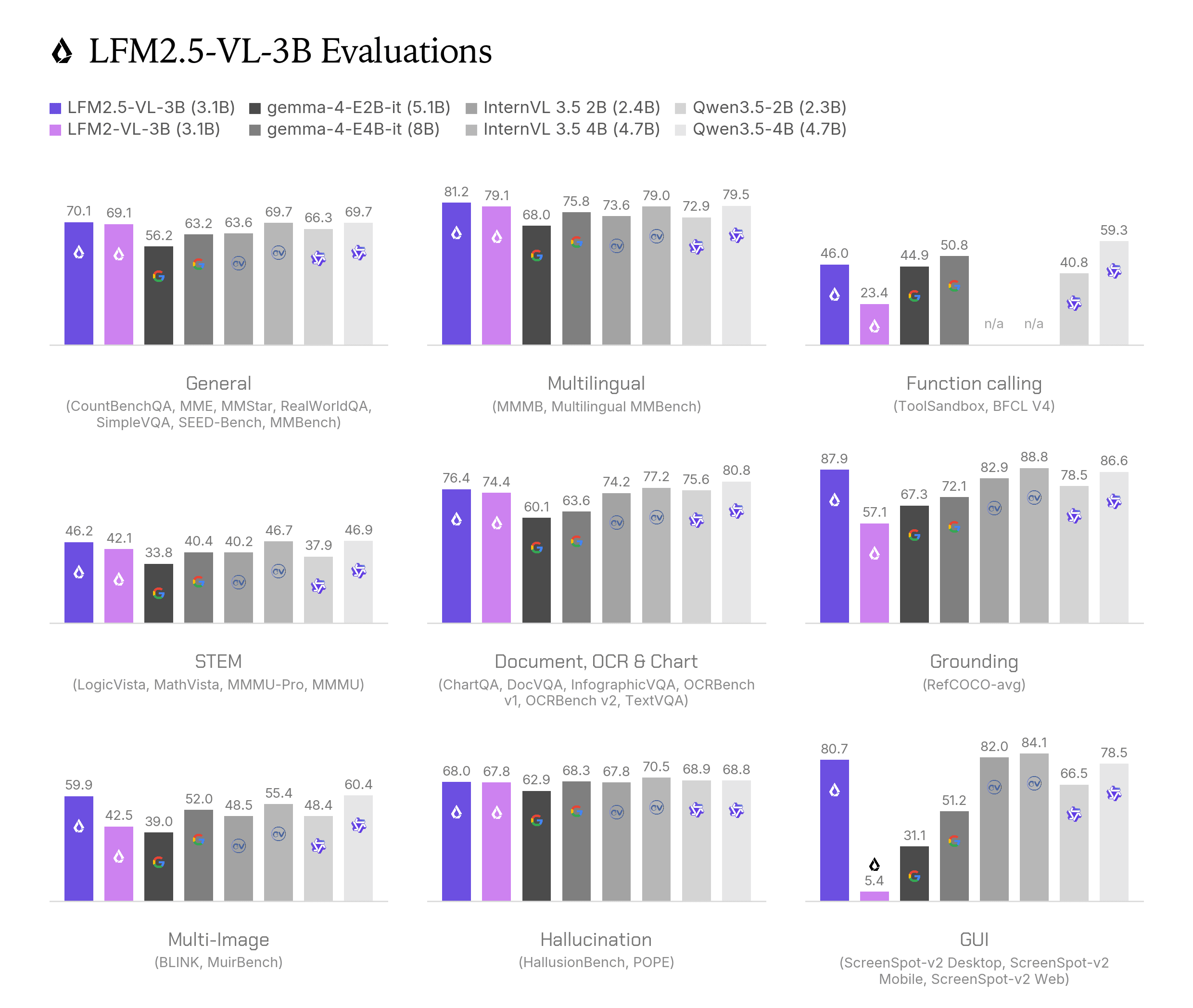
To support non-Latin scripts, we doubled the vocabulary to 128K by extending the tokenizer in place rather than retraining from scratch. Post-training runs in two stages: First is supervised fine-tuning (SFT), with knowledge distillation from a larger teacher and Antidoom training. Second is multi-reward reinforcement learning (RL). 5-VL-3B across both vision and text benchmarks.
The vision benchmarks cover multilingual visual comprehension, instruction following, visual math and scientific reasoning, document understanding, object detection, multi-image understanding, and screen understanding. 5-VL-3B leads its size class on real-world image tasks, while also reading digital content well, from documents and charts to on-screen UI elements. *All values in the table are normalized to 0–100. 0 and each model’s recommended generation parameters when available.
Non-reasoning mode is used everywhere, and models are prompted to directly answer without reasoning. 5-VL-3B on text-only benchmarks for instruction following and tool use. Instruction following climbs across the board, and tool use improves sharply. 5-2B. 5 models do not support function-calling. 5-VL-3B is a strong, general-purpose vision-language model.
It covers everyday tasks (captioning, visual question answering, document understanding) and is especially good at grounding objects, reading screens and documents, and calling tools. cpp, MLX, vLLM, SGLang, and ONNX. On-device inference. 5-VL-3B decodes 228 tokens/s on an M5 Max and 116 tokens/s on a Ryzen AI Max+ 395, and fits in about 3 GB of memory.
What to watch
That is roughly 2× the larger 4B-class models and ahead of even the smaller 2B-class models, which adds up to nearly 1B output tokens per day on a single H100. 5-VL-3B when you need on-device intelligence for high-volume workloads. 5-VL3B for multi-image inputs, grounding, OCR, tool calling, and more in our documentation. Check out our release blog for video examples. 5-VL-3B powering a vision-capable chat interface.
It allows you to take or upload multiple images and let the model interact with them, including grounding, OCR, and tool use. 5-VL-3B is available on Hugging Face today. 5, we're delivering on our vision of AI that runs anywhere. These models are: We can't wait to see what you build.
On Hugging Face Hub