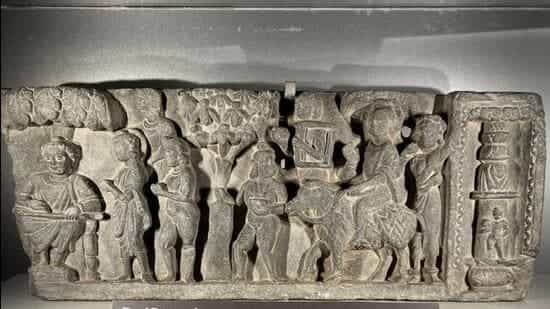
Buddhism has been India’s greatest export for the last 2,000 years. With the return of one portion of the Buddha’s relics from the collection of a private individual, it is an opportune moment to understand the intrinsic and inherent historicity of the Buddha.
It was Buddhist ideas that spread from India in all directions and influenced the world — be it the Greco-Roman world in the west; China, Tibet and other regions of the Silk Route; or the several island civilisations to our east. Buddhism, which was born in the Gangetic plains around 2,500 years ago, has won over the world with its ideology of compassion and commensality.
Gautam Buddha grew up as Prince Siddhartha in the Shakya clan, which controlled much of the present-day Terai region straddling the border between India and Nepal. It is now generally believed that he died around 428 BCE. His passing away at Kushinagar near Gorakhpur led to a struggle between various principalities that ruled parts of the Gangetic plains, as well as his own Shakya clan. An agreement was eventually reached that the cremated remains, or sarira, of the Buddha be divided between eight principalities, including his Shakya brethren.
The Shakyas commissioned a massive dome-shaped funerary memorial, under which, inside a three-tonne sandstone coffer, they deposited precious offerings in their capital Kapilavastu, near Siddharthnagar (earlier known as Naugarh).
The Sanchi stupa near Bhopal has an architrave that depicts the struggle between various principalities, all located in the present-day states of Bihar, eastern Uttar Pradesh, and the Terai region of Nepal. There are scenes of battle with archers shooting arrows and also of resolution: caskets containing corporeal relics atop elephants leaving Kushinagar, the capital of the Mallas, who had tried to keep the Buddha’s sarira to themselves. The other clans made their claims largely because, like them, the Buddha too was a Kshatriya; this is said to have therefore required a negotiation.
T. Rhys Davids writes in Asoka and the Buddha-Relics: “Our oldest authority, the Maha-parinibbana suttanta, which can be dated approximately in the fifth century B.C., states that after the cremation of the Buddha’s body at Kusinara, the fragments that remained were divided into eight portions.”
The eight principalities were Magadha, Vaishali, the Shakyas of Kapilavastu, the Bulis of Allakappa, the Koliyas of Ramagama, the Mallas of Pava, and the Mallas of Kushinagar or Kusinara. In addition, the Moriyas of Pipphalivana, who arrived after the division was made, received the Buddha’s ashes, and Drona, the Brahmin negotiator, was given the vessel in which the Buddha’s body was cremated.
All these ten recipients promised to build mound-shaped memorials and interred their share of the remains. Two hundred or so years later, during the reign of Emperor Ashoka (304–232 BCE), the relics were excavated and further divided, and housed inside many more stupas throughout his empire, which stretched from Afghanistan in the west to Odisha in the east, and from the Himalayas to at least northern Karnataka.
This story of Ashoka has been much debated for its historical authenticity. It comes to us from anthologies such as the Ashokavadana (dated from the first century BCE to the first century CE) and the Lokapannatti from the 12th century. The Kushan king Kanishka I, who reigned in the first century of the Common Era, is also believed to have interred the Buddha’s relics in a stupa near Peshawar, which was discovered in 1908–09.
By the 1800s, the British East India Company had acquired effective control of vast tracts of land from the Nawab of Awadh. These lands were then rented out to entrepreneurs who commenced clearing the marshy, pestilential tracts for farming. The British had also begun research and excavations to unearth India’s history.
Around the 1890s, a polished Ashokan sandstone pillar was discovered at Lumbini, which helped orientalist indologists like T. Rhys Davids, A. Führer and G. Bühler establish for the first time the Buddha’s birthplace, with the help of an inscription that read, “hida-Budhe-jate Sakyamuni-ti” — “Here was Buddha Sakyamuni born” — and the phrase Lumminigame, or “Lummini village”.
Almost a stone’s throw away at the Birdpur estate, its owner William Claxton Peppé, an enthusiast and humanitarian, decided to undertake excavation at the biggest of several mounds within his estate in 1897. He also wanted to help the peasants of the area who were coping with a major famine.
Charles Allen writes in Buddha and the Sahibs: “After digging through eighteen feet of solid brickwork set in clay, a huge slab of stone was disclosed… in perfect preservation, hollowed, at the cost of vast labour and expense, from a solid block of rock. This coffer was weighed on the estate’s weighing machine and found to be 1,537 pounds, the cover being an additional 408 pounds.”
Inside the coffer, Peppé found “three small vases of soapstone between six and seven inches high, a little soapstone box and a crystal bowl three and a half inches high, all in perfect condition. Opened, these revealed ‘pieces of bone, which are quite recognisable as such, and might have been picked up a few days ago’. Along with the fragments of bone were many tiny gold ornaments, including a number of images stamped on gold leaf — human figures, a lion, an elephant, a swastika, stars and flowers.”
On the side of one vessel, in an ancient Pali character, was an inscription that read: “This shrine for relics of the Buddha, the August One, is that of the Sakyas, the brethren of the Distinguished One, in association with their sisters, and with their children and their wives.”
Historians note that the Piprahwa stupa was likely constructed in three phases. It was first built by the Shakyas in the period corresponding to the Buddha’s death. This was followed by a second phase in the early Mauryan period, where construction work is believed to have been ordered by Emperor Ashoka. It was in the second century BCE that he disinterred the Buddha’s remains, replacing the circular mud-built Sakyan structure and creating one of his own to house the relics and relic offerings. This new structure was characterised by well-fired mud bricks made with rice straw and laid in concentric circles.
The third and final phase, likely in the Kushan era, saw the raising of the stupa’s height and the squaring of its base. Monastic buildings were also constructed around the stupa.
More than 1,800 objects recovered from the stupa were subsequently divided and dispersed. Some were presented by Viceroy Lord Elgin, acting on behalf of the British Crown, to King Rama V of Siam, while others were distributed to Buddhist temples in Burma and Ceylon. The remaining relics were divided between the Indian Museum in Calcutta and Peppé himself. Within Buddhist belief, all items placed alongside the Buddha’s ashes — including gemstones and ornaments — are regarded as sharirik dhatu, or corporeal relics.
The excavation uncovered a substantial quantity of ashes and bone fragments, carefully buried approximately 2,400 years ago. Accompanying them was an inscription — among the earliest known examples of writing in any Indian language — rendered in Brahmi script. This inscription explicitly identifies the depositors as members of the Shakya family, who state that they were enshrining the remains left after the cremation of their teacher, the Buddha. This alone renders the find one of the most valuable assemblages of human relics ever discovered.
The stupa is not merely an ancient monument; it is one of the original repositories of the Buddha’s relics, placed there by his own family and bloodline. The Buddha’s message remains India’s unique treasure, and it is good to have some of it back, even though Buddhism long ago waned in India.
(HistoriCity is a column by author Valay Singh that narrates the story of a city that is in the news, by going back to its documented history, mythology and archaeological digs. The views expressed are personal.)
Editorial Context & Insight
Original analysis & verification
Methodology
This article includes original analysis and synthesis from our editorial team, cross-referenced with primary sources to ensure depth and accuracy.