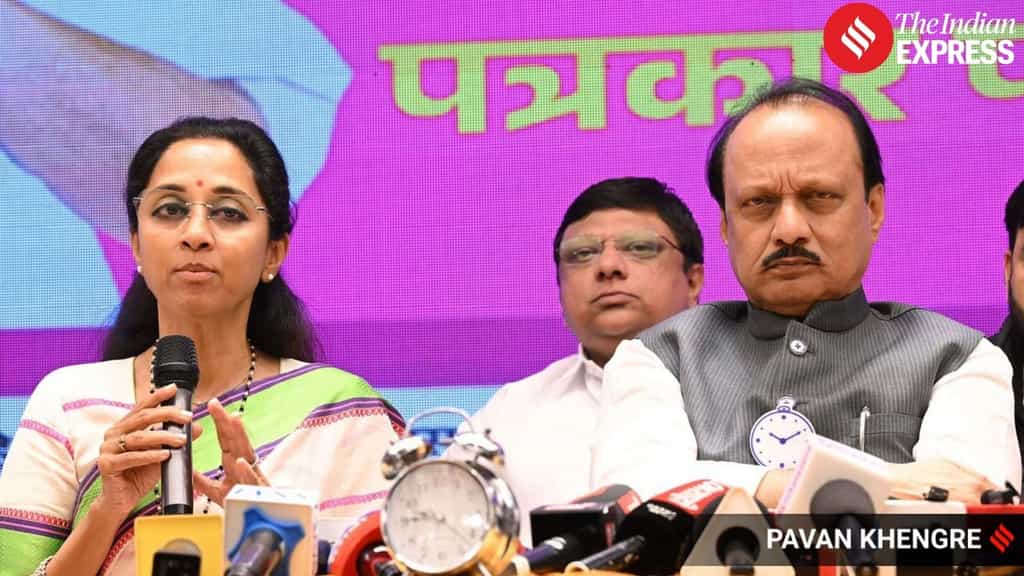
Releasing the joint manifesto of both NCPs for the PCMC polls, NCP national president Ajit Pawar promised voters that they would ensure daily water supply instead of the current system of supply on alternate days. He said that just like Pune, free Metro and PMPML services would be provided to the citizens of Pimpri-Chinchwad.
He also announced that the Draft Development Plan, which had created controversy, would be scrapped.
“Pimpri-Chinchwad Municipal Corporation has witnessed misgovernance for the last nine years. When our parties come to power, we will ensure citizen-oriented governance. Among our top priorities is providing daily water supply. During the BJP’s rule, citizens struggled to get their supply of water. Due to different timings, people had to get up early in the morning to fill their stock. All that will change once we come to power… we will ensure that citizens get daily water supply,” the Deputy Chief Minister said while releasing the manifestos which he said was a “Guarantee card”.
Among others, NCP (SP) MP Amol Kolhe, MLA Rohit Pawar, Assembly Deputy Speaker Anna Bansode, NCP leaders Yogesh Behl, Vilas Lande and Ajit Gavhane, were present.
After he released the manifesto, when he was asked about Chief Minister Devendra Fadnavis’s statement that he had not followed the “alliance dharma”, Ajit Pawar shot back, “I am fighting the civic elections here. I am pointing out the mistakes that there were committed. Showing mistakes does not mean I have not followed the alliance dharma. BJP had made 27 promises for PCMC citizens. However, they failed to keep even one promise,” Pawar said.
“We will ensure that the Pavana pipeline work, which has been stalled for nearly a decade and a half will be made operational. We will take the people of Maval into confidence and set up the pipeline directly from Pavana dam, which will ensure clean water and increased supply. We will ensure all leakages in water pipelines are repaired within a short time.”
Pawar said the cost of project which was envisaged for Rs 380 crore has now crossed the Rs 1,100 crore mark. He added that once daily water supply to every part of the city is provided, the tanker mafia raj would also come to an end.
Just as was promised in Pune, Ajit Pawar said they would provide free Metro and PMPML service to citizens. “The PMC and PCMC will recompensate Maha Metro and PMPML. This will ensure more people travel by public transport, thereby bringing less private buses on roads. As a result, we will have less traffic jams and less of pollution,” he said. The Deputy CM said free Metro and PMPML service was not an election related announcement.
Pawar said the efforts would be made to find a solution to the long-pending issue of Red Zone. “We will take up the matter with the Defence Ministry and try to find a solution to it,” he said.
Pawar said the draft Development Plan would be scrapped as it had created lot of controversy. “At least 50,000 objections were received for the draft DP. The reservations made in the Draft DP has generated controversy and had upset citizens. We would be cancelling it and will restart the process,” he said.
He said the manifesto had the core philosophy of “Seven Commitments, New Begining,” aimed at fixing key civic issues with time-bound commitments and improving the quality of life for every Pimpri-Chinchwad citizens.
“The manifesto has been shaped through six months of ground-level surveys, ward-wise interactions and Jansamvad inputs. It had captured the everyday concerns and expectations of citizens across PCMC. The findings around demands of daily water, scrapping the DP Plan, congestion-free mobility, cleaner neighbourhoods, affordable healthcare and direct relief to citizens point to a clear public demand for delivery over declarations,” he said.
The Deputy CM said when the NCP ruled Pimpri-Chinchwad for 25 years, the roads were wide, pothole-free and there was less traffic jam. “Now roads have become smaller, footpaths have become wide and potholes have become common. We will ensure time-bound road repairs with contractor accountability, citizen reporting through digital platforms, and completion of major flyovers, metro routes and missing links,” he said.
The manifesto promises 100% waste segregation and scientific processing, zero-landfill zones, cleaner streets and incentives for green housing societies.
“We will carry out the expansion of existing hospitals, set up new medical institutions, 100 neighbourhood clinics, low-cost diagnostics and will ensure stronger health protection for the poor,” he said.
As for the education system, he said, there will be more model municipal schools with national education standards, modern facilities, trained teachers and no extra fees.
“Free tablets would be provided for students, interest-free loans for women and focused support for arts and sports,” he said.
He said the “Seven Resolves” are not only based on practical surveys and consultations, but were also deeply inspired by the legacy of Chhatrapati Shivaji Maharaj’s people-centric governance, Chhatrapati Shahu Maharaj’s committment to social justice, Mahatma Phule’s belief in education as the foundation of equality, and Dr B R Ambedkar’s vision of rights, dignity and opportunity.
The Manifesto addresses the growing cost of living, unequal access to opportunity and daily financial pressures faced by citizens by ensuring affordable mobility, universal access to education, direct relief to middle-class families and pathways to self-reliance, especially for women and youth, Pawar added.
Editorial Context & Insight
Original analysis and synthesis with multi-source verification
Methodology
This article includes original analysis and synthesis from our editorial team, cross-referenced with multiple primary sources to ensure depth, accuracy, and balanced perspective. All claims are fact-checked and verified before publication.
Primary Source
Verified Source
The Indian Express
Editorial Team
Senior Editor
Shiv Shakti Mishra
Specializes in India coverage
Quality Assurance
Associate Editor
Fact-checking and editorial standards compliance