In a market where IT, defence, infrastructure stocks surge on order inflows, and pharma stocks react to Food and Drug Administration (FDA) approvals, where do healthcare stocks stand?
Before the pandemic, hospitals were largely viewed as cash-burning ventures. Since then, they have turned into steady cash flow generators. Behind this turnaround is the adoption of an integrated healthcare model that generates multiple sources of revenue and boosts operational efficiency by increasing capacity utilisation with a diverse mix of patients and medical procedures.
Apollo Hospitals Enterprise was Asia’s foremost integrated healthcare services provider, earning revenue from multi-speciality hospitals, pharmacies, primary care and diagnostic clinics, and several retail health models. It was also the first hospital stock to get listed on the Bombay Stock Exchange in 1983.
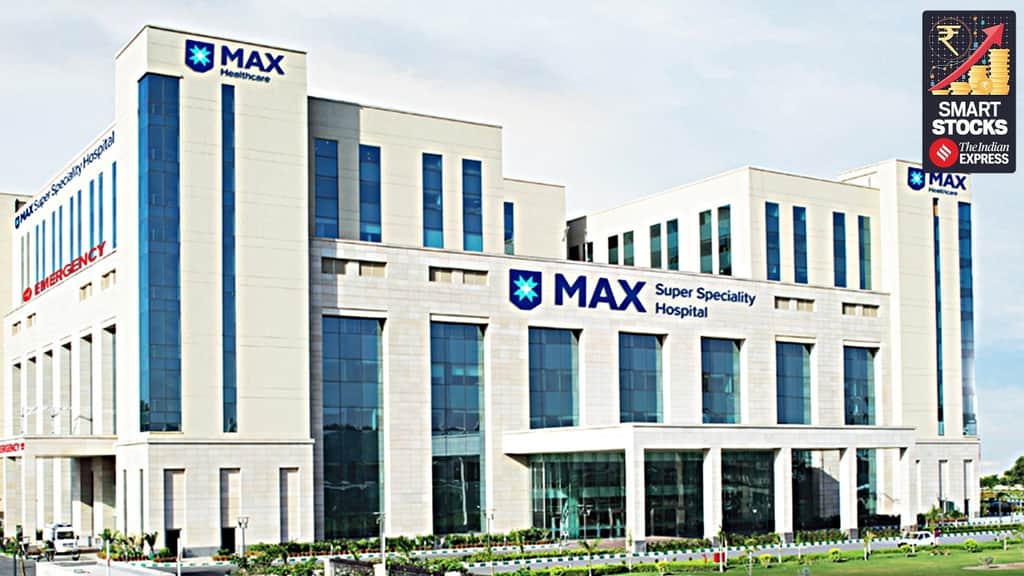
Max Healthcare Institute took a leaf from Apollo’s books and offered integrated healthcare services from primary care clinics to multi-speciality hospitals, pathology services, and related healthcare services. However, it employed a different implementation methodology to achieve profitability. Today, it has surpassed Apollo in profit margins and market capitalisation to become one of the most profitable healthcare businesses in the country.
Fundamentals of Top 4 Hospital Stocks in India. (Source: Screener.in)
Max’s strategy of acquiring underperforming hospitals in Delhi and Mumbai and turning them around has helped it become profitable. It is this profit journey that has secured Max a place in the Nifty 50 Index and trade at the highest price-to-earnings (P/E) ratio of 74x among the above four hospital stocks.
Max Healthcare’s 4.5-year stock price rally of 811% was driven by two growth cycles, from January 2021 to January 2022 and from April 2023 to December 2024. There was a period of stagnation between the two growth cycles in FY2023.
Max Healthcare’s Stock Price Momentum 2021-2025. (Source: Trading View)
The growth has plateaued once again in FY26, with the stock falling 6% in CY 2025. It is not just Max, Apollo, and Global Health stocks also slipped into the red this year. However, analysts are optimistic about hospital stocks and expect the addition of new beds to drive growth in the coming years.
That leaves investors with many questions: Is this stagnation the silence before the next growth cycle? Or have Max’s high valuations diminished its appeal as a slow compounder? To understand the current state and future growth prospects of Max Healthcare, we need to understand the compounding model driving its cash flows.
The Indian hospital industry statistics suggest a significant shortage of hospital beds, well below the World Health Organization’s recommendation of three beds per 1,000 population. Despite the shortage, many regional hospitals suffered from underutilisation, which led to cash burns.
Hospitals are capital-intensive to build. Even the operating cost is high, from doctors’ salaries to medical instruments and facility maintenance. Another problem is location, availability of specialities, and patients’ payment capacity. If a hospital aggressively builds new capacity and occupancy remains low, or there is a large mix of low-margin medical procedures, fixed overheads could hurt profit margins.
Nine years of building and huge cost overruns was the story of BLK Hospital in Delhi, which today is part of Max Healthcare. Even the Max India Group faced significant debt. High capex and low margins discouraged private equity funds from making majority investments.
Multi-Speciality Hospital Valuations July 2015-2025. (Source: KPMG December 2025 report ‘Multi-Speciality hospitals in India – Evolution of hospital deals post COVID’)
Hospitals need patient capital from private equity investors, given their lengthy breakeven time. In 2020, diagnostics companies like Metropolis Healthcare, Dr Lal PathLabs, and Thyrocare became investor favourites, attracting a value of 50x EV/EBITDA, while listed hospitals were valued at 15x.
Private equity funds saw an opportunity to unlock value by consolidating single hospitals and regional chains into large hospital groupings. The healthcare industry faced a period of consolidation post-Covid. The early PE investors who invested in integrated healthcare before the pandemic realised significant capital appreciation, and Max Healthcare was one of them.
In 2018, KKR acquired a 51.9% stake in Max Healthcare in an all-cash deal and brought on board restructuring expert Abhay Soi of Radiant Life Care. At that time, Soi was working on restructuring BLK Hospital, onboarding big doctors, focusing on medical tourism, and less-competitive sub-specialities like organ-specific oncology, bone marrow transplants, and organ transplants.
The Max deal was completed in 2020, with KKR and Abhay Soi (23% stake) becoming co-promoters and Analjit Singh, the founder-promoter, exiting the business. Soi now had the third-largest hospital chain, a strong brand but low profitability – 9.7% EBITDA margin. With long-term PE funding and a restructuring expert, Max Healthcare had all the ingredients to succeed.
Max Healthcare’s EBITDA journey FY19-25. (Source: Max Healthcare Q2FY26 Investor Presentation)
Soi combined the functions of Max and Radiant, and changed systems and processes to increase EBITDA margin to 17.5%. Acquiring underperforming hospitals and improving their efficiency became Max Healthcare’s execution mantra. It has acquired existing capacity, such as Nanavati Hospital in Mumbai, Jaypee Hospital in Noida, Alexis in Nagpur, and Sahara in Lucknow. EBITDA breakeven is almost immediate for brownfields, said Soi in the Q2FY26 earnings call.
In FY25, Max Healthcare had one of the best EBITDA margins of 26.8% and a return on capital employed (ROCE) of 15%.
Why did share prices plateau in CY 2025?
High ROCE attracted hospital chains to increase capacity. Leading hospital chains like Max, Apollo, Fortis, and Medanta (Global Health) plan to add 32,000 beds in the next five years, with Max having the most aggressive expansion plan to double its capacity to 10,000 beds. Investors fear this could lead to overcapacity and stress the hospital’s EBITDA and ROCE. Their apprehension has led to flat/negative growth in hospital stocks in calendar 2025.
Max Healthcare’s Key Performance Indicators FY24-H1FY26. (Source: Max Healthcare Q2FY26 Investor Presentation)
Max Healthcare added over 30% capacity in FY25 with a greenfield hospital in Dwarka and the acquisition of Jaypee Hospital in Noida. This reduced its EBITDA margin and ROCE between FY24 and H1FY26, pulling the stock down 6% despite an increase in average revenue per operating bed (ARPOB) and occupancy.
Unlike the manufacturing and energy sectors, expansion may not necessarily lead to share price growth. Healthcare investors look at profits more than revenue.
Is fresh growth warranted for 2026?
Around 70% of Max Healthcare’s capacity expansion is brownfield and focused on super-speciality care in metros and top-tier urban clusters such as Mumbai, Lucknow, Mohali, Dehradun, Nagpur, and Bathinda. Since the EBITDA breakeven is immediate in brownfield, ROCE will improve as debt is paid off.
However, Max’s high P/E and EV/EBITDA valuation compared to its peers show that investors have already priced in profitability growth. That explains the correction in its share price in 2025.
The last time Max’s share price growth stagnated, its P/E ratio slumped to the low-40s in March 2023 from 100x in October 2021.
Max Healthcare’s P/E ratio from 2021-2025. (Source: Screener.in)
However, analysts are bullish about the long-term growth prospects of Max Healthcare and the compounding effect of ROCE-focused brownfield expansion. Apart from expansion, they are bullish on improving payor mix, case mix (oncology and radiation), and increasing focus on international patients. Brokerages expect a 20-30% upside in the stock price.
Growth from the current market price of Rs 1,068
Taking a holistic view, Max Healthcare’s ROCE-first approach in brownfield expansion makes it a slow compounder in the long term. However, it would be difficult for the stock to replicate the 800% rally triggered by the turnaround. In fact, high valuations might limit short-term upside.
Favourable regulatory and policy changes could significantly boost the growth. The recent reduced GST rate on insurance, medicines, and medical equipment to nil or 5% and the Central Government Health Scheme’s (CGHS) 5%-30% increase in rates of medical procedures in cardiology, neurology, oncology, and orthopaedics specialities have had, and will continue to have, a positive impact on margins.
India is emerging as a medical tourism hub. Industry tailwinds like increasing awareness of preventative care, higher discretionary income in the hands of consumers, and technology advancements could make healthcare stocks stable cash compounders in the long term. Yet, there will be periods of stagnation as industry absorbs new capacity.
Note: We have relied on data from http://www.Screener.in throughout this article. Only in cases where the data was not available have we used an alternate, but widely used and accepted source of information.
Puja Tayal is a financial writer with over 17 years of experience in the field of fundamental research.
Disclosure: The writer and his dependents do not hold the stocks discussed in this article.
The website managers, its employee(s), and contributors/writers/authors of articles have or may have an outstanding buy or sell position or holding in the securities, options on securities or other related investments of issuers and/or companies discussed therein. The content of the articles and the interpretation of data are solely the personal views of the contributors/ writers/authors. Investors must make their own investment decisions based on their specific objectives, resources and only after consulting such independent advisors as may be necessary.
Editorial Context & Insight
Original analysis & verification
Methodology
This article includes original analysis and synthesis from our editorial team, cross-referenced with primary sources to ensure depth and accuracy.
Primary Source
The Indian Express