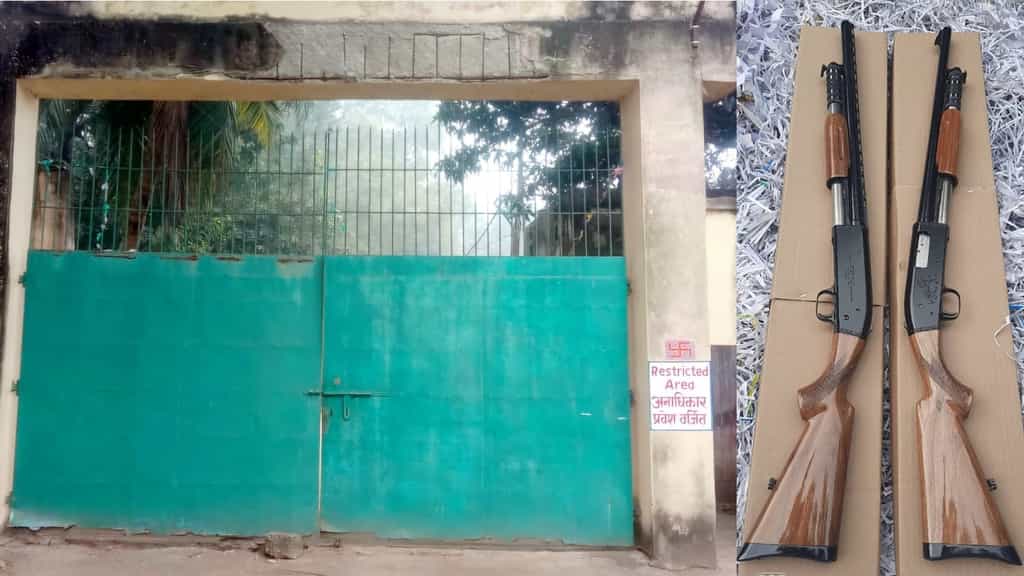
While the once-famed Munger gun factories have lost their firepower of late due to strict licensing norms and the rise of illegal arms manufacturing, they are set to get a new lease of life as a defence corridor that produces a whole range of defence equipment, including arms, bulletproof jackets, explosives, helmets, body armour, and night vision devices.
Located in Bihar’s Munger district, the factories are among India’s oldest-surviving arms manufacturing units, established in 1762 under colonial rule. The factories then evolved into a specialised hub for the manufacture of breech-loading firearms, a craft passed down through generations, ingrained deeply in Munger town’s economy and identity.
For decades, the factories catered primarily to civilian demand, and at their peak, they employed close to 1,500 families.
There are 37 privately owned gun factories in around eight acres of land that belongs to the Bihar Industrial Area Development Authority (BIADA). In 2001 alone, the factories paid excise duty to the tune of Rs 2-3 crore. However, changes to India’s arms licensing policy in 2016 reduced the number of firearms a civilian licence-holder could possess from three to two. Added to this, the parallel production and assemblage of duplicate firearms, especially desi katta, led to the slow downfall of the factory. Instead of its earlier engagement of 1,000-1,200 workers per week, it now has around 150 workers. Many of those who lost their jobs at these factories have since taken work as masons or auto drivers.
Bihar Deputy Chief Minister and Home Minister Samrat Choudhary told The Indian Express about the plan to revive the factories. “The Bihar Cabinet has recently given the nod for the creation of a new tech hub that includes a defence corridor, a semiconductor manufacturing park, global capability centres, a mega tech city and a fintech city. The Munger gun factories will be revived and upgraded under the new defence corridor,” he said.
A government official said that the defence corridor could lead to Munger manufacturing weapons such as automatic machine guns, ammunition and rocket launchers, potentially generating large-scale employment.
A defence corridor is a strategically planned region that promotes indigenous production of defence and aerospace-related items, aiming to make India self-reliant in defence production. The corridors are designed to boost the country’s defence manufacturing capabilities, reduce imports, and increase exports.
Sandeep Kumar Sharma, joint secretary of the Munger Gun Manufacturers (Licensees) Association, told The Indian Express: “The shift in licensing policy in 2016 resulted in changing consumer preferences. The demand for breech-loading weapons was replaced by demand for faster-firing weapons such as pistols and rifles. Many civilians also had to surrender the weapons they owned. Evidently, for a factory that was built almost entirely around that category of firearms, the impact was immediate and prolonged.”
Sharma said Munger’s craftsmen, with their centuries-old expertise in gun-making (barrels, precision parts, assembly), can manufacture various types of guns, including small arms, rifles, and shotguns, as well as ammunition, cartridges, weapon components and parts, along with sporting firearms, non-lethal weapons and items for defence export.
Kali Charan Sharma, a proprietor of one of the factories, spoke of the issues facing the Munger units. “A total of 108 gun factories in India, including 37 in Munger, suffered from paucity of work after only around 600 new arms manufacturing licences were issued across India since 2016. It is important to note that most of these operate without production caps and receive access to government incentives and financial support. Munger, by contrast, continues to operate with a production cap of 12,392 breech-loading guns annually, while relying on its own limited revenue. Once we get the transfer of technology under the new defence corridor, we have the skill to manufacture ancillaries and guns,” Sharma said.
A gun factory employee said, “The consequences are largely visible. Skilled workers have migrated to cities in search of alternative livelihoods, often taking up employment as e-rickshaw drivers or gig workers. What once was a generational skillset is on the brink of being erased.”
It is in this context that the Bihar government’s recent move to explore a defence corridor has sparked careful optimism. For Munger, inclusion into this framework could mark a structural revival.
A senior police officer, who has worked in Bihar, said the defence corridor could also help wipe the stigma that the town has faced due to being associated with illegal arms manufacture. “While the illegal business of firearms in Qasim Bazar and Bargeh areas of Munger is minimal now, the defence corridor could put a complete end to the illegal arms business,” the officer said.
On November 25, steps were initiated to integrate Bihar into the national defence corridor framework, which is already operational in Uttar Pradesh and Tamil Nadu. Nationwide, this policy carries an outlay of Rs 27,000 crore — funds that have thus far bypassed Bihar.
Editorial Context & Insight
Original analysis & verification
Methodology
This article includes original analysis and synthesis from our editorial team, cross-referenced with primary sources to ensure depth and accuracy.
Primary Source
The Indian Express