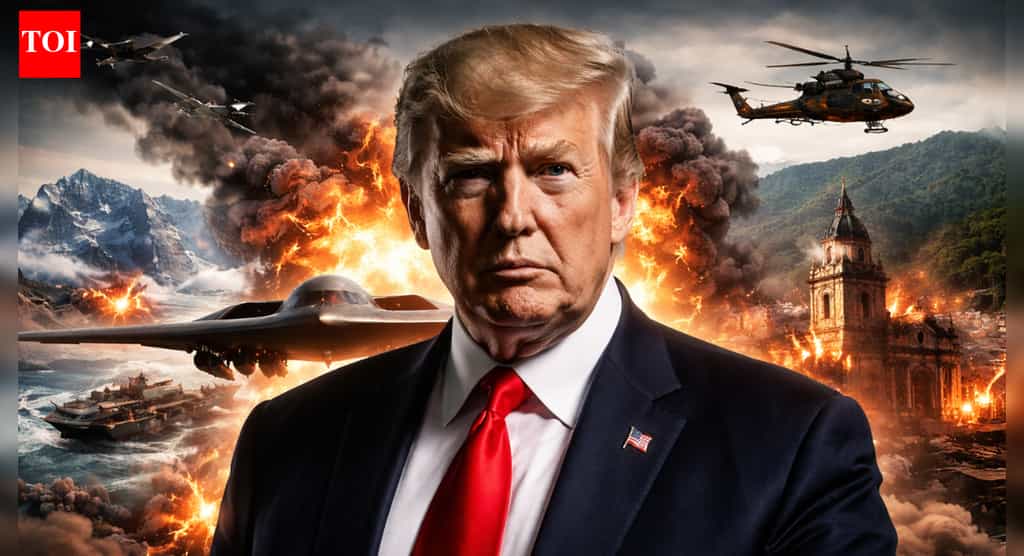
With Donald Trump chasing the "Nobel Peace Prize," the world, under his cinematography and choreography, has witnessed superscale military operations by the United States. Uncle Sam has alternated between meddler, intimidator, mediator, aggressor, provocateur and even preacher, often depending on Trump's day and mood."Peace on Earth" -- with these words, US President Donald Trump began the year 2026. Within 48 hours, however, he changed his mind, moving with full force against Venezuela's sitting president, Nicolas Maduro. Under Operation Absolute Resolve, Trump ordered overnight military action, reducing Maduro from president of a country to a prisoner in a cell on US soil, and leaving a country with the world's largest oil reserves open for American capitalists to exploit.
Trump went on to justify the move under what he absurdly termed the "Donroe Doctrine" -- a repackaged version with Trumpian twist of the 200-year-old "Monroe Doctrine" of the fifth US president, James Monroe.
Projecting himself as the self-appointed overseer of the Western Hemisphere, Trump assumed responsibility for its "well-being" through a carefully branded strategy he calls the "Trump Corollary" -- another presidential artifact unearthed from more than a century ago, inspired by the "Roosevelt Corollary", belonging to Theodore's era.
However, Venezuela was certainly not the beginning for Trump, but a bold continuation of his approach. In June, Trump ordered strikes on Iran's nuclear program and, over the past year, has also overseen attacks on Iraq, Nigeria, Somalia, Syria, Yemen -- and now, most recently, Venezuela.Even as he pushes with all his will for peaceful negotiations to end the long-running and ongoing Russia-Ukraine war and appears disturbed when his Chinese counterpart Xi Jinping takes an aggressive stance on Taiwan, Trump repeatedly takes credit for mediating ceasefires in several conflicts, some genuinely settled, others not completely.
Despite, his claim of settlign 8 wars, he often shifts roles. On some days, Trump casts himself as a "mediator" of peace; on others, he becomes an "aggressor" himself, as Uncle Sam has not shied away from deploying even the deadliest assets, such as "B-2 bombers," to secure its interests and reassert the United States as the one and only global "hegemon.
"Not even a fortnight after the strikes on Venezuelan capital, Caracas, Trump has already drawn up a new list of potential targets. Iran appears to be back in focus, along with countries and territories under Trump's "Donroe Doctrine" radar -- Cuba, Colombia, Mexico, Panama and Greenland among them. Any one of these could become the next stage for a jam-packed display of military action, watched live on television from the White House or from his private Mar-a-Lago beach club in Florida.
In the new year, US President Trump has put the world on alert, threatening countries across multiple regions with possible US military action. From Europe's Greenland to the Middle East's Iran, from North America's Canada to Latin America's Colombia, Trump has cast a shadow of risk across continents. Here are the countries that currently lie under Donald Trump's radar of potential threat.
Trump's yearlong desire to take over big icy-chunk of Denmark Kingdom gained interest again after toppling Venezuelan leader MaduroWith the start of 2026, Trump has renewed his demand from early days of second-stint presidency, pushing the demand for icy-snowy land -- near arctic -- Greenland.
However, unsurprisingly, both the prime ministers of Denmark and Greenland -- Metter Frederiksen and Jens-Frederik Nielsen, have pushed back against the US claims, emphasising on sovereignty."We do need Greenland, absolutely," Trump told The Atlantic over the weekend. "We need it for defense."
Apart from Danish and Greenlandic PMs, the other world leaders have also rejected the claims of Trump. However, Trump's recent comments to claim the great white land under the Kingdom of Denmark, has also put challenge to Nato.When asked what it would mean if the US used force against another Nato member, Frederiksen replied, "If the US attacks another Nato country, everything stops."
There is full support from Europe that borders must be respected.
Greenland is not a distant outpost but is of great importance to the whole of Europe. It is an Overseas Country and Territory of the European Union with special rights.Denmark, most recently, warned the US that Danish troops are under standing orders to "shoot first and ask question later," if Greenland comes under attack.The Trump administration is considering a plan to offer direct cash payments to Greenlanders in an effort to persuade them to break away from Denmark and move closer to the United States, according to multiple sources cited by news agency Reuters.US officials have talked internally about offering lump sum payments of between $10,000 and $100,000 per person to residents of Greenland. The island nation is currently a semi-autonomous Danish territory with a population of about 57,000 and has an abundance of useful natural resources.
The idea remains at a preliminary stage and details are still unclear. Aides have discussed figures that could amount to nearly $6 billion in total, sources said.
Iran, with the advent of 2026 found itself in the middle of another major protest. The Islamic Republic over the years have crossed the similar paths and patterns of protest in the country.The immediate spark was the collapse of the Iranian rial to roughly 1.4 million per US dollar, a historic low that coincided with inflation climbing past 50%, food prices surging more than 70% year-on-year, and wages losing value almost overnight. The protests continuing for over 10 days now. The large part of crowd gathered together against the rule of Supreme Leader Ayatollah Ali Khamenei, and found direct Donald Trump's support as he openly talked and posted on Iran protest, again showing his long-born rage against Supreme Leader Khamenei.Also warned and threatened Tehran's leadership that US will strike them "very hard." Notably, Iran, like Venezuela has vast reserves of oil, Tehran has been a stumbling block for the US.Trump said: "What they've done is, in the past, they started shooting the hell out of [protesters]... and I said if they do that, we're going to hit them very hard... So far, for the most part, they haven't... The enthusiasm to overturn that regime is incredible."The ongoing protest made the Islamic Republic under Khamenei vulnerable, it would hardly afford to deal with foreign problems invading the country, and this very reason makes it all easy for Trump to go and bomb the country and look to topple the Khamenei regime.However, Khamenei responded that Iran will not tolerate mercenaries for foreigners. Iran’s 86-year-old supreme leader accused protesters of “destroying their own streets to please the president of another country,” referring to Donald Trump, as crowds responded with chants of “Death to America.”
Donald Trump's problems with Iran is no new mystery. In his first presidential stint -- 6 years ago, as the US president that time also, Trump-led administration carried out a targeted drone strike in January 2020, that eventually led to the elimination of major figure in Iran -- Major General Qasem Soleimani.
Trump's problems with Mexico seems deeper as he moves towards second year of his second stint. "She is very afraid of the cartels," Trump said of Mexican President Claudia Sheinbaum in an interview with Fox News. "I've asked her many times, 'Would you like us to eliminate the cartels?'" Sheinbaum, he claimed, had declined. "So we have to do something, because in my opinion the real number of deaths [from drug use] is 300,000 a year."The left-wing Mexican president has so far managed to contain the US president with great diplomatic skill, even earning her the nickname the "Trump whisperer."Speaking to journalists on Monday, Sheinbaum said she did not see a hypothetical US intervention in Mexico as likely, even though Trump had insisted on it during calls between the two leaders."I don't believe in an invasion; I don't even think it's something they're taking very seriously," Sheinbaum said.
It is necessary to reaffirm that in Mexico the people rule, and that we are a free and sovereign country, cooperation, yes; subordination and intervention, no.
In Donald Trump's latest attack directed towards the neighbouring Mexico. The US president blatantly said "We are going to start now hitting land with regard to the cartels. The cartels are running Mexico."This sums up the damage caused by Trump's threats towards Mexico. Even if the US does not attack any of the three countries, Washington's intimidation attempts are not failing to have an effect on society.
“Cuba now has no income. They got all of their income from Venezuela, from the Venezuelan oil.
They’re not getting any of it. Cuba literally is ready to fall,” Trump said.
Publicly, Cuban President Miguel Díaz-Canel appeared unfazed. Addressing thousands at a rally in Havana the same day, he accused the United States of “fascist state terrorism” and “imperialist barbarism.”“No, gentlemen imperialists, this is not your ‘backyard’… We do not recognize the Monroe Doctrine, nor the kings or emperors above us,” Díaz-Canel said.
“For the sake of Venezuela, as well as for the sake of Cuba, we are ready to give even our blood, even our life, but we will not back down."He added, "Now is not the time of half measures; it is the time of certainty and choice of sides in the face of fascism and imperial barbarism. Down with imperialism!”
Behind the defiant rhetoric, however, experts warn that Cuba may be the biggest casualty of the US military strike on Venezuela.
According to Bert Hoffmann, a Cuba specialist at the GIGA German Institute of Global and Area Studies in Hamburg, the loss of Venezuelan oil has sharply intensified an already severe crisis.“The situation is already very tense, and the loss of Venezuelan oil is dramatically exacerbating the energy crisis. This oil accounted for 70% of all Cuba’s oil imports,” Hoffmann told DW. “There is no one in Cuba who is not deeply concerned about this, both among the population and the government.
So the crisis will continue to worsen.”The assessment suggests that Washington’s strategy of economically squeezing Cuba could be effective. Daily life on the island is already marked by hours-long power cuts, shortages of food, medicine and fuel, and dwindling tourism, once the country’s most important source of income. In response, the Cuban government is searching for alternative oil suppliers, with Hoffmann mentioning that Havana is looking toward Russia, Arab states, Iran or Algeria.“The most likely scenario is that the political leadership will make every effort to keep the ranks so tightly closed that the dissatisfaction of the population will ultimately find no political expression,” Hoffmann told DW.So far, Cuba’s power structure appears intact. “The Communist Party, the military, and the security apparatus are closely intertwined,” Hoffmann said. “As long as no cracks appear there, this elite will remain relatively firmly in the saddle.”He added that while some assistance from Russia and China is likely, it will fall short of any open confrontation with the United States. Hoffmann also does not expect direct US military intervention against Cuba in the immediate future.
US President Trump described Colombia as “very sick” and said its government was being run by “a sick man who likes making cocaine and selling it to the United States.”
Gustavo Petro’s response to Trump’s remarks was swift. The Colombian president, who has frequently pushed back against attacks from Trump and Elon Musk on social media, went all out once again on platform X.“Every soldier in Colombia now has an order: any commander of the security forces who gives preference to the US flag over the Colombian flag will be immediately dismissed from the institution on the orders of the base, the troops and myself. The order to the security forces is not to shoot at the people, but at the attacker,” Petro wrote. He went on to ask Trump to “stop slandering” him and urged Latin American nations to unite or risk being “treated as a servant and slave.
The Trump administration has never hidden its view that left-wing governments in South America are a problem, long regarding the continent as the United States’ backyard.Apart from direct strikes in Venezuela's neighbourhood, Trump could hope for the change in government.To install a preferred government in Bogota, Trump, short of military action, could look to the upcoming presidential elections in May, where ultra-right-wing candidate Abelardo de la Espriella, seen as friendly to the US, is in the race.However, polls currently show left-wing candidate Iván Cepeda in the lead, while incumbent president Petro is constitutionally barred from seeking another term.
US President's another fancy is to welcome Canada added in his dream map of US.For Canada, Trump initially turned down the usage of American military prowess to take over it and make 'The Great White North' as "51st state" of US.Trump said the US “subsidizes Canada to the tune of $200 billion a year,” argued that “we don’t need anything that they have,” and claimed that “if Canada was a state, it wouldn’t cost us.”"Something could happen with Greenland, I'll be honest," Trump said in an interview with NBC News. He said that "we need that for national and international security," but he added "I don't see it with Canada. I just don't see it."However, that said, Trump’s next moves cannot be predicted with certainty, as he is known for sudden mood swings and policy flip-flops. Canada, one of the world’s largest economies and geographically larger than the United States itself, presents a vastly different scenario—far removed from airstrikes on Caracas in Venezuela.Since his re-election, Trump has repeatedly talked about making Canada the "51st state," enraging Canadian leaders and residents. He even went to the extent, referring the then-Prime Minister Justin Trudeau as "governor," and mused about erasing the 5,525-mile border altogether.
Venezuela - Despite modelling himself as the “president of peace” deserving of a Nobel Peace Prize, who -- he claims -- has ended eight wars around the world this year, Trump’s Venezuela strike was just the latest in a string of his administration’s military attacks around the globe since its inauguration in January.
Trump-led US launched Operation Absolute Resolve in midnight hours and ultimately toppled Venezuelan leader Nicolas Maduro with his wife from Caracas.Not just Venezuela, Trump's offensive in 2025 covered targets in Caribbean Sea, the US has amassed presence of military in decades, causing tensions among governments there.Nigeria - On Christmas Day, the US carried out what Trump called “powerful and deadly” strikes on groups Washington says are linked to ISIL in Nigeria’s Sokoto State. The action followed weeks of US pressure on Abuja, accused by Trump and Republicans like Ted Cruz of enabling a “Christian genocide,” claims Nigeria denies, saying both Christians and Muslims suffer amid violence by ISIL- and al-Qaeda-linked groups.Somalia - The US has long trained Somali forces and carried out airstrikes against armed groups, including al-Qaeda-linked al-Shabab and an ISIL offshoot known as ISIS-Somalia.
Syria - US strikes on 70 ISIS in Syria in December were carried out in retaliation for a shooting in Palmyra which killed two US soldiers and a civilian interpreter a week earlier.Iran - During brief hostilities between Iran and Israel earlier in 2025, the US intervened, striking three major Iranian nuclear sites on June 22 under Operation Midnight Hammer, using most lethal B-2 bombers. With this bombing, Trump threatened Khamenei's rule in Islamic Republic.
Iran, a signatory to the 1970 Nuclear Non-Proliferation Treaty, is barred from developing nuclear weapons and in 2015 agreed under the JCPOA to limit uranium enrichment in exchange for sanctions relief.Yemen - Yemen was another Middle East target in 2025, as the Trump-led US launched retaliatory strikes over Houthi attacks on Israeli-linked vessels in the Red Sea in solidarity with Gaza. The campaign intensified into daily attacks in March 2025 under a mission dubbed Operation Rough Rider.Iraq - The US carried out airstrikes in Iraq’s al-Anbar province in March, killing a senior ISIL leader, according to CENTCOM. The strikes killed the group’s second-in-command, Abdallah “Abu Khadijah” Malli Muslih al-Rifai, and another operative. Trump later hailed the operation on Truth Social, writing, “Today, the fugitive leader of ISIS in Iraq was killed.”
Editorial Context & Insight
Original analysis & verification
Methodology
This article includes original analysis and synthesis from our editorial team, cross-referenced with primary sources to ensure depth and accuracy.
Primary Source
Times of India