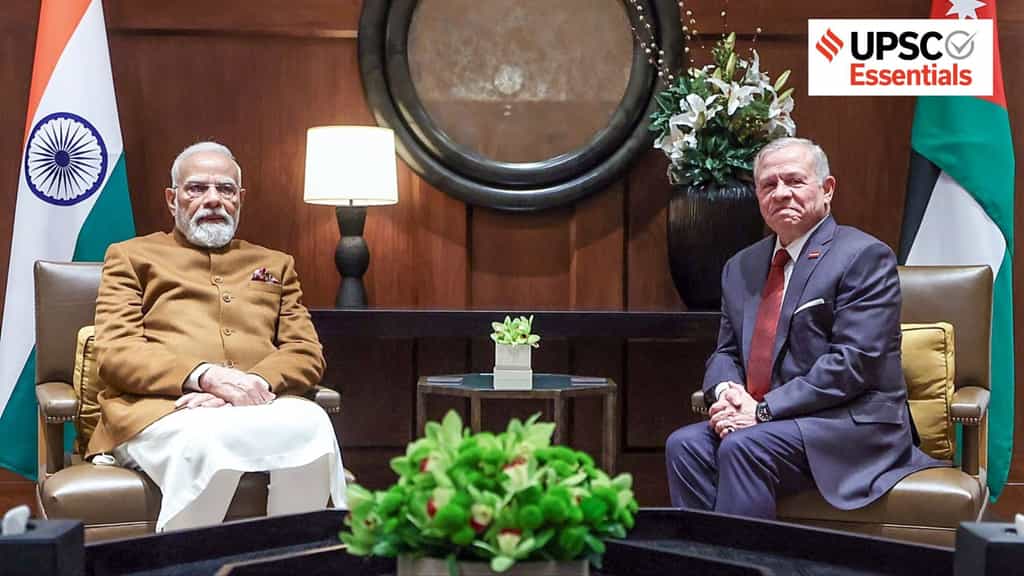
Prime Minister Narendra Modi’s visit to Jordan on 15-16 December 2025 has acquired greater importance in view of the Hashemite Kingdom’s strategic and political significance, as well as trade and investment opportunities it offers to India.
It also reinvigorates the scant diplomatic and political attention Jordan has received in India’s engagements with the Middle East since the establishment of formal relations in 1950. The visit can also be seen in the context of the new dynamism in India’s foreign policy approach, reflected in the vigorous engagements with the strategically important Middle East region.
Prime Minister Modi’s visit was the first official visit to Jordan by an Indian Prime Minister since 1988, when then-Prime Minister Rajiv Gandhi had visited the kingdom. In February 2018, Prime Minister Modi made a brief stopover in Amman during his official visit to Palestine.
The next high-level visit from the Indian side to Jordan occurred when President Pranab Mukherjee visited Amman in October 2015. This was a landmark visit, underscoring India’s importance to the relatively lesser discussed but significant regional country in the Middle East. Notably, the visit can be attributed to the new dynamism in India’s foreign policy that resulted from Modi’s election as the Prime Minister following his landslide victory in 2014.
From the Jordanian side, the first visit came in 1963 when King Hussein visited India. It took over 40 years for the next visit by a Jordanian monarch to India, when King Abdullah visited New Delhi along with Queen Rania in 2006. After Pranab Mukherjee’s visit to Amman, King Abdullah visited India for a second time in February 2018.
Although the absence of strong bilateral relations during the Cold War can be attributed to the divergent foreign policy approaches of the two countries, the continued sidelining of Jordan in India’s engagements with the Middle East in the post-Cold War period was puzzling.
For an ambitious and powerful nation like India, the absence of vigorous engagement with a small but important country like Jordan belied its interests in a highly volatile yet significant Middle East region. Jordan’s importance lies both in its geographic location and political positioning.
Sitting at the crossroads of the major regional powers, Jordan has long attracted international attention due to its strategic location in the Levant. With its significant presence on the Gulf of Aqaba and its strategic location between Egypt, Israel, Syria, Iraq, and Saudi Arabia, Jordan serves as a crucial access point in the region.
Together with the strategic and political significance of the kingdom, it is its economic attraction that makes Jordan significant. Over the years, Jordan has faced financial and demographic challenges and continued to depend on external support for economic survival.
It presents ample opportunities for India and Indian businesses in terms of physical and digital infrastructure developments, offering state-of-the-art services, contributing to its food, health and energy security, enhancing sustainability through affordable and efficient solutions to climate vulnerability and in training human resources.
Hence, from an economic perspective, Jordan offers India both trade and investment opportunities. Moreover, the country is significant due to its location in the Eastern Mediterranean, a region rich in gas, which can be an attractive proposition for Indian energy companies seeking to expand their international footprint.
The location further makes Jordan important for India’s ambitions to augment its trade with the Middle East and Western Europe, especially as the India-Middle East-Europe Economic Corridor (IMEEC) is set to pass through Jordan.
In addition, Jordan’s cultural and religious importance provides it with strong international attraction, especially for the Abrahamic faiths. The Kingdom’s custodianship of the Haram al-Sharif/Temple Mount, including the Dome of the Rock and the Al-Aqsa Mosque, makes it even more important in the prolonged contest over the religious sites in Jerusalem.
More importantly, in the Israeli-Palestinian conflict, Jordan’s ability to avoid polemics and maintain relations with Israel without compromising on its support for Palestinian statehood is remarkable.
Given the above-mentioned significance of the kingdom, the visit of Prime Minister Modi has taken on even greater importance. During the visit, Prime Minister Modi met with and held closed-door and delegate-level talks with King Abdullah.
The discussions were significant, as the two leaders appreciated the support they received on critical issues, including combating terrorism and addressing the exigencies arising from the public health crisis caused by the COVID-19 outbreak.
The Prime Minister also highlighted the need to expand trade relations, which currently stand at US$2.6 billion, to US$5 billion over the next five years. The two leaders agreed on the importance of improving trade, business and commercial relations, especially in the fields of “renewable energy, fertiliser and agriculture, innovation, IT and digital technologies, critical minerals, infrastructure, health and pharma, education and capacity, tourism and heritage”.
The two sides also agreed to strengthen defence and security relations, as well as people-to-people and cultural ties. Five MoUs, including one on technical cooperation in the field of new and renewable energy, were signed.
The other MoUs were on cooperation in the field of water resources management and development, on a twinning agreement between Petra and Ellora, on the renewal of the cultural exchange programme for the years 2025-2029, and finally, a Letter of Intent on cooperation in the field of sharing successful digital solutions implemented at a population scale for digital transformation.
Prime Minister Modi and King Abdullah jointly addressed the India-Jordan Business Forum in Amman on 16 December 2025, where they highlighted the potential for cooperation and urged the business community to capitalise on it. Crown Prince Hussein bin Abdullah took Prime Minister Modi on a tour of the historic city of Petra, a city that shares ancient trade linkages with India. The Prime Minister also interacted with the vibrant Indian community in Jordan.
Although Jordan remains largely on the margins of international attention that the Middle East region receives, the reason is not its lack of significance, but rather its ability to avoid conflicts and wars in an area that has constantly been in turmoil for decades. While this may not have garnered Jordan international headlines, it does not diminish the kingdom’s political, strategic, and economic importance, especially for India, which has gradually adopted a multi-aligned policy towards the region.
This has gained more intensity under Prime Minister Modi and External Affairs Minister S. Jaishankar, who has brought years of diplomatic experience and a sense of purpose often lacking in the past. New Delhi has also gingerly adopted a more regional approach towards the Middle East region under Modi and Jaishankar. Although the contours of this new approach may not have become clear yet, it can chart a new template for India’s more vigorous engagement with the critical region, extending beyond the Persian Gulf.
For an ambitious and powerful nation like India, does the absence of vigorous engagement with a small but important country like Jordan belie its interests in a highly volatile yet significant Middle East region? How does Jordan’s importance lie both in its geographic location and political positioning?
In addition to its strategic and political importance, does Jordan’s economic potential also make it a significant partner for India?
How does Jordan’s location in the Eastern Mediterranean, a gas-rich region, make it an attractive destination for Indian energy companies seeking to expand their international footprint?
Jordan’s geographic location also enhances its importance for India’s ambitions to expand trade with the Middle East and Western Europe, particularly in the context of the India–Middle East–Europe Economic Corridor (IMEEC) passing through Jordan. Illustrate.
Has India’s engagement with the Middle East gained greater intensity under Prime Minister Narendra Modi and External Affairs Minister S. Jaishankar? Can this emerging approach enable India to extend its Middle East engagement beyond its traditional focus on the Persian Gulf?
(The author is an Associate Professor of Middle East studies at Jawaharlal Nehru University, New Delhi.)
Share your thoughts and ideas on UPSC Special articles with ashiya.parveen@indianexpress.com.
Stay updated with the latest UPSC articles by joining our Telegram channel – IndianExpress UPSC Hub, and follow us on Instagram and X.
Editorial Context & Insight
Original analysis & verification
Methodology
This article includes original analysis and synthesis from our editorial team, cross-referenced with primary sources to ensure depth and accuracy.
Primary Source
The Indian Express