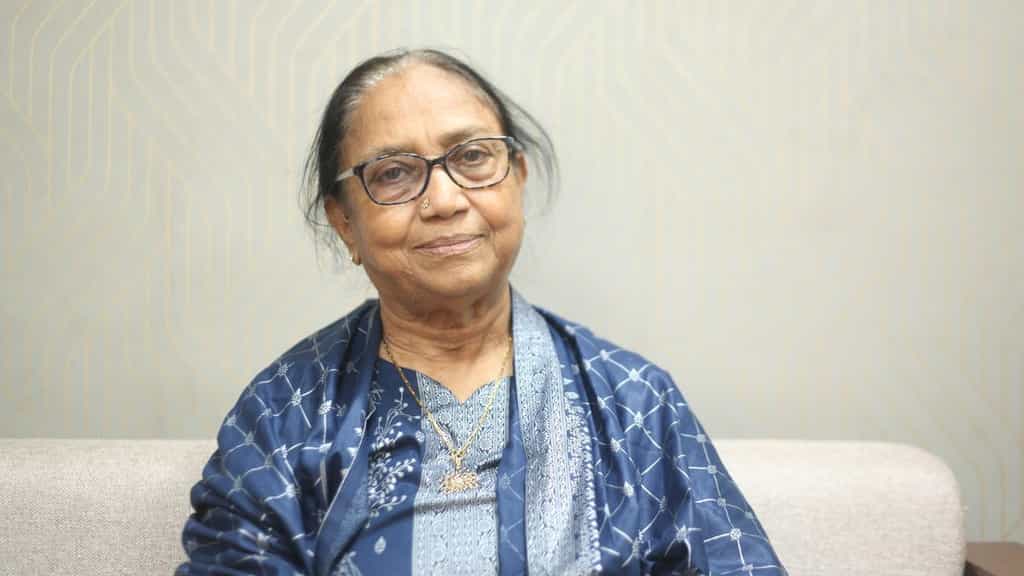
Banu Mushtaq conjures up an imagery, half-jokingly, when asked about her writing process. It has her standing with swords on either hand, fending off opponents from either side and writing with the remaining imaginary hand. That image is in a way justified by the kind of adversities the International Booker Prize winner had to deal with over the past several decades of her writing career.
Later, she answers the question in a more practical sense. She dictates poems and short stories to the voice-to-text software in her phone, often when she is travelling, as her work as a lawyer and an activist leaves her precious little time to sit down and put pen to paper.
“Yesterday, when we stopped for breakfast on the way to the airport, I found the body language and behaviour of the person who was serving us to be interesting. By the time I reached the airport, I had dictated a poem titled A Normal Incident,” she says, displaying the Kannada poem in her mobile, during an interview to The Hindu on the sidelines of the 4th Kerala Legislature International Book Festival (KLIBF), which began here on Wednesday (January 7, 2026).
Ms. Mushtaq’s book Heart Lamp: Selected Stories, a collection of 12 short stories selected from the many she has written between 1990 and 2023, translated to English by Deepa Bhasthi, won the International Booker Prize for 2025.
She reminisces about her early days as part of the Bandaya (rebellion) movement that swept Kannada literature in the 1970s, an experience which has influenced her work.
“As a member of Bandaya, the basic compulsion was that writers should be activists too. They should identify with Dalits, farmers, feminist movements and local language movements, take up issues of the marginalised and the downtrodden, whose voices did not have sufficient strength to be heard. The writers had to lend their voice to them,” she says.
But as a Muslim woman writer, she had to deal with a whole different set of dilemmas as to what would become the material of her literature.
“When we had discussions with the Bandaya writers and readers, they told me to accumulate the various experiences and grey areas, the strong notions of patriarchy and alienation that are part of the Muslim experience. That was the toughest job, because then I had to act as a critical insider. I know so many ins and outs of the community, their weaknesses and their happiness. When I portray a Muslim, he will not only be godly, but demonish too, which is when people in the community started saying that I am exposing or targeting them when they are already in trouble. They don’t even think that this is literature,” she says.
Her younger sister, who accompanies her, remembers the time in 2002 when an organisation issued a ‘fatwa’ against her following the comments she made in an interview.
“All these pressures, all these allegations from radical Muslims as well as the right wing have led me to self-censor a bit. When I start writing, it does not come easily to me. I have to weigh each word and its implications,” says Ms. Mushtaq.
She says that the simple, accessible language of her stories, without much literary adornments, was a conscious decision to reach the largest number of people.
“I wanted to say whatever most Muslims are practising is not in the true spirit of Islam, it is just the patriarchy in the guise of Islam. It is not the religion talking, it is some people talking in the name of religion. Most of the women characters in my stories talk in this tone. Most of my protagonists are uneducated, but they have clarity of thought,” she says.
Her practise as a lawyer has provided her opportunities to take in a lot of varied experiences, some of which have become subjects of her stories. “When faced with uncommon circumstances and challenges, people react in unique, unexpected ways. One just has to witness it for it to later turn into stories,” she says.
The work also means that short story is her most preferred form. A novel and her autobiography has remained at a half-way point for the past two years. She hopes to take a break from all the Booker-led globe-trotting to complete these soon.
Editorial Context & Insight
Original analysis & verification
Methodology
This article includes original analysis and synthesis from our editorial team, cross-referenced with primary sources to ensure depth and accuracy.