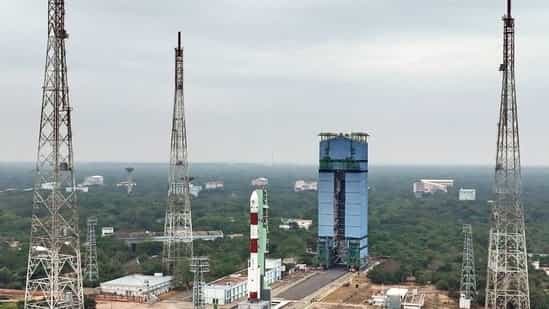
India is set to open its 2026 space calendar with the launch of the PSLV-C62 mission, as ISRO prepares to place an Earth observation satellite and 14 co-passenger satellites into orbit from Andhra Pradesh's Sriharikota on Monday, January 12.
The countdown for the mission began on Sunday afternoon, marking a crucial moment for the country’s most trusted launch vehicle after its last mission in 2025 was aborted due to a technical observation.
The 260-tonne PSLV-C62 rocket will carry the EOS-N1 satellite, also known as Anvesha, into a polar sun-synchronous orbit a few hundred kilometres above Earth.
Along with it, 14 co-passenger satellites from domestic and international customers, arranged through NewSpace India Ltd, ISRO’s commercial arm, will be deployed in space.
The mission is also significant for its in-orbit demonstration of a re-entry capsule belonging to a Spanish startup.
“Yes. Countdown started at 12.48 pm. 22 hours 30 minutes duration,” ISRO sources told news agency PTI on Sunday. According to the space agency, the launch is scheduled for 10:18 am on Monday.
The mission profile includes the sequential deployment of the main Earth observation satellite followed by the remaining co-passenger satellites within 17 minutes of lift-off.
More than two hours after launch, ISRO scientists will restart the fourth stage of the rocket to demonstrate the de-boost and re-entry of the Kestrel Initial Technology Demonstrator capsule, weighing about 25 kg. Both the PS4 stage and the capsule are expected to re-enter Earth’s atmosphere and splash down in the South Pacific Ocean.
The PSLV has completed 63 missions so far, carrying landmark payloads such as Chandrayaan-1, the Mars Orbiter Mission and Aditya-L1. The upcoming flight will mark its 64th mission, reaffirming its role as the backbone of India’s space launch programme.
“Tomorrow, January 12, 2026, marks India’s first launch of the year. The PSLV is among the most reliable launch vehicles in the world and has earlier carried missions such as Chandrayaan-1, Mangalyaan and Aditya-L1,” Jawaharlal Nehru Planetarium Director B.R. Guruprasad told ANI.
“This will be the 64th PSLV launch. The vehicle will carry the Anvesha EOS-N1 satellite into a polar sun-synchronous orbit, roughly a couple of hundred kilometres above the Earth’s surface,” he added.
The mission also follows ISRO’s recent success with the LVM3 launch of the BlueBird Block-2 communication satellite of AST SpaceMobile, which marked the heaviest payload ever placed in low Earth orbit by the rocket.
Editorial Context & Insight
Original analysis and synthesis with multi-source verification
Methodology
This article includes original analysis and synthesis from our editorial team, cross-referenced with multiple primary sources to ensure depth, accuracy, and balanced perspective. All claims are fact-checked and verified before publication.
Editorial Team
Senior Editor
Dr. Elena Rodriguez
Specializes in India coverage
Quality Assurance
Associate Editor
Fact-checking and editorial standards compliance