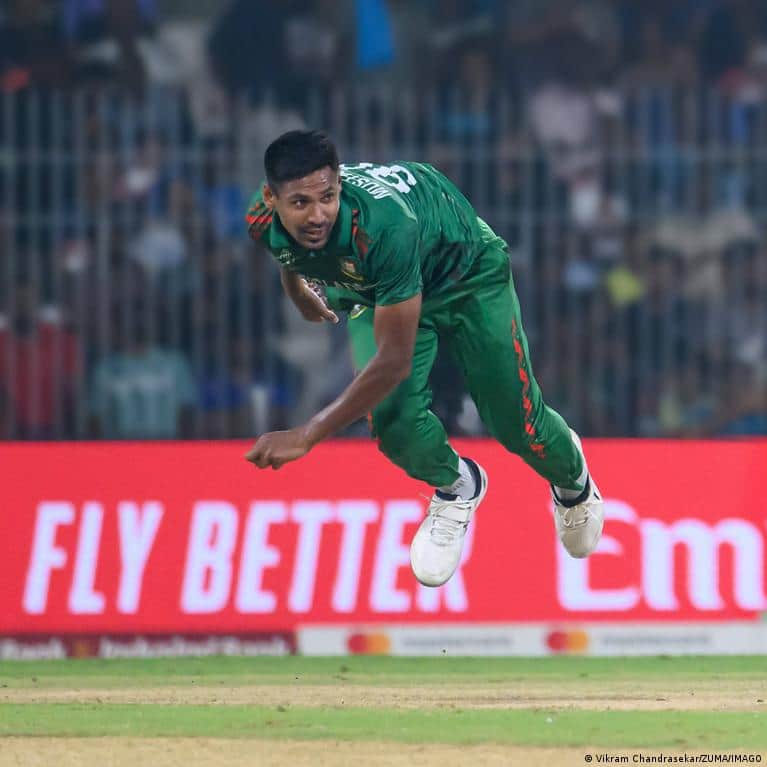
Concerns about the "safety and well-being" of players and officials have seen the Bangladesh Cricket Board (BCB) refuse to play their men's T20 World Cup matches in neighboring India.
"Following a thorough assessment of the prevailing situation and the growing concerns regarding the safety and security of the Bangladesh contingent in India and considering the advice from the Bangladesh Government, the Board of Directors resolved that the Bangladesh National Team will not travel to India for the tournament under the current conditions," read a statement from the organization.
"In light of this decision, the BCB has formally requested the International Cricket Council (ICC), as the event authority, to consider relocating all of Bangladesh's matches to a venue outside India."
India , who are cricket's dominant off-field force, are co-hosting the 20-team tournament, which runs from February 7 to March 8, with Sri Lanka.
Bangladesh were slated to play three matches in Kolkata and one in Mumbai during the group stage but the ICC are now faced with a logistical and politcal challenge. Ranked 9th in the world, Bangladesh have a decent chance of progressing to the quarterfinals by finishing in the top two of Group C.
While the statement doesn't mention it specifically, referring instead to "recent developments," the withdrawal of Bangladeshi Mustafizur Rahman from the lucrative Indian Premier League (IPL) season, which starts a few weeks after the World Cup, appears to be the trigger. The bowler was the only Bangladesh player picked up at the IPL auction last month but had won a $1 million (€860,000) contract with the Kolkata Knight Riders.
"Due to recent developments going on all across, the BCCI (Board of Control of Cricket in India) has instructed the franchise Kolkata Knight Riders to release one of their players, Mustafizur Rahman of Bangladesh, from their squad."
On Monday, Bangladesh's ministry of information and broadcasting said it would not broadcast this season's IPL as a result.
"No reasonable or justified explanation for such a decision by the Indian cricket board is known, and this decision has caused pain, distress and anger among the people of Bangladesh," a statement read.
The banning of Mustafizur, who has played for numerous IPL franchises in past seasons, appears to be the straw that broke the camel's back, amid heightening political tensions between the countries.
Anti-India sentiment in Bangladesh has been growing since former Prime Minister Sheikh Hasina fled to the country in 2024. India has so far refused all requests to extradite her. There have also been violent protests over the murder of Sharif Osman Hadi, a prominent student leader, in Bangladesh.
To view this video please enable JavaScript, and consider upgrading to a web browser that supports HTML5 video
Also, in December, a Hindu man was accused of blasphemy and beaten to death by a mob in Muslim-majority Bangladesh. This attack led, in turn, to protests by Hindu nationalist groups in India.
These incidents have led to a breakdown of diplomatic relations which has spilled over into sport.
Yes, there are many echoes here with another of India's neighbors and cricketing rivals. Pakistan's players have been banned from playing in the IPL since 2009 after the 2008 terror attacks in Mumbai committed by Pakistani terror group Lashkar-e-Taiba.
The teams have not played each other in a traditional bilateral series since then, only meeting at World Cups and other global or continental events on neutral territory — a situation that has caused several headaches for the ICC.
Pakistan is already scheduled to play all its group games and beyond if it advances in the tournament, in Sri Lanka due political tensions with India that brought both countries to the brink of war last year.
A solution such as that found for Pakistan seems the most likely way to enable Bangladesh to compete. But with the draw already made and fixtures assigned to cities and stadiums, reorganization is complex and may even require changing which groups teams are in at a very late stage.
If no solution is found, the ICC may be forced to forfeit matches involving Bangladesh or find another team to fill their spot. The sport's global governing body have yet to comment on the situation but will be forced to take action soon.
Editorial Context & Insight
Original analysis & verification
Methodology
This article includes original analysis and synthesis from our editorial team, cross-referenced with primary sources to ensure depth and accuracy.
Primary Source
Deutsche Welle